
Penman No. 256: Get a Life (2.0)

2222316043_844c033f3e_z

GET A LIFE Ver. 2.0

Jose Dalisay Jr., PhD

Address to the Graduating Class

University of the Philippines Baguio

22 June 2017


Chancellor Ray Rovillos, Members of the UP Baguio Faculty and Staff, Distinguished Guests, Members of the Graduating Class and their Proud Parents, Families, and Friends, Ladies and Gentlemen:


GOOD AFTERNOON, and thank you all for having me here today as your commencement speaker.

Let me begin with a confession. If you were expecting someone more famous, more accomplished, and more handsome than me to be standing at this podium here today, well, so was I. No one is more surprised than I am to be your guest speaker.

I woke up at 5 am yesterday to attend the UP Manila graduation at the PICC, rushed back to Diliman to pick up my bags, then took the long, leisurely ride up to Baguio, recalling the days when, as a young boy, I eagerly anticipated visiting this city, which used to involve a train ride to Damortis, La Union, before transferring to a bus that would wind its way up Naguilian Road. I recall my nostrils tingling when they caught the scent of pine. In high school in the 1960s, Baguio meant the CMLI, Teachers Camp, marching on Session Road to proclaim “student power,” pretty faces from a school called St. Theresa’s, and a dark and exciting place called the Basement—which some of your older teachers might remember.

Those happy memories embraced me as I arrived in my hotel last night. Chancellor Ray had thoughtfully sent me a copy of the program, and after dinner, just before I went to bed, I opened the program, curious to see who the commencement speaker was going to be. And then I saw my name. Oh my god—it was me!

And it’s all my fault, because I’d told Chancellor Ray that President Danicon couldn’t make it—he sends you all his warmest congratulations, by the way. But I had volunteered to represent him, because it would give me the best excuse to enjoy Baguio all over again, to sit here and listen to some wise person talk. Apparently, Chancellor Ray reasonably took that to mean that I was also going to speak in the President’s stead. So here I am, the dutiful surrogate who can’t refuse.

But I shall speak for myself, so you cannot hold our President responsible for the outrageous things that I will be saying to this hapless audience.

Thankfully, I had the perfect speech in reserve. That happens when you’re a professional writer and you write many speeches for other people. In this case, it was a speech that I had written for myself and delivered 12 years ago—at the Baguio Convention Center, to the graduating class of UP Baguio of 2005.

Since none of our graduates today was presumably here then—unless you’re a very slow learner—I thought I would resurrect that speech and update it as Ver. 2.0 for our very interesting if troubled times.

Former President Dodong Nemenzo—my old boss—was frankly not too fond of the phrase iskolar ng bayan to describe the UP student. We are all, of course, scholars of the people in this university, in the technical sense that our studies are subsidized by the sweat of the masses, whose hopes we bear upon our shoulders.

But his point was that scholarship was a distinction to be earned not merely by scoring well in an entrance examination, but by adopting a lifelong attitude of critical inquiry and rational judgment.

This, sadly and ironically, is something that many of us lose upon our entry into the University and our immersion in its life. The curiosity ends, the magic fades, the writing dries up, and we retreat to a cocoon—to a dimly lit room marked “Me & Myself”—there to spend the rest of our career fretting over the next fellow’s salary grade and so-and-so’s appointment as dean or chancellor.

Many years ago, when I ran for the chairmanship of the Department of English and Comparative Literature—among the oldest, largest, and most pala-away of our departments—I gave the usual homily about achieving excellence in teaching, research, and extension work.

And then, I said in my vision paper: “I expect our members to be actively engaged in interests other than their immediate subjects—in social and political concerns, in creative projects, in new technologies—to save them from the kind of small-mindedness or tunnel vision that can result from locking yourself up at the Faculty Center. In other words, get a life.”

“Get a life” has actually been one of my lifelong mantras. I have always believed that while a formal education is a wonderful thing, what I call an active life—with all its serendipitous detours and little accidents—is even better. It’s a cliché by now to say that there are many things we can never learn in school—but for those of us who are in school, it’s even more important to remember this.

As a mentor to many young students, I have always advised those burning with the desire to teach or to go on to graduate studies—in other words, those who want to stay in the university—to spend a few years first outside of it: to sell insurance, work at a call center, make some money—so they can get a sense of what everyone else goes through, and give their poor parents some relief. And then they can return, enriched by their experience.

When people complain to me about the emptiness and confusion in their lives, I feel sad because I know that only they can ultimately help themselves. But there’s a principle in fiction writing—in plotting and characterization—that might offer a solution to the perplexed. When my writing students tell me that they no longer know what their characters should do to solve their overwhelming problems, I tell them to take their characters out—literally and figuratively. Get them off their butts, make them walk, make them ride the MRT, put them on a Ferris wheel, bring them to the Navotas fish market at four in the morning. Too many stories try to resolve themselves in small cafes and bedrooms, behind shut doors and windows.

Some of the best things happen when we step outside of our own lives and begin to be engaged in those of others. Often, the answers to our own problems lie in others, and in their larger predicaments. While involvement in a great cause can also create its own kind of blindness to everything else, I believe that, at least once in our lives, we should embrace a passion larger than ourselves; even the disillusionment that often follows can be very instructive, and will bring us one step closer to wisdom.

I would not have been the writer I became if I had chosen the safe path and stayed where I was supposed to be.

At 17, shortly after graduating from the PSHS and entering UP as an engineering major, I dropped out as a freshman—over the tears of my mother, whose fondest hope was for me to graduate from UP just like she did. I wanted to join the revolution, like many of my comrades; at the same time I was impatient to get a job. At 18, I was working as a newspaper reporter covering hospital fires, US embassy rallies, bloody murders, factory strikes, and disaster operations. I spent most of my 19th year in martial-law prison.

At 20, I was a husband and father. At 22, still a dropout, I studied Development Economics as a special student, and later worked as an economist with the UNDP. At 26, I took my first foreign trip. At 27, I learned how to drive—and went back to school. At 30, I got my AB, and decided that what I wanted to do was to write and teach for the rest of my life. I found a scholarship in the US. It took me two years to finish my MFA, and only three to finish my PhD, to make up for lost time, and came home, and here I am, about 30 years and 30 books later.

It’s been a messy, crazy, but blessedly glorious life. I have been shot at, imprisoned, and worst of all, rejected by more crushes than I care to remember. Aside from my abortive career in journalism, I once worked as a municipal employee, checking the attendance of street sweepers at seven in the morning. And then I studied printmaking and sold my etchings cheaply by the dozen in Ermita. in the US, I worked as a cook-waiter-cashier-busboy-janitor, cutting 40 pounds of pork and chicken everyday before turning them into someone’s dinner.

Some of these events have found their way to my writing; most of them have not and never will. I believe that creative writing should generate its own excitement, beyond whatever may have happened to the author in his or her own life. But neither can I deny that my outlook has been influenced by what I have seen out there, as bright, as indelible, and as disturbing as fresh blood.

If we are to abide by the Phi Kappa Phi motto to “let the love of learning rule humanity,” we should first ourselves be ruled by the love of learning—learning from books, and learning beyond them.

On the other side of the equation, let me observe that there is, today, a nascent but disturbing strain of anti-intellectualism in Philippine politics and society. The vulgar expression of this sentiment has taken the form of the suggestion that we can dispense with brains and education when it comes to our national leadership, because they have done us no good, anyway.

It’s easy to see how this perception came about, and how its attractiveness derives from its being at least partially true. Many of our people feel betrayed by their best and brightest—the edukado, as we are called in our barangays—because we are too easily bought out by the powers that be. Marcos and Estrada had probably the best Cabinets in our political history, well-stocked with prestigious PhDs; but in the end, even they could do nothing against their President and his excesses.

Sometimes we never learn. Today, once again, some of us are tempted by the notion that because we seem to have made a mess of our freedom, because EDSA didn’t seem to work, then maybe giving up our rights and freedoms and letting someone else do the thinking and choosing for us is a good thing. Think again.

That’s what we UP people are good at—thinking, and thinking again.

To be a UP student, faculty member, and alumnus is to be burdened but also ennobled by a unique mission—not just the mission of serving the people, which is in itself not unique, and which is also reflected, for example, in the Atenean concept of being a “man for others.” Rather, to my mind, our mission is to lead and to be led by reason—by independent, scientific, and secular reason, rather than by politicians, priests, shamans, bankers, or generals.

You are UP because you can think and speak for yourselves, by your own wits and on your own two feet, and you can do so no matter what the rest of the people in the room may be thinking. You are UP because no one can tell you to shut up, if you have something sensible and vital to say. You are UP because you dread not the poverty of material comforts but the poverty of the mind. And you are UP because you care about something as abstract and sometimes as treacherous as the idea of “nation”, even if it kills you.

Sometimes, long after UP, we forget these things and become just like everybody else; I certainly have. Even so, I suspect that that forgetfulness is laced with guilt—the guilt of knowing that you were, and could yet become, somebody better. And you cannot even argue that you did not know, because today, I just told you so.

I thought that my hardest days as an activist were over at EDSA. Now I have to think again. I thought that I had done my bit for UP by serving as Vice President 12 years ago. When President Danicon asked me to take on the same job last January, I had to think again. I said yes, because you can’t refuse when UP calls—di rin magbabago ang damdamin. I actually wept when I told my undergraduate class that I was going to be a VP again, because nothing makes me more fulfilled than teaching a roomful of undergraduates, and working in Quezon Hall was going to pull me away from them. I’ll tell this to all of you now, 18 months short of retirement: teaching people like you has been my greatest privilege.

In the first edition of this speech that I gave 12 years ago, I told my young audience to do things like read a good book, play the guitar, learn how to swim, and have fun. I’m going to update that by sharing the sort of things I told my undergrads, things my wife and I have told our only daughter all her life.

  1. Do something different, do something stupid, do something risky. Just don’t die, or land in jail—although landing in jail gave me a prizewinning novel about martial-law prison 20 years later. Nobody who didn’t take risks ever made a difference.
  2. My teacher in German taught me a saying: “Ein Fehler ist kein Fehler”—one mistake is no mistake. Or as my billiards buddy used to say, “We’re all entitled to one big failure.” Nothing will teach you better than that one big mistake you’ll make—so go ahead and make it, but make it worth it.
  3. And finally, I’ll repeat what I said at the end of that first speech—get a life, and get a good one!

Mabuhay kayong lahat, mabuhay ang UP, at marami pong salamat!


Penman No. 253: Wealth You Can’t Buy

IMG_1773Penman for Monday June 5, 2017
 

BENG AND I flew down to Iloilo City two weeks ago—she to hold a workshop on art restoration at the University of San Agustin, and I to attend Pagtib-ong, an International Conference on Intangible Heritage organized by the University of the Philippines Visayas at Casa Real—so it was a culture-heavy weekend, but happily so.

And what, exactly, is “intangible heritage”? Simply put, it’s wealth you can’t buy, of the cultural kind—the songs, stories, dances, traditions, practices, and beliefs of people, especially of those outside the increasingly homogenized and globalized mainstream. At a time when we’re all watching (and paying for) the same shows on Netflix and having the same Americano at Starbucks, younger Filipinos are fast losing touch with their own cultural roots. “Pagtib-ong” means “putting on a pedestal,” so this time and for a change, it’s our intangible heritage taking center stage.

UP President Danilo Concepcion framed the context well in his message that I read for him: “As nations and societies modernize and move deeper into the 21st century, the emphasis on material growth becomes even more pronounced, often obscuring all other considerations. Those considerations include intangible heritage—the cultural threads that bind not just people together but the past and the present, and indeed the present to the future. Our intangible heritage speaks to the very soul of our cultural community. It may not have much monetary value, if at all, but it is priceless in terms of containing, preserving, and propagating the values we seek to transmit from one generation to the next.”

Politicians will wonder how studying folk songs, kitchen practices, and the vocabulary of obscure languages can be important to national development, and it will be for us—both as scholars and cultural advocates—to show them how and why. Gatherings of scholars such as Pagtib-ong are rare and valuable, but we should also learn how to translate and communicate the significance of these events and their implications for our societies to a larger audience.

Just to give you an idea of what went on at Pagtib-ong, I’ll give you a sampler from the talks of the scholars who presented their research at the conference, and note the Asian and Filipino values and practices that I culled from their work.

Harmony. Pham Thai Tulinh of Lu TuTrong Technical College in Vietnam, the granddaughter of a general and a poet, had this to say about “QuanhoBac Folk Songs”: “The women traditionally wear distinctive round hats and scarves, while the men wear turbans, umbrellas and tunics. The Quanho folk songs are always performed voluntarily in groups of male or female (singers)…. A group of females from one village sings with a group of males from another village with similar melodies, but different lyrics, and always with alternating tunes. In each group, one person sings the leading tune and another sings a secondary part, but the two should be in perfect harmony at the same timbre.”

IMG_0920

Continuity. Anna Razel L. Ramirez of the University of the Philippines Visayas reported on “Dungkulan: The Eternal Fire”: “A dungkulan is a large piece of wood that provides kitchen fire and ensures that an ember is always available to start a fire in the absence of matchsticks…. More than a fire starter for food, dungkulans are significant in the lives of people in the countryside and in the mountain areas. It is the source of warmth at nighttime, a reliable source of coffee on cold mornings; a steady source of warm water for health emergencies; and what many others need from that slow burning log that sustains the dapug and the lives of the people attached to the dungkulan.”

Conversation. Jose R. Taton Jr. of the Philippine Women’s University spoked on “Talda for Mixed Chorus”: “The talda is one of the various forms of musical repartee practiced by the Panay Bukidnon of Central Panay. Considered as a tukod-tukod (creative invention) tradition, it involves a dynamic altercation of deep sentiments of longing and love from singers who actively and spontaneously stream words (gina-gato) using metaphorical and figurative language. It is sung at leisure at any occasion, and the length of the musical conversation varies depending on the conscious and willful response of both parties.”

There were dozens more of these fascinating talks on the menu—I was especially taken by a lecture on Panay’s fabled golden boats by Dr. Alicia Magos, herself a legend in folklore studies, because it reminded me of the golden boat with my grandfather’s name emblazoned on it, reported to have been seen in Romblon off Calatong, our own enchanted mountain—but alas, we all had to return to our more tangible existences.

Many thanks and congratulations to UPV Chancellor Dr. Rommel Espinosa and Conference Chair Prof. Martin Genodepa for reaffirming the position of both the Visayas and intangible heritage in our cultural and social maps.

IMG_1758


Penman No. 248: Ring in the Old

IMG_1088

Penman for Monday, April 24, 2017


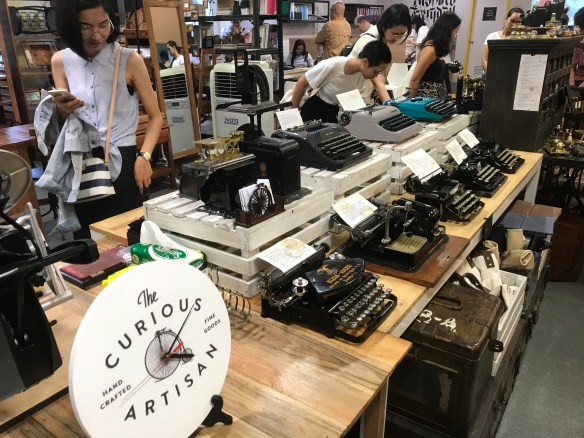
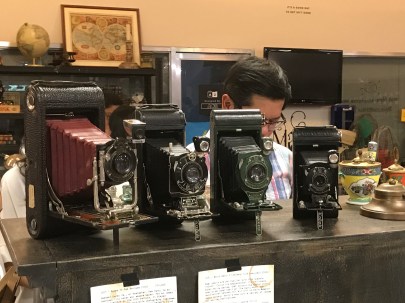
IN A GENERATION preoccupied with newness, it’s a refreshing surprise to find young people engrossed with things far older than themselves, and that’s exactly what Beng and I stumbled upon a few Saturdays ago when we entered Warehouse Eight on Chino Roces Ave. in Makati. There was absolutely no hint of it from the outside, but going up a flight of stairs, we stepped into a large room filled to the brim with antiques—typewriters, watches, cameras, bicycles, turntables, vinyl records, books, eyeglasses, and, yes, pens!

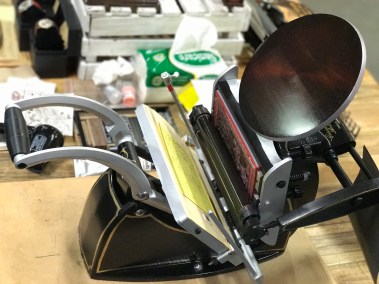
This was the Istorya Vintage Appreciation Fair, an event organized by entrepreneur and collector Lennie Dionisio (whom I’d never met before, so had the temerity to ask “What’s your day job?”). I’d come to show some of my vintage pens, of course, but I made a beeline for a tableful of Lennie’s fabulous vintage typewriter collection—a passion she shares with another friend of mine, George Mamonluk. I proudly showed off a picture of my 1922 Corona 3 which I’d found in San Francisco and hand-carried home—if you get a high from inhaling typewriter lubricant, you’d be my kind of person. But the piece de resistance of Lennie’s spread wasn’t even a typewriter but a lovely Adana letterpress machine of the kind that I’d been dreaming of, for hand-printing pages of poetry on paper you could run your fingers over and feel every word.

IMG_1105

It was that kind of vanished romance that tingled in my bones as I looked over the exhibits (most items in which were for sale), elated by the discovery that they had been brought over not by doddering seniors like me but by a new crop of millennials who actually knew how to use a Rolleiflex TLR or a Sheaffer Snorkel. Quite a few even came over to the booth we operated for the Fountain Pen Network-Philippines, asking to see how flexible nibs and lever fillers worked. There’s hope for this generation yet!

For about a decade, Beng and I used to indulge our mania for the old stuff on our October sorties to New York and its fabulous flea markets and thrift shops (that’s right, I’d save up the thousands for the plane fare so we could poke around looking for $5 bargains in dusty piles of bric-a-brac). Those fun times may be over as our knees themselves turn vintage and as our budgets dry up, but with local shows like Istorya popping up, who needs Manhattan? I can’t wait to see the next edition of Istorya and to step back into the land of the lost.

IMG_1092

THERE’S ANOTHER way of bringing the past into the present, and that’s by remanufacturing old classics into new and modernized versions that exude vintage charm but perform with almost digital precision.

I was reminded of this last month when our friend Celia, who shared our footloose ways with her late husband Rene, introduced me to a very interesting pair of locally-made grandfather clocks. I have a small trove of vintage wristwatches, mostly from the 1950s, that I manually wind up every few months or so—and I have to admit to a clock fetish in that I’ll likely have at least two clocks in one room so I can see the time wherever I look—but I have yet to acquire my first grandfather clock.

I’ve seen quite a few of these in homes and museums abroad, and what’s fascinating about them is their imposing size and that deep, sonorous chime they produce to announce the hours.

Apparently, according to Celia, there’s a company out here somewhere that makes several models of grandfather clocks, following the tradition of furniture artisan Simplicio Adriano, a Pampanga native who started his craft in 1911. The company is called SAFM, and it’s now managed by Simplicio’s great-grandsons Alfred and Francis.

I’ve yet to visit the factory, but Celia tells me that a seven-foot model they call the RAGA 70 has a chain-driven, Westminster chime movement that strikes every quarter and every hour. The movement is made by Hermle of Germany, considered the leading clock and clock movement manufacturer in the world. The cabinet is made of Philippine hardwood and comes in mahogany, dark walnut or light walnut finishes.

RAGA70_2

If tall clocks and loud chimes float your boat, text or call the manufacturer at 0905-2765288 or email adriano.grandfather.clocks@gmail.com.


A FEW years ago, I had the pleasure of giving the keynote speech at the Iligan National Writers Workshop at the MSU-Iligan Institute of Technology (MSU-IIT) in Iligan City, and I’m happy to see that despite all the odds it’s had to face, the workshop is moving along just fine and will be holding its 24th session from May 29 to June 2 under the stewardship of stalwarts Christine Godinez-Ortega and Steven Patrick Fernandez. Co-sponsored by the National Commission for Culture and Arts (NCCA), Iligan is an important hub in the national network of workshops designed to encourage new young writers in all languages and genres.

Eighteen writing fellows from all over the country have been selected for Iligan. From Luzon come: Poetry (English) Bernard Kean Mappala Capinpin; (Filipino) Joey Alcones Tabula and Vanessa Anne Joice Tanada Haro; Fiction (Filipino) Lenin Carlos Macaraig Mirasol; and Drama (English/Filipino): Fatrick Romo Tabada;

From the Visayas: Creative Non-Fiction (English) Eric Gerard de la Cruz Ruiz; Poetry (English) Andrea de Guzman Lim and Gay Josephine Valles;  (Sebuano) Hannah Marie Ramirez Aranas; and Fiction (English): Nino Augustine Masa Loyola; and

From Mindanao: Poetry (Filipino): Delfin Hingco Mundala; Loi Vincent Caparos Dériada; (Sebuano) Mildred Eran Garcia; Creative Non-fiction(English): Silvana Erika Nasser Navaja; and Drama (English/Filipino) Kwesi Ian Jay Miguel Junsan.

This year’s Boy Abunda Writing Fellow is Waray poet Reynel Mahilum Ignacio; the Ricardo Jorge S. Caluen Writing Fellow is Sebuano poet Kim Ashley B. Escalona; and the Manuel E. Buenafe Writing Fellow is Maranao poet Alican Mendez Pandapatan.

I haven’t read these young writers’ works, but the mere idea of, for example, someone continuing to write Maranao poetry in this global century is heartwarming. That probably won’t happen in Diliman, which is another good reason why a homegrown workshop in Mindanao is absolutely necessary for the enrichment and preservation of our national culture.


Penman No. 247: On the Wings of Women

LadyPilots

Penman for Monday, April 16, 2017


IN MY line of work, I get to edit a wide range of books, from institutional histories and biographies to annual reports and technical manuals. They’re all important to my clients, of course, and I accord them all the same seriousness and diligence they should expect from a professional editor.

But now and then a project comes along that’s not only significant but truly interesting, and one of them was the book I recently edited for Philippine Airlines—Stories from the Heart: Buong Pusong Alaga (PAL, 2017)—that the company launched to celebrate its 76th anniversary. The book is a collection of vignettes about PAL’s people, from the ground crews to the pilots and flight attendants to the president and CEO himself, and tells all kinds of stories from delivering babies in mid-flight to having the Pope as a passenger.

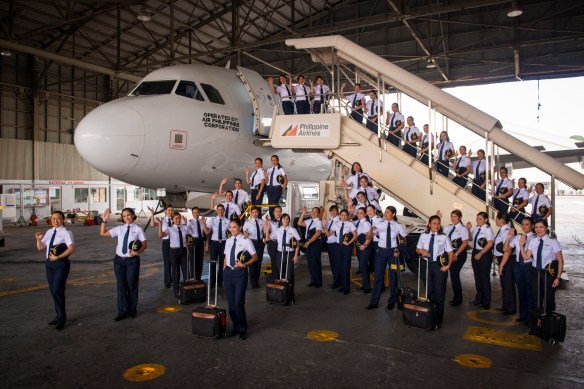
But some of the stories I found most fascinating had to do with PAL’s women—especially those who keep the planes up in the air. As a belated salute to National Women’s Month, let me share a few of those stories:

Since Capt. Aimee Carandang-Gloria became the first female to take the helm of a PAL plane in 1993, the number of lady pilots in the airline has continued to grow in recent years—from 20 in late 2012 to 54 (39 from PAL and 15 from PAL Express) in 2016.

“Yes, we’re still a minority, but a growing one. We just recently added a provision in our Operations Manual regarding female pilots. It’s a giant step for us,” says A320 pilot Capt. Emi Inciong-Ragasa.

A lady pilot on the flight deck is not something passengers see every day. But when they do, a magical moment always happens, attended by much curiosity and awe. “I remember a few times when some parents, upon seeing me, would exclaim, ‘Look, she’s a lady pilot!’ and would ask if I could have my picture taken with their daughter,” says A320 pilot Kelloggs Tioseco.

Aside from the occasional picture-taking on the side, these ladies get no special treatment—and they don’t expect it. They go through the same training, read the same manuals, and soar and slog through the same skies as the men.

“Ever since I could remember, I’ve wanted to be a pilot. I remember being in awe of this big machine that graced the blue skies,” says Capt. Ragasa. Emi comes from a family of pilots. Her husband is B777 First Officer Terrence Ragasa, and her father-in-law is former Air Force General Ramon Ragasa.

Having been with PAL for 11 years, she aspires to be a hands-on mother while enjoying her flying career. She doesn’t mind being on long layovers but she makes sure that she regularly sees her two-year old son. “I have only one chance to raise my son well. I arrange my schedule to spend more time with him,” she says.

AVP for Pilot Affairs and A320 pilot Lilybeth Tan Ng says that taking red-eye flights were much easier to handle than waking up in the wee hours of the morning to attend to her motherly duties. “Flying a plane is easier than being a mother. Flying comes with a manual while motherhood doesn’t. So you had to learn by instinct as the answers were not always easy to find.”

A330 pilot Cherryl Flores crossed over from military to commercial flying. She had been a registered nurse in a military hospital in Zamboanga City before joining the Philippine Air Force, where she served as an instructor pilot for four years. Cherryl was a bemedaled UH-IH helicopter combat utility pilot in the PAF. She was also the first and only female PAF pilot to be certified as Pilot-in-Command of UH-IH in Night Vision Goggles by the US Air Force.

Cherryl’s husband, a ship crew member, gave up his job to take care of their first-born. “When I was pregnant with my first-born, we decided that one of us had to stop working to attend to our child. My husband selflessly gave way to me so I could chase my dream of flying planes.”

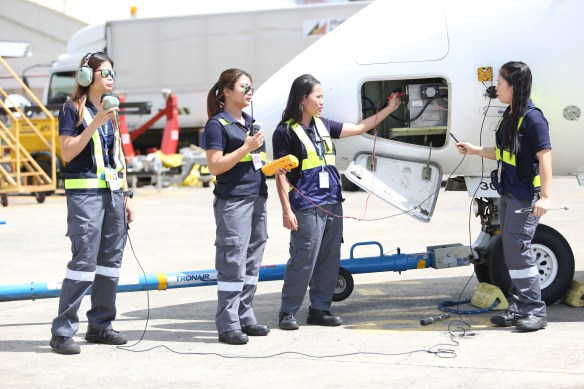
That same tenacity can be found in the seven female mechanics checking cables and wirings, overhauling systems, and replacing parts among the platoons of men working at PAL Express’ maintenance and engineering.

Avionics mechanic Maridel David wanted to work in an airline since her youth. “In Bicol, whenever we saw a helicopter flying overhead, we ran and followed it as far as we could,” she recalls. When she entered college, she chose to study BS Aviation Electronics Technology at the Philippine State College of Aeronautics.

LadyMechs

Before becoming an avionics or aircraft mechanic, one has to undergo a one-year Maintenance Training Program (MTP), which comprises six months of classroom training and six months’ field exposure. In school, the proportion of male to female students has always been high. “There have always been very few females in aviation and I find it a privilege to become one of them,” says another avionics mechanic, Mercedes Sabordo.

“My motto in life has always been, if they can do it, I can do it. We’re all equal when it comes to the job, because this is what I studied for. So whatever they can do, I can do as well,” says Elaine Saldivar, an aircraft engineer in PALEx for two years now.

More than the physical tasks, the job of an aircraft and avionics mechanic requires critical decision-making that can only be learned through time and experience.

“You have to be really smart if you enter the field of aviation. You have to be ready to go head to head with the men if you want to learn. It’s a long process of continuous learning, like getting a doctorate so you can really be an expert at what you do,” attests Engr. Rhona Abrera, an avionics mechanic. Rhona herself has overhauled and then rebuilt an airplane. From one task card to another, she finished the job after several attempts. “It’s most fulfilling when you can troubleshoot the problem right away. It’s ‘mission accomplished’ when you can watch the plane fly.”

Maridel adds that she treats a plane like her “baby” and would always talk to them. “At morning dispatch, I talk to the plane and say, ‘Baby, safe flight,” she quips.

So, go girls, and many thanks and congratulations to PAL’s Pinky Balagtas and Paeng Evangelista for piloting this project and for letting me use these excerpts!


Penman No. 246: Beauty and Sadness on Calle Bautista


IMG_1175

Penman for Monday, April 10, 2017


WITH WORK piling up at the office, I’ve increasingly been looking forward to weekends, especially Saturdays, for some fun and leisure. Weeks ahead, I start scouting the cultural horizon for interesting things to do or shows to attend. A few Saturdays ago, for example, Beng and I drove out to Makati to explore the Istorya Vintage Fair at Warehouse Eight—a totally engrossing event that merits its own write-up, which I’ll do in a forthcoming column—before rushing back to Diliman to catch the Ihudyat! marching band competition at the UP Amphitheater.

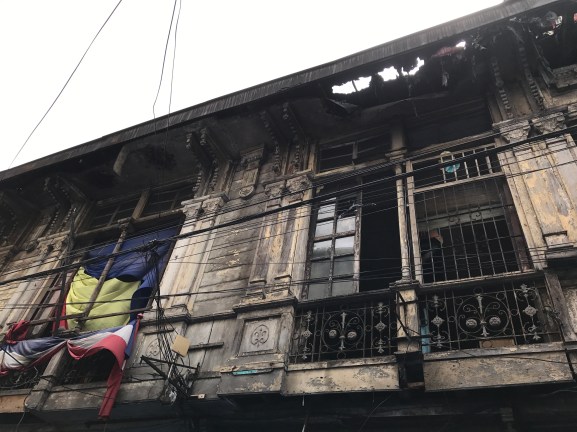
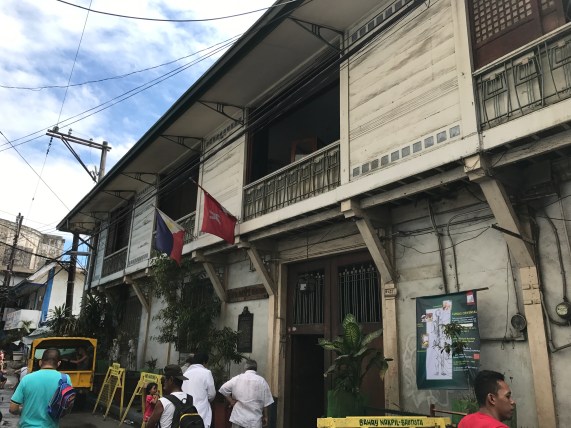
It was the following Saturday that I’ll write about first, afraid that I might forget some important detail if I wait too long. Indeed, “forget” is the operative word here, because it describes what most people did to our destination: the Boix House (also known as the Teotico-Crespo House) on Ariston Bautista Street in Quiapo, Manila. I tagged along with a posse of UP Fine Arts alumni that included Romy Carlos, Boysie Villavicencio, Ernie Canlas, and Beng—a group that had heard about the house and were interested in seeing if and how they could help in its restoration, perhaps through a benefit art exhibit. (I was delighted to learn later that an old friend, the art dealer and patron Jack Teotico, is a direct descendant of the original house owner and will be pitching in.)

Located in what has become Quiapo’s Muslim quarter, the Boix House is so named because it was acquired by the Boix-Tarradellas family from the Crespos, who got it in turn from the Teoticos. Don Marciano Teotico had the Neo-Renaissance house built in 1895 on what was then Calle Barbosa, and it soon attracted student boarders like the young Manuel Luis Quezon, who reputedly went out partying next door. There, two decades after Don Marciano built his brood a home, would rise the better known and more fortunate Nakpil-Bautista House.

We don’t know what happened next, but at some point, the ownership of the house reportedly passed on to the Society of Jesus, and we lose track of the Boix connection except through the house and what’s been put on the Internet about it—if any reader knows any more, please do share. (I’ve also been wondering about how exactly “Boix” is pronounced; I initially defaulted to the French bwah, but online sources suggest a Spanish or Catalan origin, in which case it would be boish—but then again, what do I know?)

The sad part of this story is how decrepit the Boix House has become, despite the noble efforts of well-meaning organizations such as the Kapitbahayan sa Kalye Bautista to save the house through crowdfunding. Even the World Monuments Fund has taken note of and extended some assistance to the Boix House project (https://www.wmf.org/project/boix-house).

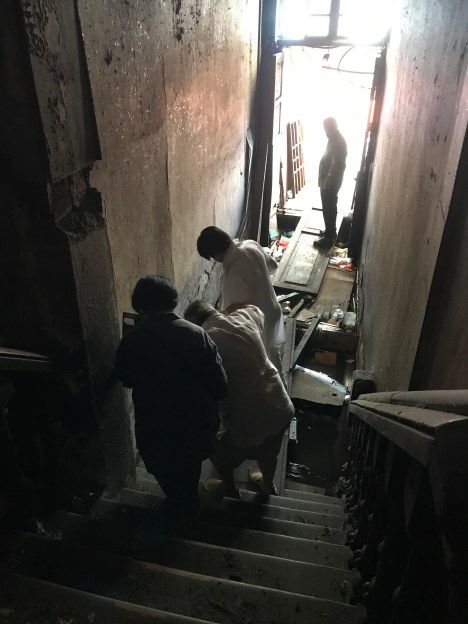
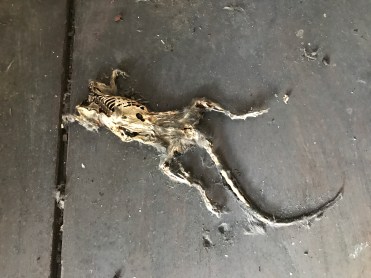
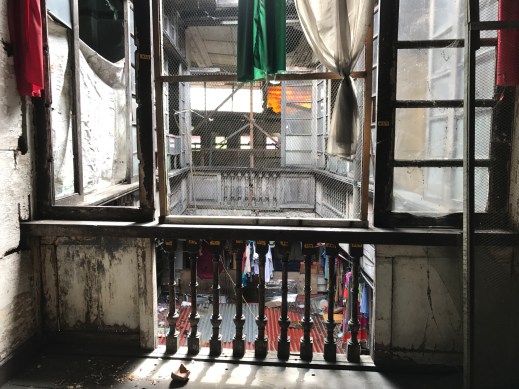
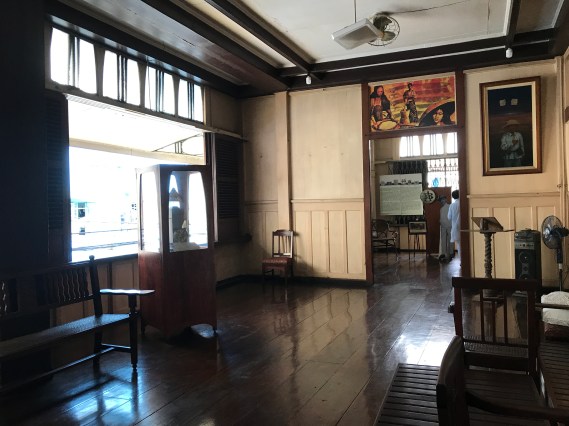
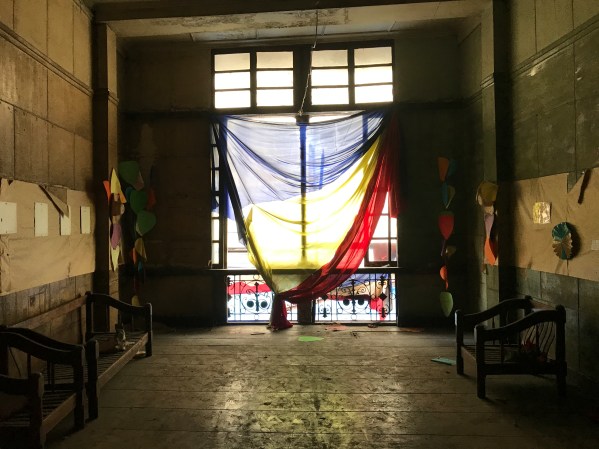
If you pay it a visit like we did, you’ll see why it could use all the help it can get. Just getting across the threshold to the stairs takes—almost literally—a leap of faith: two old doors now serve as creaky planks over which you cross a puddle of water. The wooden stairs and floor are thickly coated with dust and grime; a rat’s carcass molders away in a corner like a forgotten lab specimen. Framed panels provide a history of the house, and tattered flags and ribbons offer proof of some earlier appeals to patriotic fervor. Overall, one’s impression is a commingling of beauty and sadness, the passage not only of time but of care.

IMG_1192

IMG_1181

IMG_1187

One thing you couldn’t avoid noticing was the fact that while the second floor seemed eerily vacant, it was an entirely different story belowdecks, with the visual evidence of many families crammed into every habitable inch. The undisturbed dust and the odd debris upstairs suggested that the people left that space alone, most of the time, despite the absence of any kind of barrier or restriction. Why? Ghosts? A deep-seated respect of the departed?

IMG_1178

What’s clear is that no restoration project will succeed without taking the house’s present occupants—and indeed the whole neighborhood—into account. Even if you manage to raise the many millions required to return the house to its old glory, its antique opulence will stand in ironic contrast to the very present and very real poverty blighting its surroundings.

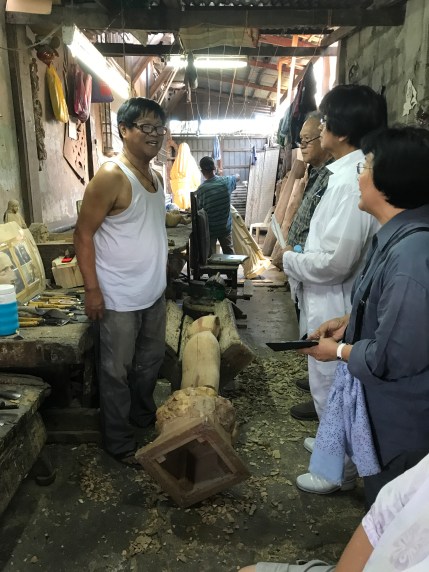
The well-preserved Nakpil-Bautista House next door might yield some clues—but not all—to what to do eventually. This ancestral home had seen generations of such notables as the composer Julio Nakpil and his wife Gregoria de Jesus, Andres Bonifacio’s widow. Still maintained by the family and open to public viewing, the house has also served as a home and studio for the past 38 years for master carver Ner Manlaqui, whose religious statues crowd the basement. Priests, churches, and other patrons keep Mang Ner busy, as the half-finished saints and virgins being worked on by his assistants attest to, employing trunks of pale yellow baticulin sourced from faraway Quezon.

IMG_1194

IMG_1220

IMG_1203

So preserving or reviving the past might necessitate providing for the present, and the cultural activists behind the Boix House project will do well to temper their admirable passion with some dry-eyed pragmatism. Houses are always more than wood and stone, and bringing old ones back to life should also mean ensuring a sustainable future for the people who live in and around them.

I couldn’t have imagined a richer Saturday morning but yet also a more poignant one, spent in the crumbling heart of the city.

IMG_1188

Penman No. 242: A Husband’s Purpose

Dog

Penman for Monday, March 13, 2017


I’M NOT a dog person—next to my wife Beng, my marmalade tomcat Chippy was my best friend for twelve years until he meowed goodbye in 2012—but when I saw the trailer for this new movie A Dog’s Purpose, I just knew that I had to take Beng out to see it.

Beng loves dogs; at any given time, she has six or seven of them running around the yard. Her favorite, Bunso, invariably greets her when we get out of the car with a yelp and raises his paws for a shake and head rub, maybe even a sloppy kiss. I cringe when I see that, especially the part where the pooch’s wet tongue flicks across a cheek I might be visiting myself. For Beng, it’s just one more proof that dogs are more faithful than men, never mind that we don’t have tails to wag to flaunt our extravagant affections.

Of course, Beng knows the names of all her dogs, and who sired whom three generations removed. To me, they’re all noisy little mongrels distinguished by the fact that some are white, some are brown, and some are black. As you can imagine, over the years, we’ve given away scores of puppies to neighbors and relatives who thankfully couldn’t see beyond the cuddly cuteness to where certain recessive genes assert themselves. I become vaguely aware that the litter (and I suspect that’s where the word’s other meaning came from) is gone when a deep and abiding silence descends upon the household, at least until the other dogs demand their share of the food budget.

I’m not sure where my indifference to dogs comes from. Discounting guppies in water bags and terminally ill mayas in bamboo cages, we didn’t have pets as children—my four smaller siblings were a handful enough for my mom—so that’s probably one reason. My one dog memory from childhood involves a barking bitch and her pup whom I met on the street; I was nine years old and summering in my provincial hometown, but even at nine I had begun to read a lot, and one of the things I read was “Barking dogs don’t bite.” Well, this one did, and I grew up to be a skeptic from that point on.

At the same time, and strangely enough, I was a big fan of Lassie, and became something of a pest in the eyes of our TV-owning neighbor, parking myself in front of their TV nearly every afternoon in anticipation of another episode of Lassie chasing down scumbags and finding her way home after straying 200 miles. So I knew dogs were smart, and maybe that’s where the problem was—there could be only one top dog in the house, and as far as I was concerned, that position was already taken.

But back to the movie. Beng and I see a lot of movies, usually after a foot massage and a panciteria dinner. It’s as predictable as Tuesday, but life’s like that when you edge past 60; you don’t want too many surprises messing up your week. At least I don’t; now and then Beng makes mewling sounds about trying out new dishes or even new restaurants, and to be gracious I’ll say, “Okay, since we’ve had the miki bihon in this place half a dozen times now, let’s see what it tastes like across the street!” This is how we’ve survived 43 years together—understanding, compromise, and a little generosity.

The G word was on my mind last week when I suggested that we watch the damned dog movie. Usually we subsist on some iteration of Fast & Furious—that’s how I get my kicks, by watching cars crash into concrete walls and skulls get smashed by sledgehammers (“Isn’t violence relaxing?” I ask Beng over the popcorn). Once in a while, typically when a new iPhone hits the market, I treat Beng to a movie without Jason Statham, Dwayne Johnson, or Vin Diesel in it. I scored big with La La Land; you know she had fun when she asks you to look for the soundtrack, which is what the house will sound like for the next week, over the woofs and the whimpers of our canine company.

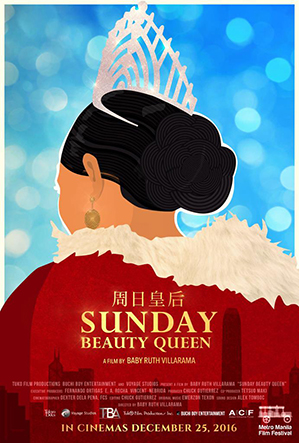
Beng likes movies like Hidden Figures and Sunday Beauty Queen where strong, smart women are smiling as the closing credits roll, where good people go to heaven, and where frogs turn into princes (she’s still waiting for that to happen). Whether it’s a happy or a sappy ending, she’s likely to cry over something. (She was probably the only person on the planet who wept when the Soviet Soyuz rocket ship docked with the Space Station—“Isn’t world peace wonderful?” I remember her saying.)

So I knew she was going to weep buckets when I took her to the dog movie; for me, watching her watching the movie makes it all worthwhile. Now this is going to be a spoiler, but if you’ve seen the trailer, you’ll know that A Dog’s Purpose is all about canine reincarnation, and about finding your way home (which, again, is apparently on every presumptive Lassie’s script).

I lined up for our tickets—we usually get D15 and D16, about midway across the theater—but dozens of families had also come out for the mutt show, and now only V15 and V16 were available, way up in the balcony where all the young couples nested. When I showed Beng the tickets, she giggled and said, “Are we going to neck?” I mumbled some incoherent, noncommittal reply, suddenly feeling very frog-like. She thought it was a funny idea, and threatened to call our daughter Demi in California, to tell her that her parents were going to go necking in the moviehouse.

Thankfully the movie started, and soon enough, as one dog died after the other, Beng was pulling out her tissues and sniffling serially, and I touched her on the cheek to assuage her grief. I could’ve licked her right there, but I could imagine Demi going “Ewwwww!” I left it to Bunso to do the licking later—having, for that day, served my husbandly purpose.


Penman No. 239: A Pinoy Pangalay in Hyderabad

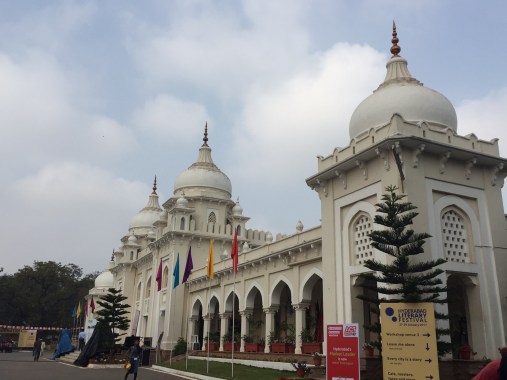
hyderabad-literary-festival-venue

Penman for Monday, February 20, 2017


I’M GOING to turn over most of my column this week to a colleague at the UP Institute of Creative Writing, the playwright and essayist Luna Sicat Cleto, whom I commissioned (badgered is the more appropriate word, since I’m not paying her anything more than my deepest thanks) to do a report on a recent mission that she and a group of Filipino writers undertook in Hyderabad, India.

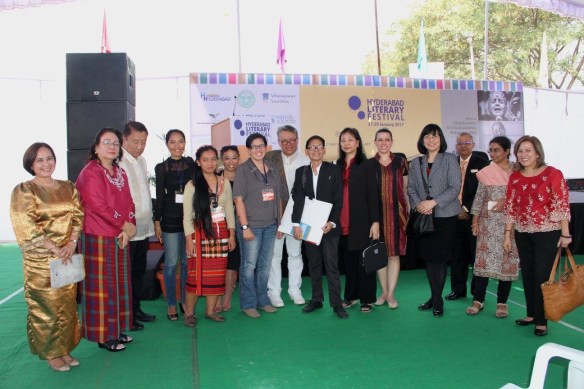
The original invitation to attend the Hyderabad International Literary Festival and organize a delegation as a “guest nation” had been sent to me, but since I couldn’t work it into my schedule, I asked performance poet and Philippine High School for the Arts director Vim Nadera to put together and lead a troupe of Filipino writers and artists. And what a delegation it turned out to be. With Vim went fellow writers Jun Cruz Reyes, Victor Sugbo, Luna Sicat Cleto, Jeena Rani Marquez, Christine Godinez Ortega, Hope Sabanpan-Yu, and Neila Balgoa. Spoken word poet Kooky Tuason also came along, as did Ifugao poet Dumay Solinggay. Dance and music were represented by Cecilia Artates and Marty Tengco. Let’s hear the rest from Luna:

“According to Dr. T. Vijay Kumar, Professor of English at Osmania University in Hyderabad, the Philippine delegation was the biggest group they had received so far, having hosted five nations since it began in 2010. The other four were Germany, France, Ireland, Poland, and Singapore.

“Dr. Kumar, alongside the novelist Pranesh Prasad, had encouraged the attendance of the Filipino writers. Prasad graced the Iligan workshop in 2013 as guest writer and also attended the Asia Pacific Writers and Translators Conference in Manila in 2015.

Since then he has felt a strong affinity with Filipinos. Prasad was happy with the performance of the delegation, saying that ‘I think we achieved our goal of creating awareness about Philippines in India, given the number of newspapers that covered your participation and all the people contact that has resulted. It bodes well for India-Philippines cultural relations.’

“Prasad’s observation was echoed by Jun Cruz Reyes, who felt that it was refreshing to read about the convergence of so many talents and minds in the festival, which was not limited to the literary field alone. Topics as diverse as politics, history, sports, and popular culture were taken up in parallel sessions. While some German industrial designers discussed the sustainable technology of chai shops, a Mumbai-based young entrepreneur talked about Instagram ruminations, while another focused on the Indian graphic novel. There were talks given by poet laureates Ashok Payjevi alongside investigative journalists like Josy Joseph and Harsh Mander, and discussions of translations of the Bhagavad Gita and Tamil stories alongside debates about the effects of the partition and human trafficking. Particiapns got to see martial-arts demonstrations of the shilambam as well as India’s latest art films. The plurality of HILF is based on its inclusive ethos: it is multilingual and multidisciplinary, and the multiple speakers—writers, artists, scholars, filmmakers, journalists, publishers—represent a wide range of creative fields. Hyderabad has been described as a ‘teeming urban masala of color and commerce,’ and indeed the city evokes the ancient prosperity of its Mughal past, alongside its twin reputation as a Silicon Valley of India.”

Luna adds that “Indeed, it is fortuitous that the Philippines was invited now, while both countries are assessing their relative positions in the global literary and cultural scene. It also became a chance to rediscover the bonds between India and the Philippines, evident in the many words from Sanskrit that are in the Filipino’s vocabulary: budhi, guro, and diwata, among others. While India has a strong tradition of writing in English because of the colonial legacy of British education, the Philippines also has a strong contingent of Filipino writers in English. India’s raucous democratic plurality in religion and politics is echoed in the Philippines’ plurality of religion, politics, cultural traditions and languages. The many languages of India are celebrated in the Hyderabad International Literary Festival, and for this year, its focus was on the Tamil language. One artist, the great Indian dancer Leela Samson, who performed in ‘Past Forward,’ said that it is about time that India listened to its many voices, and let the major languages of India be the conduits of thoughts and ideas.

“Samson’s sentiments were echoed in the Philippine delegation’s performance, aptly titled ‘Philippine Pangalay: Karmic Harvest.’ Vim Nadera strutted onstage, dressed in an all-white suit complete with an American flag tie. Channeling Donald Trump and the doomsday rhetoric of born-again speakers, he pronounced that he was dedicating his performance to the memory of National Artist Francisco Arcellana. ‘Close all open things, Lord/Open all closed things,’ Nadera intoned, appropriating Elvis’ crotch choreos with riffs from the musical Hair. The crowd was energized. He then introduced Jeena Marquez, who performed a powerful dramatic monologue based on Rizal’s epilogue in El Filibusterismo, a re-enactment of Maria Clara’s leap to death as witnessed by two civilians. Romancing Venus was the next act, which featured Tuason’s slapshock verbal performance, enhanced by Tengco’s drumming and Artate’s pangalay. But the real star of the delegation was Dumay Solinggay, who channeled the anguish of epic chanters with her poignant chorus of  ‘We must remember, we must remember…’ Solinggay did not only echo the trauma of the postcolonial subject, who may feel trapped in identities and names arbitrarily assigned, in specific situations like the call-center agents or the inevitable loss of memory in the fast pace of urban life. When she danced at the last part of her ensemble, her body resembled the paroxysm of the chanters in a trance.”

What can I say? I wish I’d been there with them in Hyderabad. The name alone sounds like magic, and I’m sure the place and the experience were every bit just that.

philippine-delegation-with-ambassador-daza-from-hope-yu

(Photos by Jeena Marquez and Hope Yu)

Penman No. 236: A Web of Entertainment

img_4017

Penman for Monday, January 30, 2017


IF I HAD to name three of the most important and most useful sites on the Internet that I’ve ever used, they would, unsurprisingly, be Google, Wikipedia, and YouTube. (Some would stick Facebook in there, but since I stay off the FB grid, I wouldn’t know).

Granted, they’re far from perfect and are eminently susceptible to manipulation by both the well-intentioned and the unscrupulous. It’s easy to become overly dependent on them for information, and to simply believe what they say and show without any kind of critical intervention. For many students and researchers, Google and Wikipedia have long replaced the physical library—and why not?—without minding the inflexible if inconvenient need for proper attribution of sources and for fact-checking. Google in particular gives weight to the popular, and in this age of fake news, post-truths, and “alternative facts,” where “If it’s retweeted a hundred times, it must be true,” the pitfalls abound.

But with enough awareness and discernment on the user’s part, they can be valuable tools for learning, and I have to say that I can’t possibly get as much work done as I do these days without drawing several times a day on these indispensable sites.

And there’s an even better reason, I’ve discovered, than cold research or trawling for factoids to explore these sites. They form a veritable Worldwide Web of entertainment, taking me to serendipitous discoveries of all sorts, thanks to the Web’s structure of hyperlinks. They often lead me to things and places I’d never have encountered otherwise, which is where much of the entertainment lies, in the continuously unfolding panoramas of knowledge that open up onscreen.

A good example came up about a month ago, while I was watching an episode of Great Performances on PBS (which I get by paying a small subscription fee, well worth the treasure trove of documentaries and arts programs). This one was titled “La Dolce Vita: The Music of Italian Cinema,” and it featured the New York Philharmonic Symphony Orchestra in a concert of classics by such renowned and popular film composers as Ennio Morricone and Nino Rota. (Morricone is a personal favorite—I keep playing Yo-Yo Ma’s rendition of “Gabriel’s Oboe” from “The Mission”, and even visited Morricone’s hometown in Cervara di Roma, where he’s venerated as a hero.)

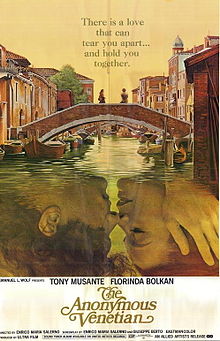
220px-anonimous_venetian

One tune that captured me was the haunting theme from a film called “The Anonymous Venetian,” played on the violin by Joshua Bell. I had heard the song before, but Bell performed it with such sublime intensity that it brought my wife Beng to tears when she listened in.

Now that I had the title, I went to Google to find out more about the song and the movie; Stelvio Cipriani had composed the music for the film, which had been directed in 1970 by Enrico Maria Salerno, starring Tony Musante and Florinda Bolkan. Further Googling revealed that the movie was about a terminally ill musician who meets his ex-wife in Venice, briefly rekindling their old passion. It was panned by the critics (and then again, some bad movies produce the best scores–remember “The Promise”?). I’m a fan of movies about Venice (Luchino Visconti’s “Death in Venice”, Nicholas Roeg’s “Don’t Look Now”) and Beng and I had spent some of our most blissful moments there riding the vaporetto on a one-day visit three years ago, so I went on eBay to buy the movie, but it wasn’t available on DVD.

Neither was it on YouTube, where you can find whole movies if you get lucky (and don’t mind the dubious provenance). But I was able to download the full PBS video on the PBS site and to find other versions of the song on YouTube, from which I cut clips to save to iTunes.

141170050

My attention then turned to Joshua Bell, who turned out to be something of a sensation in American music. Among other interesting factoids brought up about him by Wikipedia was that he owned and used a 1713 Stradivarius violin called the Gibson ex Huberman after two of its previous owners, a $4-million instrument which has been stolen not once but twice.

That led me to the story of the violin itself and back to YouTube, where a one-hour documentary titled “The Return of the Violin” traces the long and poignant pedigree of the violin, particularly its time in the hands of the Polish prodigy Bronislaw Huberman. Huberman received the violin as a gift from a Polish noble family in recognition of his astonishing prowess, but even more remarkably, he didn’t rest on his laurels; he saved many Jewish musicians during the Nazi period by recruiting them to join the Israel Philharmonic Orchestra, which he was setting up at the time.

bronislaw-huberman

At this point, I was getting far more than entertainment; I was getting an education in music and its humanizing influence, thanks to a few clicks on my keyboard.

Penman No. 235: High Time at the Henry

img_0634

Penman for Monday, January 23, 2017


A COUPLE of weekends ago, against all odds, Beng and I celebrated our 43rd wedding anniversary and not coincidentally my 63rd birthday. It seemed like an inspired idea at the time to get hitched as I turned 20, but over the years I’ve wondered if I should have given each day its proper due, and doubled my presents that way. But I soon realized that I was never going to get or find a better gift than Beng—patient, forgiving, and gentle Beng—so January 15 has largely been a day for two.

img_0616

Around Christmas I start thinking about how and where best we can spend the day, and this year, with UP having shifted its academic calendar to begin the school term in mid-January, we could have opted, funds permitting, to fly out to some exotic destination like Penang or Pattaya (or, heck, why not Paris?).

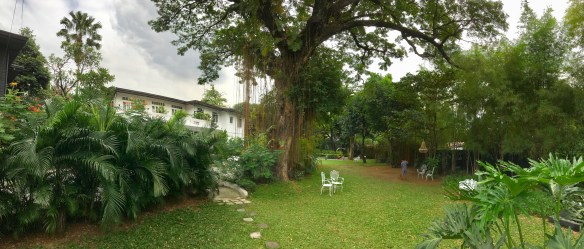
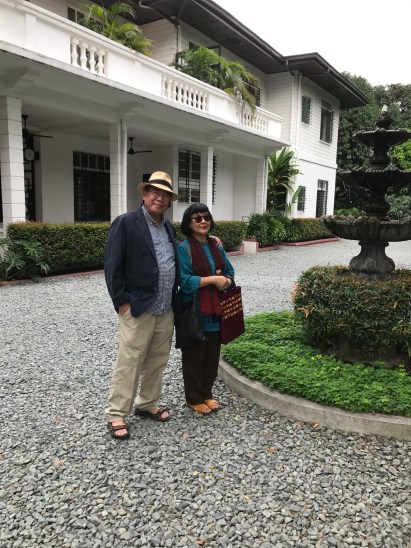
Instead, after some Googling, we ended up in the most unlikely of romantic locales—Pasay City, at the Henry Hotel along F.B. Harrison, to be more specific, where the magic begins once the gate opens.

I’d read about the Henry somewhere before and had seen pictures of the place—a visual and sentimental journey back to the 1950s, with its stately main house and sculpted gardens, and I remember being amazed even then by the fact that such a sylvan hideaway could exist in the heart (or less kindly the armpit) of the metropolis. It was high time we checked in for a weekend staycation; the saved airfare alone would answer for the room. And being staunch northerners, we barely knew the southern sector of the city, except for visits to the Cultural Center and the Luneta area. We hadn’t even reconnoitered the cavernous Mall of Asia except again for the briefest sorties.

But again that’s not entirely true, because I had actually grown up in Pasay in the late ’50s and early ’60s, in a house on P. Manahan branching off F.B. Harrison. It was a neighborhood interlaced with catwalks, off one of which I once fell into the fetid water while showing off my brand-new cowboy outfit, which I had probably received for my fifth or sixth birthday.

That bit of unpleasantness aside, I could still remember afternoons swimming in Manila Bay and lounging on the long beach chairs by the sea wall, riding the double-decker Matorco buses up and down what was still Dewey Boulevard, and munching on foot-long hotdogs at the Brown Derby.

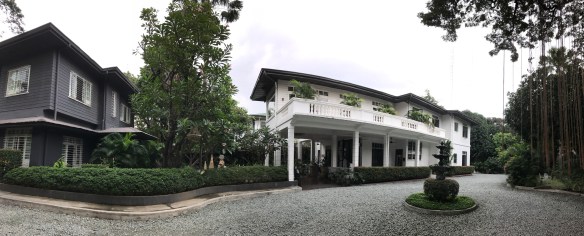
So this weekend in Pasay was something of a homecoming for me, even if all the old landmarks were gone. What’s now the Henry was already there when I was humming the Tom Dooley song, but it wasn’t a hotel yet then but a sprawling compound of large squarish but stylish wooden houses flanking a white concrete main house, amid greenery tamed and teased by Ildefonso P. Santos, who would go on to become a National Artist for Architecture.

img_0586

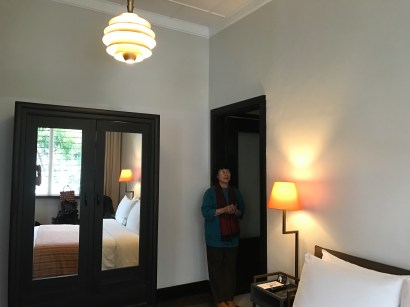
The 32-room Henry was built by its new owners out of that layout, preserving as much of the old while providing such modern amenities as wi-fi and air-conditioning. A long gravel driveway leads to a fountain and a roundabout fronting the main house, past a curtain of angel’s-hair vines; a swimming pool glows opalescent blue amid the verdure; the main house stands proud but welcoming.

I’ll report that we had a most pleasant and restful stay, helped along by an unobtrusively efficient staff. We luxuriated in the fluffy pillows and the hot shower. It was a bonus to discover that the art gallery of an acquaintance, Albert Avellana, occupied one of the houses in the compound.

img_0594

img_0593

But our anniversary weekend wasn’t meant to be spent cooped up in a room, however charming the ambience. We’ve lately been used to taking 5-7 kilometer walks as part of our seniors’ exercise regimen, so we gamely walked for our bangus and salad breakfast to a restaurant near MOA, and walked many kilometers more within the mall itself.

Staying at the chic Henry was in a way the compleat anti-mall experience, but Beng and I have never pretended to be anything but pedestrian, so that for us was the exotic treat. The mall, like all markets, was familiar territory.

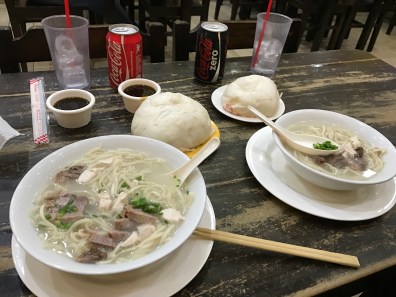
We took in a couple of action movies, buying more popcorn than we could ingest, and oohed at all the nice clothes that wouldn’t fit us. When we had lunch of ukoy and suam na halaya at the KKK restaurant, Beng loudly let the manager know that we were celebrating our 43rd, snagging us a free dessert of leche flan. Hankering for a sushi dinner, we misread Chinese for Japanese and stumbled into Masuki, which served huge bowls of my all-time favorite, Ma Mon Luk-style mami.

img_0617

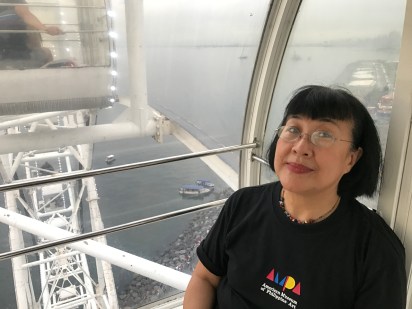
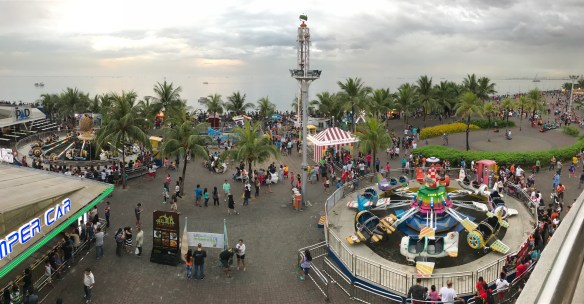
The literal highlight of our weekend had taken place earlier that afternoon. We had asked ourselves, the night before, “What kind of cheap, mindless fun haven’t we tried in a long time?” (Not that, naughty boys and girls.) We paid P150 each the next day for the answer: an eight-minute joyride up and down the MOA Eye, the big white Ferris wheel from whose apex we took selfies before tumbling out of our pod, giggling, to rejoin teeming humanity and the surefooted ordinariness of things.

img_0609

img_0612

Penman No. 233: A Ray of Filmic Sunshine

Sunday_Beauty_Queen_poster.jpg

Penman for Monday, January 9, 2017

AS SOMEONE who wrote about 25 full-length screenplays for various film projects and directors in another life between the late 1970s and early 2000s, I really should be more interested in the remarkable developments that have taken place since in local cinema, especially on the indie scene.

But I have to confess, with some guilt and shame, that I haven’t kept up with what our younger, post-Brocka and post-Bernal directors have produced, except for the occasional viewing of a Brillante Mendoza or a Lav Diaz film, or outstanding documentaries such as last year’s Curiosity, Adventure and Love and An Open Door: Jewish Rescue in the Philippines. There are some personal reasons for this estrangement (not worth getting into at this time), but I do realize that I’ve missed out on a lot of good material while bingeing unpatriotically on Hollywood and Netflix.

I must say that the Metro Manila Film Festival and its seemingly bottomless decline from its glory days ages ago to the inevitable iteration of Enteng Kabisote contributed to my dismay. This most recent MMFF, however, seemed open to letting a ray of filmic sunshine through, with new criteria and a new selection process that put a premium on quality over commercialism. When I saw the list of the people involved and when I noted that their final selections were fresh titles by new directors, my expectations rose and I told Beng, after Christmas, “Let’s go see a movie!”

We’ve managed to see only two MMFF films as of this writing, but in both instances, our hopes were well rewarded.

Sunday Beauty Queen, which eventually won the Best Picture Award, documents the labors of Hong Kong’s OFW community in putting together a beauty pageant to ease the pangs of loneliness and the drudgery of their work. Directed by Baby Ruth Villarama, the film tracks pageant organizer Leo Selomenio—herself a longtime domestic helper—and the lives and stories of several key participants, all of them hardworking DHs. These girls, clearly, are no Gemma Cruzes or Pia Wurtzbachs, but even those of us who may scoff at the predictable inanities of beauty pageants will appreciate how the idea of “beauty” itself has been turned inward by this film, whose insistent positivity prompted me to tweet, as I stepped out of a cinema, that it was a “beautiful film about truly beautiful people.”

It wasn’t lost on me that I myself had written a novel, Soledad’s Sister, about OFWs, set briefly in Hong Kong, and had more than once observed our compatriots’ festive Sunday gatherings in Statue Square. Novels like mine tend to be morose reflections on human suffering, but there’s nothing like a well-crafted and even-handed documentary to bring out the verve and the tenacity that must accompany and cushion all that sorrow, and Sunday Beauty Queen draws on Pinay resilience in spades. The ultimate crown its subjects wear—and they are all winners—is that of dignity. Bravo, brava!

The other movie we chose to see was Ang Babae sa Septic Tank 2, with the irrepressible and hugely talented Eugene Domingo reprising her title role. We hadn’t seen the original movie from 2011 (and are now sorry we didn’t), but had no trouble wading into the premises of this sequel, which has Eugene playing herself as a comebacking star and tormenting her director (Kean Cipriano) with her “suggestions” for “improving” the script. It’s a riotously satirical project through and through, well-acted by its ensemble and well-scripted by the unfailingly sharp Chris Martinez, intelligent without being pretentious.

I may have chuckled more appreciatively than others in the audience, having gone through many of the absurd situations and propositions Eugene’s character raises in the film with her director-scriptwriter. I know I said at the start of this piece that I didn’t want to talk too much about how and why I got fed up with working in the film industry, but I feel like I should share at least one incident, from around 20 years ago, that’ll help explain why I moved from writing film scripts to writing novels and biographies.

Let’s set our scene in the offices of a big film studio, somewhere in Quezon City. I’ve been called to an urgent meeting by the producer because the movie we’re shooting (yes, we’re actually in the shooting stage) needs a new ending. Why? Because the studio’s Big Boss, who keeps track of the bottom line, doesn’t want our hero to die, like we’d originally planned; dead heroes bomb at the box office. So now we have to figure out a new extro, and the producers’ friends and alalays are all generously available and willing to help us think the ending through.

“So Gabby doesn’t die at sea when his banca is run over by a big ship,” one of them suggests, “but of course Sharon doesn’t know that, and in despair, she accepts Eric’s offer of marriage. But on the way to the wedding, she asks the car to stop by the beach, where she and Gabby used to promenade. She’s in her wedding gown, and she walks on the beach thinking about Gabby, until she reaches the tree they used to stand under. So she does some muni-muni, remembering their happy days….” At this point, another alalay interjects: “Ay, you know what, it will be so kilig if she looks up at the tree, and she’ll see the face of Gabby shimmering on every leaf!” I take a huge gulp of water to drown the welling acid in my gut.

“She makes a speech and tells the absent Gabby how much she truly loves him,” the original contributor ventures breathlessly, “and then she walks away… to her marriage and her life with Eric…. But it doesn’t end there! Because… because when she drives away, we see that there’s movement from behind the tree—it’s Gabby! He’s alive!”

There’s clapping and cheering all around the table, until somebody has the temerity to ask, “But why doesn’t he show himself to her?” It’s a question met with profound disdain. “Because—don’t you see?—Gabby is now in crutches, he lost one of his legs in the boating accident, and he loves Sharon too much to make her share her life with a cripple! So, nobly, he lets her go, as the theme song plays to the closing credits…..”

Appreciative sighs greet the revelation, as some of my water sputters onto the table.

Thankfully my director and I found a way to weasel out of that inspired conclusion, and the movie was shot and finished. I collected my paycheck, and resolved to do my best to write just stories, novels, nonfiction, and columns from that moment on.