Penman No. 227: The Southern Lights Shine Brightly

IMG_9859 2.jpeg

Penman for Monday, November 28, 2016


A RECENT gallbladder operation and the stitches in four corners of my belly couldn’t stop me from flying down to Iloilo City last week to catch the tail-end of VIVA Excon 2016, which I’d plugged here some time ago but just had to see for myself. The personal reason was that my wife Beng was one of the scheduled speakers, for a session on “Art Conservation and Restoration,” but I’d also heard that VIVA Excon was one of the most successful events of its kind in the country (“probably the only surviving and longest-running Filipino biennale,” VIVA Excon stalwart and chronicler Cecilia Locsin-Nava would emphasize to me). Here’s what I found.

From November 17 to 20, more than 250 artists, speakers, and guests from the Visayas, Mindanao, and Manila gathered at Casa Real in the old provincial capitol of Iloilo to celebrate, interrogate, and propagate art in all its splendorous variety—the important qualifier being that this was new art produced south of Manila. It’s been around since 1990, moving around the major capitals of the Visayas such as Cebu, Bacolod, Dumaguete, and of course Iloilo. Surprisingly, it was only the second time that Iloilo hosted VIVA Excon, after a 20-year hiatus, so the local organizers made up for lost time by mounting one of its most vibrant editions ever.

When it started—spurred by the need to create a southern antipode for the arts, given the emergence of such bright new talents as the Negrense painter-sculptor Charlie Co—VIVA Excon had to be funded by the artists themselves, but this year Iloilo’s provincial and city government pitched in to guarantee the event’s success, with help from a host of sponsors led by the National Commission for Culture and the Arts (NCCA). On top of the local planning was painter Rock Drilon, assisted by a corps of wizards and elves who made sure that the dozens of events on the program went off like clockwork. VIVA Excon originals Ed Defensor, Charlie Co, Peewee Roldan, and Cecilia Nava were also around to lend their wisdom and support.

IMG_9862.jpeg

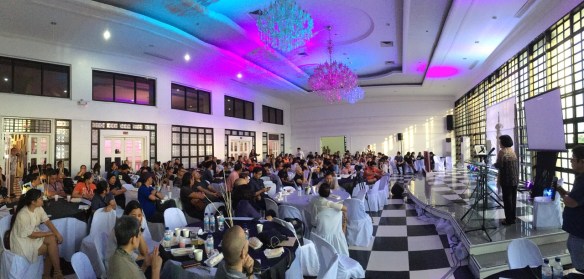
As its name suggests, VIVA Excon (the “VIVA” stands for Visayas Islands Visual Arts) was at once both an exhibition and a conference. As someone who has helped to organize quite a few literary conferences myself, I was much impressed by the scope and depth of the topics taken up at the conference and by the expertise of the speakers engaged for the occasion, some of them coming from as far as the US, Singapore, and Hong Kong. I missed most of the earlier sessions, but I would have loved to listen to Ma. Victoria “Boots” Herrera speak on “Museum Practices: What Artists Need to Know”; Silvana Diaz on “Creative Economics: Art Management and Economic Viability”; Elvert Bañares on “Creative Crossover: From Visual Art to Cinema and Back—The Visayan Artists’ Experience”; Rex Aguado on “Art, the Artist, and the Art Collector”; and Patrick Flores on “Art Criticism—Its Value to the Artist and the Artworld.”

Fortunately, I came in time to catch UP art theorist Lisa Ito address issues in writing about the arts—“for what and for whom,” she would say, “beyond the popular writing geared toward the art market, and the academic writing produced by scholars and theorists.” Lisa felt that more writing should be undertaken to “connect artistic production to social contexts and current realities, and developing publics and communities that validate the vitality of art and culture” as well as to “document design practices and projects and to record transient cultural events for future generations—how communities adapt, such as by using tricycles as mobile galleries and by putting up makeshift museums.”

She was followed by New York-based Carina Evangelista whose lecture on “When Forces Shape Form” led the audience to where art has gone far beyond and outside the museum, in performative gestures—often deeply and manifestly political—that emphasized process over product, transience over permanence, and repurposing over originality. (One example: the banknotes that Brazilian artist Cildo Meireles stamped with a political message and circulated in 1970 as a form of mobile graffiti, which nervous recipients couldn’t pass on quickly enough, thereby abetting its purpose.) It was truly a semester’s worth of material packed into 45 minutes on new forms of art from body mutilation to sound and video installation, reminding me of Marjorie Perloff’s lecture on avant-garde poetry just a couple of weeks earlier in Singapore; sometimes you learn the most wonderful things in the oddest places.

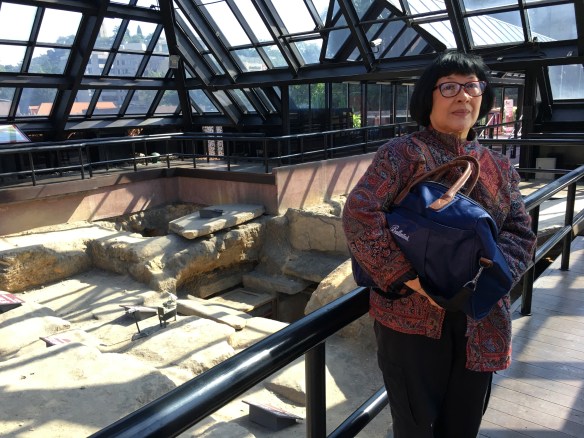
Of course, I was happiest and proudest to see Beng onstage walking the audience through the various stages of restoring Amorsolos and Botong Franciscos, and it was clear from the flurry of questions she fielded after her presentation that conservation and restoration were two of the least understood concerns of the art world, yet also two of the most vital if not inevitable. (Sculptor and installation artist Martin Genodepa graciously emceed the presentations.)

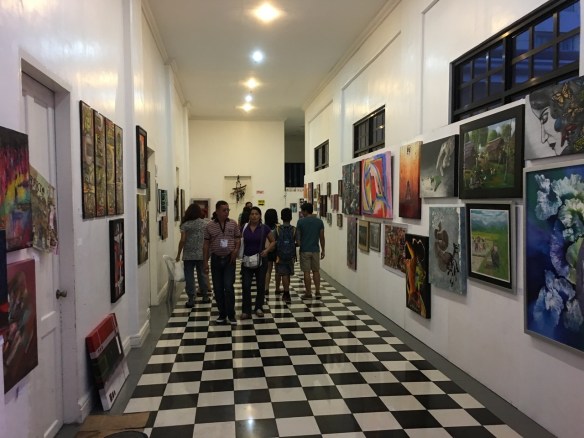
Outside the conference hall, three art exhibits were held: a curated one on “Contemporary Art of the Islands” at the UP Visayas Art Gallery, the more freewheeling Visayas Art Fair at Casa Real, and a special retrospective of the late Ilonggo sculptor Timoteo Jumayao at the Museo Iloilo.

IMG_9867.JPG

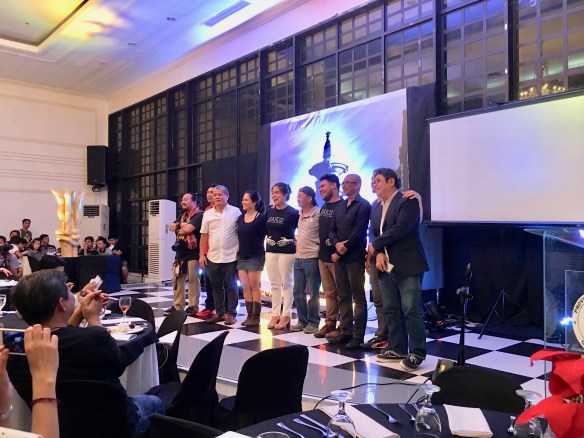
The culminating activity of VIVA Excon was the presentation of the Garbo sa Bisaya award to eight outstanding Visayan artists for excellence in their respective fields: painter Antonio Alcoseba (Cebu); scholar and painter Dulce Cuna Anacion (Leyte); film artist Elvert Bañares (Iloilo); film animator Oliver Exmundo (Iloilo); painter Allain Hablo (Iloilo); multimedia artist Manny Montelibano (Negros Occidental); painter Javy Villacin (Cebu); and painter and scholar Reuben Cañete (Cebu).

IMG_9887.jpg

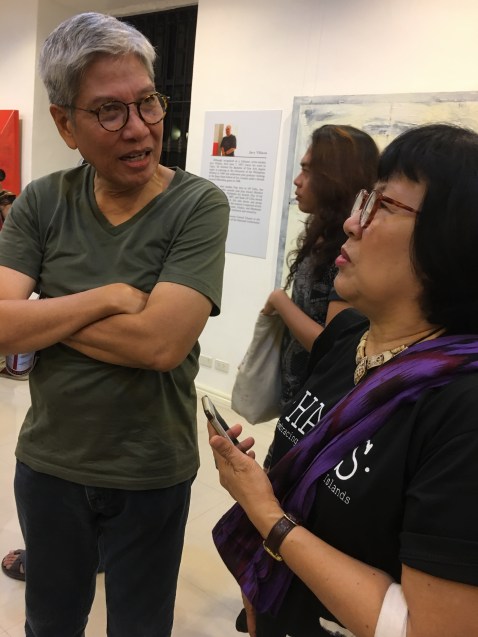
But I’m sure that all the attendees will agree if I suggest that the best part of VIVA Excon was, ultimately, the company of fellow artists, a fraternity forged over beer and music as much as over linseed oil and plaster. Even if I was little more than an onlooker at the event, I was glad to meet up with old friends and acquaintances like Rock Drilon, whose Mag:Net bar and gallery on Katipunan Avenue used to be one of our favorite hangouts. He moved to Iloilo years ago to take care of his ailing mom, and found himself drawn inextricably into the local art scene, until he realized that he was truly home. “Viva should last beyond the Excon,” Rock told me, “so an artists’ cooperative has been organized to sustain the energy sparked by VIVA Excon.”

IMG_9881.JPG

Two years from now, the event will be hosted by Roxas City in Capiz. Iloilo could be hard to top, but these Visayans are full of surprises.

Link

IMG_9635.jpg

Penman for Monday, November 17, 2016


IT WASN’T on the official itinerary, but I have to report that the personal highlight of our recent participation at the Frankfurt Book Fair didn’t happen at the fair itself, or even in Frankfurt, but about an hour and a half away by train and bus. This was a plan that a few of us had hatched even before we left Manila: we’d do our jobs and put in our hours in the Philippine booth, then take a day off in pursuit of a pilgrimage that any Pinoy in Frankfurt shouldn’t forgo: a visit to Jose Rizal’s haunts in Heidelberg and neighboring Wilhelmsfeld.

I’ve been a lifelong fan of Pepe, not just for his writing skills and love of country (I won’t mention his charming ways with the ladies) but also his wanderlust which made him, in my book, the first truly global Filipino. Considering that he didn’t live very long, he was still able to do more and see more than most of us do in a full lifetime. The intensity of that life and the excellence he sought at every turn have been enduring inspirations for me, and I’ve realized that sometimes by design and sometimes by serendipity, I’ve been tracking his footsteps around the world.

In 2009, my wife Beng and I, along with our daughter Demi and her husband Jerry, had booked ourselves into the Palace Hotel on Market Street in San Francisco, where it took a waiter (a fellow Pinoy, of course) to inform us that Rizal had stayed there during his only visit to America in May 1888, an event commemorated by a marker just outside the hotel, which we had missed.

PalaceHotel.jpg

Two years later, Beng and I visited Rizal’s well-kept shrine in Dapitan, where he had spent four fruitful years in exile before being transported back to Manila. How poignant it must have been to catch the sunset along the bay with Josephine Bracken, inflamed and torn by two of the strongest passions to afflict any writer—love and revolution.

Dapitan.jpeg

And then in 2014, again with Beng, Demi, and Jerry, I sought out some of Rizal’s locales in Spain, from Plaza Mayor in Madrid to the Castell de Montjuic in Barcelona, where Rizal had been detained before being shipped back to Manila for trial and eventual execution. (The castle has designated a room, Sala Rizal, in his honor and in memory of the many political prisoners who had spent time in that place—ironically, one of the best spots from which to appreciate the city’s beauty.)

Montjuic.jpg

There was no question, therefore, that I would make that sortie to Heidelberg, given the once-in-a-lifetime opportunity. Five other sojourners made up our group: National Artist Virgilio “Rio” Almario and his wife Lyn, their daughter Ani and her husband, the geologist CP David, and the poet and Inquirer staff writer Ruey de Vera. Lyn and Ani were attending the book fair on behalf of Adarna House and the Book Development Association of the Philippines, but we all agreed that a visit to Heidelberg was well worth a day off.

Rizal had stayed in various places in Heidelberg and Wilhelmsfeld for much of 1886, marking his 25th birthday there, studying ophthalmology with tutors like Dr. Otto Becker while improving his command of German. When he moved to Wilhelmsfeld—a 12-kilometer walk through the forest that Rizal essayed and even today a 30-minute bus ride from downtown Heidelberg—Rizal boarded with Pastor Karl Ullmer and his family, and it was there that he completed the manuscript of Noli Me Tangere (a feat that, achieved at 25, still astonishes me when I consider the juvenilia most of us still produce at that age).

Rio Almario had visited Heidelberg once before but not Wilhelmsfeld, and the rest of us were total newcomers to the area (I had traveled around Germany and reported on it extensively in 2004, but hadn’t gone this far). So it was with giddy enthusiasm that we assembled at the Frankfurt Bahnhof and boarded the 9:20 train to Heidelberg. About an hour later, we were in Heidelberg, where we made a beeline for the information kiosk just outside the train station to buy bus tickets to Wilhelmsfeld. “Filipinos?” asked a clerk at the kiosk, apparently familiar with posses of brown-skinned Asians asking about Jose Rizal, and he whipped out a xeroxed guide to Rizal’s known habitations in Heidelberg and Wilhelmsfeld. There were about six of these sites in Heidelberg alone, so we decided to go for Wilhelmsfeld first, given our limited time.

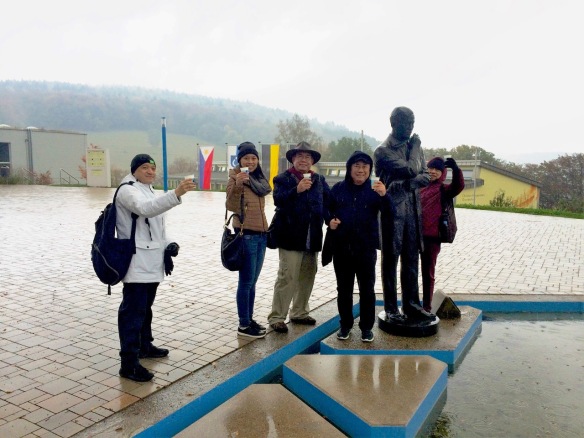
After a pleasant ride along the Neckar River and the lovely autumn scenery (punctuated only by an unexpected stop during which two European bison appeared fairytale-like out of the woods), we reached Wilhelmsfeld, which announced itself in a most unusual way, with a Filipino flag flying abreast of its German counterpart in front of the Rathaus, or town hall (Wilhelmsfeld and Calamba are sister cities). We were in search specifically of the statue that sculptor Anastacio Caedo had made of Rizal in a special park devoted to him. An initial query led us astray, to the wrong church and into a drizzle of hail (magical story elements we couldn’t have invented to accentuate our pilgrim status), until a kind lady pointed us in the right direction.

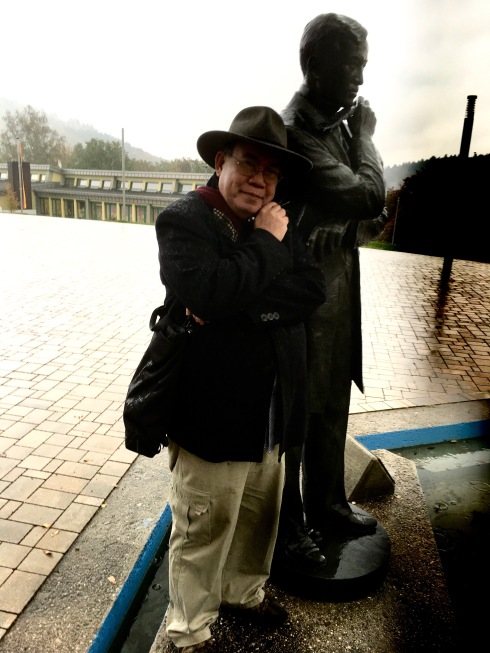
Many shuddering steps later, we arrived at a park overlooking the valley, in the center of which stood Rizal’s figure, easily a foot larger than life, as it deserved to be. We celebrated by opening a bottle of Potsdamer beer which CP had brought along for the occasion, and raising a toast to the great wanderer who had preceded us by 130 years but who yet challenged us, as it were, to write a Noli for our own times. After lunch back in Heidelberg, we prepared for another long trek to find his clinic at Bergeimherstrasse, only to realize that we had gotten off on exactly that street, and were only steps away.

Wilhelmsfeld.JPG

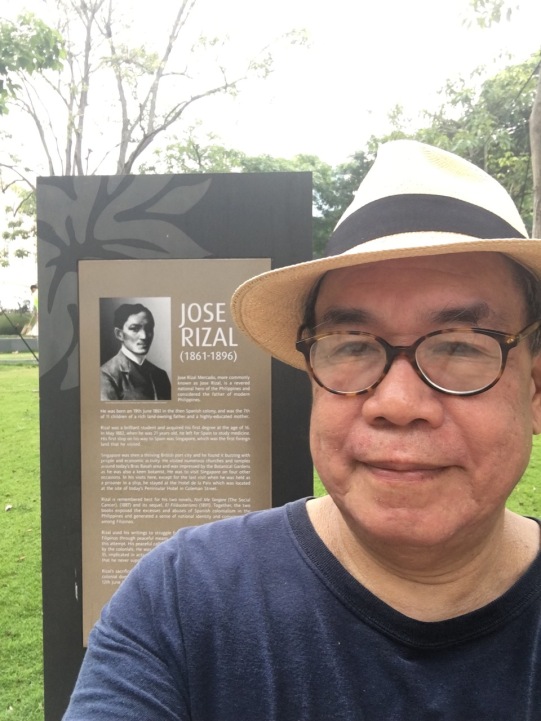
Weeks later, a totally unexpected bonus followed. I was in Singapore covering the Writers Festival when fictionist Cathy Torres—a diplomat who was serving with the Philippine Embassy in Berlin after a stint in Singapore, and had also joined us in Frankfurt—casually mentioned to me that Rizal had taken note in his letters of the black elephant statue beside the old Parliament House where the festival was being held. As it turned out, Rizal had visited Singapore four times—the first time in 1882, on what also happened to be the 21-year-old’s first trip abroad. The tip prompted me to look up Rizal’s Singaporean connections—immortalized in a marker near the Cavenagh Bridge, beside the likes of Ho Chi Minh, Jawaharlal Nehru, and Deng Xiaoping—but what floored me was discovering that he had once stayed at the old Hotel de la Paix at the corner of Coleman and Hill Streets—long gone, but since replaced by the Peninsula-Excelsior Hotel, where I was staying. I felt like I was no longer following Rizal, but he was following me.

IMG_9813.jpeg

In Dapitan, he had written: “I left, scarcely a youth, my land and my affections, and vagrant everywhere, with no qualms, with no terrors, squandered in foreign lands the April of my life.” If this was squandering one’s youth, what a glorious waste it was.


Penman No. 224: Fantastic, Frenetic Frankfurt (2)

IMG_9577.JPG

Penman for Monday, November 7, 2016


GOING TO the Frankfurt Book Fair was a great opportunity to renew old friendships and make new ones within both the global and Philippine publishing community. While we authors count publishers among our closest and most valuable friends, I realized in Frankfurt that we really don’t talk about their side of the business that much, as engrossed as we often are by our own fabulations.

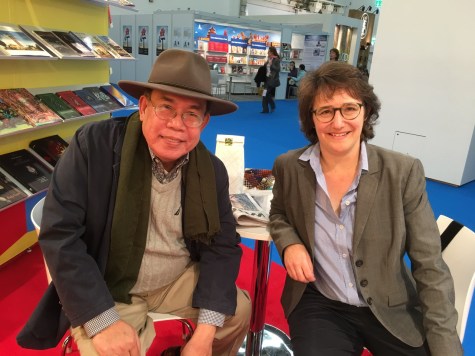
I was particularly happy to finally meet Renuka Chatterjee, who had been India’s premier literary agent when she worked for the big Osian’s cultural conglomerate in New Delhi. As my first literary agent, Renuka had been instrumental in getting my second novel, Soledad’s Sister, translated and published in Italy; but more than that, she guided me through my first textual revisions, through which I began to learn how international publishing worked. When Osian’s shut down its literary operation, I passed on to another very capable agent in New York, and Renuka eventually joined another leading publishing house in India, Speaking Tiger. We had corresponded by email over the years, but Frankfurt gave us an excuse and a venue for a long-overdue face-to-face.

Another acquaintance lost and found was the dynamic and groundbreaking Malaysian publisher Amir Muhammad, whom I had first met at a conference in Penang in 1992; Amir gifted me with a new trilogy of Southeast Asian stories he had just published, featuring the works of some of our best young Filipino authors. (Those books—like many others I’ve gathered on my travels—are now lodged at the Gonzalo Gonzalez Reading Room in UP, where we keep a repository of contemporary Southeast Asian literature.) Indeed, and not surprisingly, the Malaysians became the Philippine delegation’s best buddies at the fair; we frequented their booth to partake of the nasi lemak and to trade notes on the writing life. The Indonesians were equally hospitable, and our troop of visitors enjoyed a chat and the inevitable selfie with their star, the novelist Eka Kurniawan, whose Man Tiger made the 2016 Man Booker International Prize long list.

IMG_9554.JPG

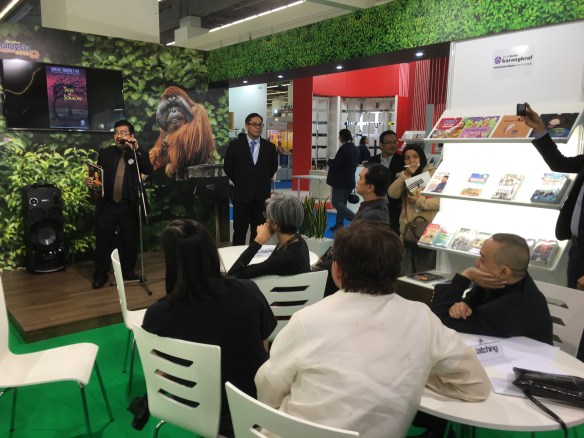
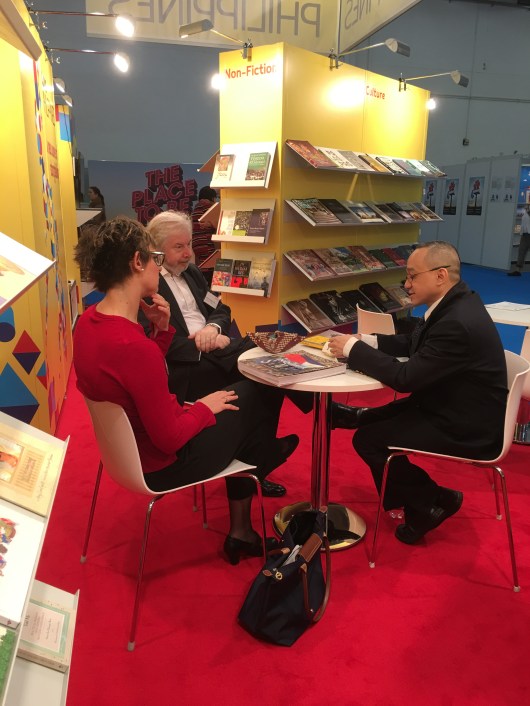
Neither were the long hours at our own booth wasted, as a steady stream of visitors curious about our books and our culture came by to browse, to converse, and to do business. Business, after all, was what most people went to the book fair for, and while some of us minded the store, our delegates were often out meeting with their counterparts from the US, the UK, Europe, and the rest of Asia. (I had a very productive conversation with a gentleman from Montenegro who runs a kind of global blog of blogs—expect “Penman” to appear there soon, but only after it’s published here, of course.)

IMG_9583.JPG

It was the Ateneo University Press’ new boss Karina Bolasco’s third straight year at the fair, which she had previously attended representing Anvil Publishing. University presses don’t generally look at their books as profit-makers, reducing the financial pressure somewhat, but Karina still had a full schedule of meetings with academic publishers, especially longtime Philippine partners such as the University of Wisconsin Press. “Our job is to negotiate for reprint rights,” Karina told me. “We try to find material already published abroad that will be interesting to Filipino readers, and we also offer other presses the rights to reprint Filipino works with a global appeal.”

One of the most visited displays in the Philippine booth this year was that of Mandaluyong-based OMF Literature, Inc., which has published religious and inspirational books since 1957. OMF CEO Alexander Tan told me that their market was big and growing—extending even to OFWs in the Middle East—and that it had developed its own local stars such as pastor Ronald Molmisa, who draws huge crowds to his lectures on love and relationships. “I realized that by breaking the rules and letting people like Ronald use Taglish in their books, we could reach more readers,” Alex said.

On the other hand, literary agents like Andrea Pasion-Flores, who now works with the Singapore-based Jacaranda agency, assume the task of representing Filipino authors abroad and finding publishers to buy their works (and who then assign editors to work closely with the authors on revising their text for publication). Andrea—an accomplished author in her own right who also happens to be a lawyer and the former executive director of the National Book Development Board—is the first and, so far, the only literary agent working actively in the Philippines. Jacaranda has already sold the rights for such distinguished Filipino writers as the late Nick Joaquin, Charlson Ong, Isagani Cruz, and Ichi Batacan (whose Smaller and Smaller Circles will be a movie soon).

IMG_9563.jpg

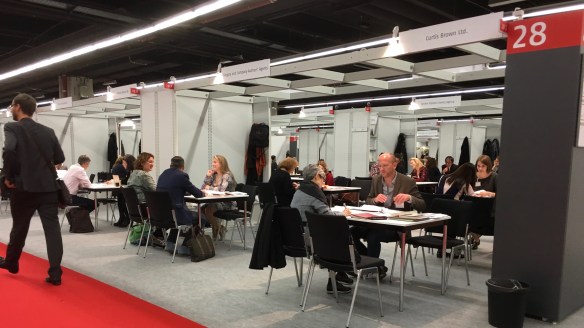
Andrea and her Jacaranda colleagues Jayapriya Vasudevan and Helen Mangham spent long working days in Frankfurt at the exclusive Literary Agents section upstairs, which only registered agents (who paid a hefty price for table space) and publishers could theoretically access. But Andrea secured a pass for me so I could observe the frenetic 30-minute “speed-dating” sessions that took place in hundreds of cubicles. “You’re probably the only author in this room,” Andrea told me. When I asked her what international publishers were looking for from Filipino authors, her response was quick and to the point: “The big novel, more genre fiction, and more high-quality literary fiction—and less ego, please, as Filipino authors generally aren’t used to revising their work!”

Back downstairs the next day, my companions at the Philippine booth were surprised to see me in animated conversation in Filipino with a Caucasian lady, whom I was happy to introduce to everyone. Our visitor was Annette Hug, a novelist and translator who had come from her home in Zurich to meet with me and with her publisher at the book fair. Annette—who took her MA in Women’s Studies in UP and regularly practices her Filipino with an OFW friend—had just translated a piece I had published last month in the Philippine edition of Esquire magazine, a piece on extrajudicial killings that had somehow gone viral; Annette’s translation had come out that same day in a Swiss newspaper and she brought me my copies, fresh off the press. But apart from that sad topic, Annette had also just published a novel in German, Wilhelm Tell in Manila, based on Jose Rizal’s work on that Swiss hero’s life, and the UP Press will now explore the possibility of publishing a translation of her novel in the Philippines.

IMG_9597.jpeg

Another visitor was children’s book author and Palanca Hall of Famer Eugene Evasco, who just happened to be in Munich on a three-month research fellowship, so he took the three-hour train ride to Frankfurt to visit the fair and to take in the mind-blowing displays at the children’s literature section.

Of such providential encounters, magnified into the thousands, was the Frankfurt Book Fair made, and while I was there less on business than as a roving cultural ambassador of sorts, I was glad and privileged to tick another item off my bucket list. I’ve run out of space to talk about an excursion some of us took to trace the footsteps of that quintessential Filipino writer, Jose Rizal, in nearby Heidelberg, so I’ll save that for another column soon.

IMG_9567.JPG

Penman No. 223: Fantastic, Frenetic Frankfurt (1)

IMG_9550.jpeg

Penman for Monday, October 31, 2016


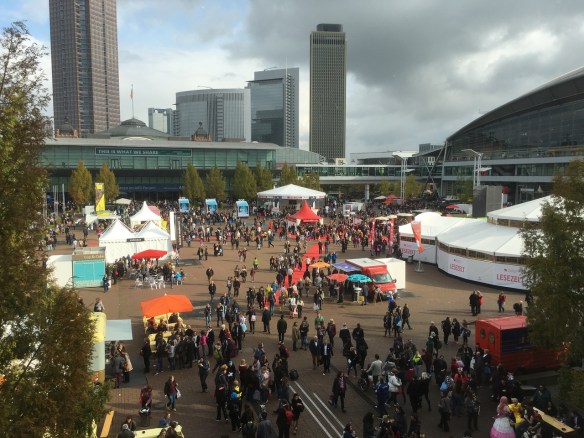
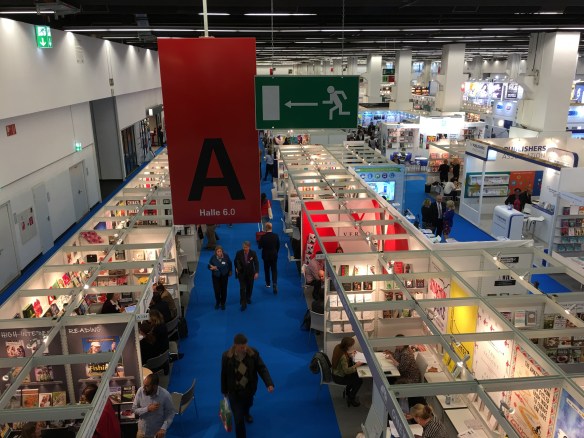
I’VE BEEN to mammoth meetings before—the Modern Languages Association in Chicago, MacWorld in San Francisco, Comic-con in San Diego, for instance—but nothing comes close to the Frankfurt Book Fair in size and scope. Covering over ten hectares of exhibition space spread out over several buildings and many floors, it’s certainly the world’s biggest and best-known book fair, gathering participants from nearly 200 countries.

Unlike author-focused literary festivals, the vast majority of those participants are publishers, booksellers, editors, literary agents, and printing industry representatives, all looking to make a pitch and a sale of their wares across the globe. That globe may have been made much smaller by the Internet, but nothing still beats a face-to-face transaction with one’s possible partners, and that’s where a book fair like Frankfurt’s comes in, as a week-long physical marketplace where the world’s publishers, from the biggest to the smallest ones, all go.

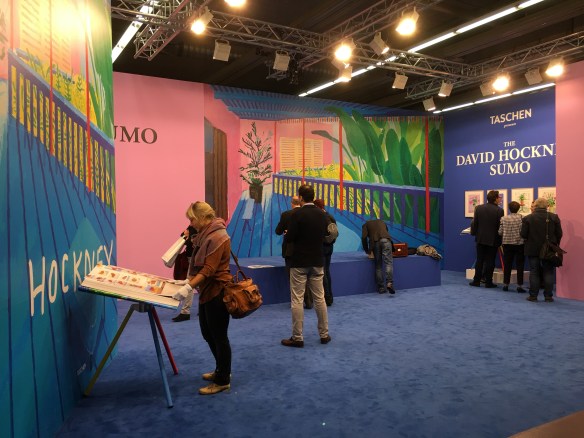
Inevitably a few writers and artists stray into the mix (we spotted David Hockney through a crack in the wall being interviewed at the Taschen booth by German TV), and this year I was one of those lucky few, with some help from the National Commission for Culture and the Arts and the University of the Philippines. Spearheaded by the National Book Development Board and invaluably assisted by the prime advocate of culture and the arts in the Senate, Sen. Loren Legarda, the Philippines expanded and upgraded its representation at FBF 2016, with a much larger booth and an impressive array of books from all our major commercial and academic publishers. The NCCA also sponsored one of our top graphic artists, Manix Abrera, and it didn’t hurt that National Artist Virgilio Almario came along in his private capacity to accompany his wife Lyn and daughters Asa and Ani who were representing Adarna Books and the Book Developers Association of the Philippines.

IMG_9720.jpeg

While Filipinos have attended the FBF in dribbles for some time now, it was only this year that we went all out, helped incalculably by our bigger booth. Last year, publishers had to chip in P100,000 each to rent a tiny plot of real estate at the fair, which starts at 400 euros per square meter. Sen. Legarda’s timely intervention meant that publishers could put their rental money into bringing more representatives and more books, and our 2016 delegation hit a historic high at over 40 members.

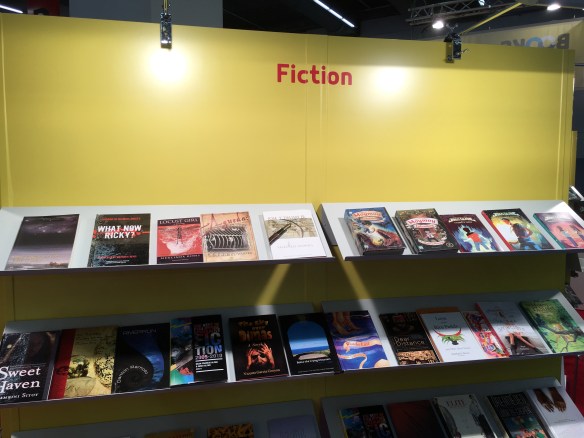
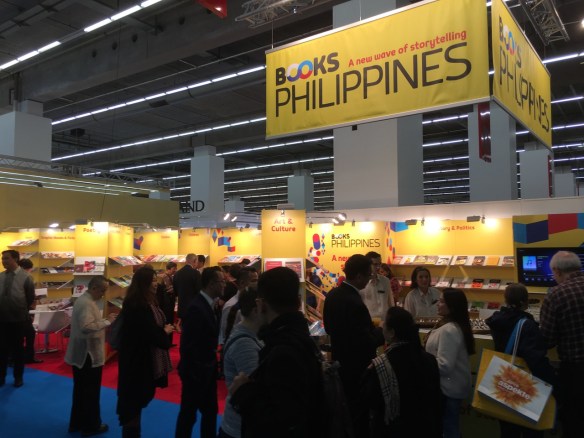
Though not yet quite the pavilion that countries like China and Singapore could afford, our corner booth was colorful and visually attractive—a plus in a fair with thousands of such offerings, all competing for the passing viewer’s eye. Through the Ateneo University Press (now headed by Karina Bolasco, formerly of Anvil Publishing), the Philippines also had another albeit smaller booth in another hall as part of the FBF’s invitational program, an affirmative-action project that brings in and sponsors selected publishers from developing countries. Predictably, China’s exhibit occupied a whole city block (for the price of which they could have gotten a better English editor for their signs, which proclaimed “Chinese Publication”).

On the other end of publishing pomp and circumstance, the FBF annually invites and celebrates a Guest of Honor, and this year it was the Netherlands and Flanders, which decked out an enormous hall as a haunting landscape reminiscent of the Dutch flatlands. The Guest of Honor status focuses attention not only on that country’s literature but its entire culture and society, providing an opportunity to put one’s best foot forward (Dutch royalty attended the opening ceremonies, lending a touch of glamor to the event—and ratcheting up security for everyone). The Guest of Honor also gets to choose a theme for its exhibit, which this year was “This Is What We Share” (last year, New Zealand—on the other side of the world, for Europeans—whimsically chose “While You Were Sleeping”). My fancy tickled, I asked what the Philippines needed to be named Guest of Honor—one can both apply or be invited—and received an unequivocal answer: “Millions of dollars.” I shut up.

Its cultural import aside, the book fair means big business for Frankfurt, which, in partnership with the private sector, leases out the fair grounds to such clients as the publishers’ association which directly runs the book fair; at other times the venue hosts other big events such as automotive fairs and a forthcoming Justin Bieber concert. Last year the FBF brought in 250,000 participants, a figure the organizers expect to rise to 280,000 in 2016.

IMG_9573.JPG

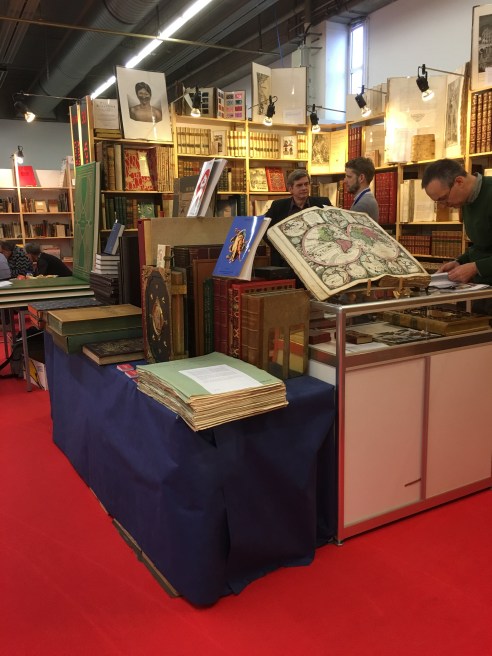
This year’s edition of the Frankfurt Book Fair is officially the 68th, but it traces its lineage much farther back to medieval times, when friars traded pages of illuminated Biblical manuscripts. There’s still a special section of the FBF devoted to the antiquarian trade, to which I gravitated naturally, being interested in all things ancient. Other than this parchment-heavy and leather-bound corner, the FBF dwells and thrives on nothing but new, newer, and newest—new books, new ideas, new authors, new media, new technologies, new markets, new connections, new networks.

Exhibits are grouped by geographic region, by language, and by theme, so one has to roam far and wide to get the full scale of things and to zero in on specific interests. Much of the business at Frankfurt, however, is pre-planned; with table space at a premium, publishers and agents would have emailed each other months or weeks in advance to set up meetings for specific dates and times in Frankfurt.

IMG_9584.JPG

The publishers of so-called “trade books”—novels, cookbooks, children’s books, etc. aimed at the general public—showcase their works to attract attention from international publishers and booksellers who may want to translate them into another language, or to sell the books on consignment in other countries. Academic publishers—this year we were represented by the UP Press, Ateneo de Manila University Press, and UST Press—negotiate among each other for reprint rights, which can make costly works more easily available to local readers.

Led by NBDB Chair Neni Sta. Romana-Cruz, the Philippines launched its exhibit with a reception at its booth on the fair’s formal opening on October 19, a well-attended event graced by Ambassador Melita Sta. Maria-Thomeczek (who was happy to recall that she had once been an employee in Rio Almario’s Adarna Books and had been a student of Rio’s wife Lyn at Maryknoll) and by First Secretary and Consul Cathy Rose Torres, who herself happens to be a prizewinning fictionist. The reception was catered by Maite Hontiveros, who laid out a scrumptious spread that featured lumpia, spoonfuls of adobo on rice, mango juice, and Philippine chocolate, which were clearly a hit among our foreign guests.

IMG_9536.jpg

Filipino books, of course, remained on top of the menu, and for the next week, we took turns at the booth to entertain visitors and book buyers from other countries, while occasionally slipping out to survey the vast array of exhibits and inevitably to marvel at the scope, vitality, and quality of global publishing in the 21st century. I came away even more convinced that culture is a global battleground, and that books are weapons—of mass instruction, if you will.

Next week, I’ll share the highlights of my conversations with key people at the book fair, and report on retracing Rizal’s footsteps in Heidelberg.

IMG_9564.JPG

Flotsam & Jetsam No. 47: Fountain Pen Day Nov. 5-6 at SM Aura

I1Ptaxz.jpg

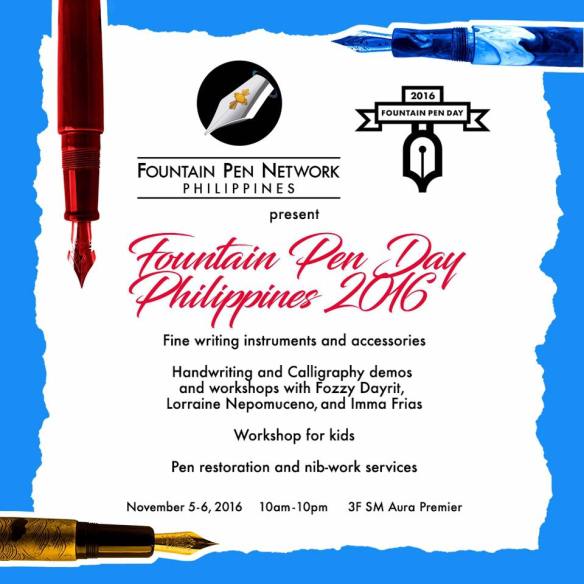
 IN CELEBRATION of Fountain Pen Day—marked globally every first Friday of November—Manila’s foremost dealers of pens and inks will set up shop on November 5 and 6 at SM Aura Premier in Bonifacio Global City near Toby’s Estate on the 3rd floor.

Scribe Writing Essentials, Pen Grafik, Everything Calligraphy, Faber Castell, National Book Store, and Lamy will be showcasing some of the finest brands of pens and inks from Europe, the United States, and Asia.

Handwriting workshops have also been lined up over the weekend. Kids wanting to discover the joy of handwriting can sign up for demonstrations guided by children who themselves use fountain pens for writing and illustration. Local pen restorers and nibmeisters will be present to tune, repair, and appraise pens. Pen lovers wishing to learn more about both vintage and modern pens can pick the brains of seasoned collectors, and students of the ornamental word can interact with expert calligraphers.  An art exhibit will feature works rendered in pen and ink by some of the country’s best artists. (Some of my best vintage pens will be on display, as will those of other FPN-P members.)

9461223955_cfe9b4d40b_o.jpg

Fountain Pen Day was started in 2012 by American pen collector Cary Yeager. In the Philippines, the Fountain Pen Network-Philippines (www.fpn-p.org) organizes this festival. With over 2,000 members in its Facebook group, FPN-P is a diverse community bound by a shared love for the written word in an increasingly digital age. Its members include writers, lawyers, doctors, teachers, artists, tech professionals, civil servants, and students.

Fountain Pen Day Philippines 2016 is also made possible by the support of SM Aura Premier, PNB Savings Bank and Asia Brewery. For more updates on Fountain Pen Day, go to Instagram and follow @fountainpenday and @fpnph, or interact using hashtag #fpdph2016.

Penman No. 219: The Chase and the Company

Pens3.jpg

Penman for Monday, October 3, 2016


THERE COMES a time in every collector’s life when he or she realizes that the road has suddenly ended—that there’s hardly anything more to be found, no further byway to be explored. It’s a sad acknowledgment but also in some ways a relief, knowing that one’s disposable income (and better yet, one’s savings) can go to more prosaic but in all likelihood more practical objects—a roof repair, or new tires for the car, or a larger fridge, all long overdue.

None of those, of course, will quite compare with the gleam of a 1786 Carolus III dos reales or an early edition of the Noli or Fili, or a 1950s Mercedes 180 (nothing too special, just one of my favorites) tucked away in an old garage. Or, in my case, a 1936 Wahl Eversharp Coronet, widely upheld to be the “acme of Art Deco pen design.” I’ve lusted after a Coronet in more than 30 years of pen collecting, even keeping a picture of it in my burned-out Faculty Center office, and maybe came close to acquiring it once. But like all “grail” pens, it remained a wisp of a dream, within tantalizing sight but always beyond one’s feeble grasp.

I knew I’d come to the end of my collecting road when the thought struck me the other day that if a Coronet were to be offered to me tomorrow for a reasonable price, I would probably smile and politely decline, preferring to keep it a pretty phantom forever. If I actually held it in my hand it might seem dull and stale, its Pyralin inserts (whimsically described as “Dubonnet red”) somehow lacking in the fire of fantasy.

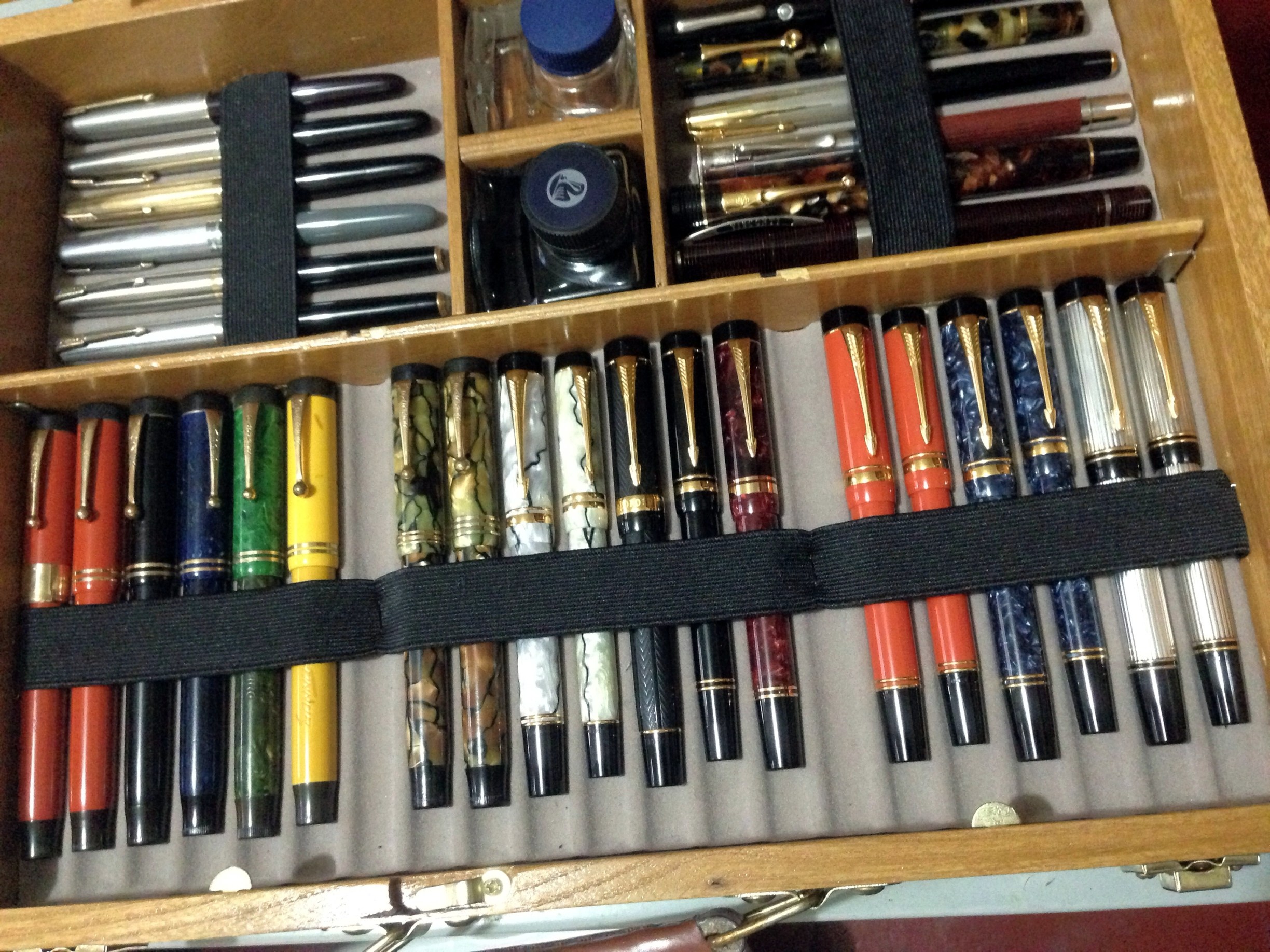
Come to think of it, I’ve bought only two or three pens over the past three months—at least one of them for resale—when I used to acquire one almost every week. At its peak three or four years ago, my collection of vintage and modern pens numbered more than 300, ranging from the 1890s to the present and representing many of the best pens of every period (excepting the Coronet), by brand and model. It was a collection put together over many years of patient pursuit, of moving up from one model to the next tier, of selling five average pens to buy a first-rate one, of foregoing ampler lunches in my grad-school days in the American Midwest to be able to afford mid-range Parker Duofolds, Vacumatics, and 51s.

Some of those early buys turned out to be bargains and lifetime keepers. Back in 1987, I agonized for a week over whether to purchase an ebony Wahl Eversharp Doric from 1934—another Art-Deco icon, with a 12-sided cap and barrel and a latticed cap band—for the princely sum of $28. Thankfully beauty won over economy and I still keep the Doric, now easily ten times its purchase price.

Another classic I found at a Milwaukee antique shop in 1990 for a small fraction of its true value was a Parker Duofold Senior in Mandarin Yellow, a large fat pen from the mid-1920s, much sought after for the rarity of its color. Bought for $68, I had to resell it a year later for $380—still well below what it would fetch today—when I was living on turkey backs and trash fish on my meager stipend. And how can I forget the gorgeous 1938 Parker Vacumatic Oversize in burgundy red which I found in Edinburgh in 1994 and based my “Penmanship” story on?

It was stories like these that kept my interest in collecting alive, almost as much as the pens themselves, the remaining 150 or so of which I can’t possibly all use and learn to love, even if I rotated them every other day. I still value my best pens as marvels of both art and engineering, which also just happen to lay exquisitely shaded lines and whorls of glorious ink on fallow paper.

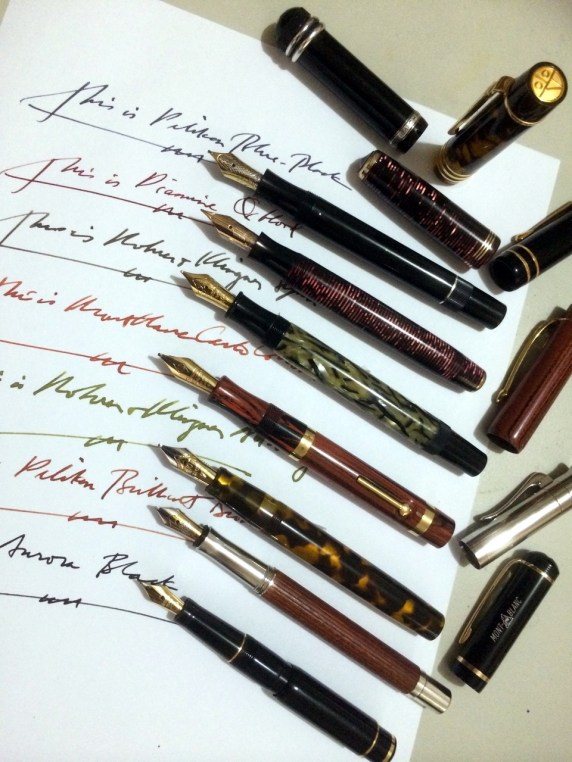
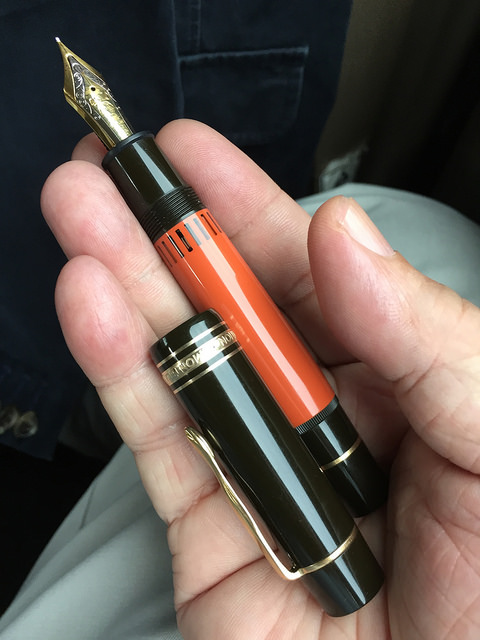
I suppose the end began a couple of years ago, when I turned 60. I started selling pens from my collection—even pens I had kept for over 25 years—to allow the members of our pen club, especially our millennial newbies, the privilege of owning and writing with something their grandparents may have used. That’s also when I began using my best pens, like the Montblanc Agatha Christie, on a regular basis—a bit like driving a Rolls to the 7-11—but my reasoning was, as we UP people like to say, if not now, when? What might have been ostentation at age 35 can now only be fondness in a senior, and the silver-snake-clipped Agatha gives me sublime pleasure even in the pocket, and many times more so when I sign my name—even on office forms—with its double-broad stub nib and sepia ink.

Such, I think, are the pleasures of aging, when one turns from sheer accumulation to discernment, and to the dawning acceptance of the finitude of all things, including and especially material objects, no matter how lovely and intricate and painstakingly acquired, be they pens, cars, watches, or Persian carpets.

Whereas I used to check eBay literally a dozen times a day (employing a special search term to ferret out the most desirable vintage pens), today I hardly blink when, say, a 1928 Parker Big Red sails under my nose for less than $100—let someone enjoy the bargain, as I’ve done myself many times. It was the hunt that kept me in the game, but I’ve learned that spotting the target but letting someone else take the shot could be just as satisfying.

In what was likely my last big pen adventure, a few months ago, I found another of my “grail” pens—the much-coveted Montblanc Ernest Hemingway from 1992—being sold online for about half its usual price (if you really want to know how much these babies cost, try Google). The seller was in Malaysia—reason, perhaps, for Western buyers suspicious of anything too far East to shy away, but to me a heaven-sent circumstance.

19408949056_7cabfd53d3_z.jpg

I closed the deal (drawing deeply on my savings, but what the heck, a Hemingway appreciates better than a time deposit) and, in a moment of inspiration, I did some quick computing and figured that it was only marginally more expensive and a lot safer to fly out to KL on a budget fare and pick up the pen personally the next day than to entrust everything to PayPal and a courier service. And that’s what I did. I always enjoy KL for whatever excuse takes me there, but I daresay no Argonaut ever crossed the South China Sea just to pick up an orphaned Hemingway and bring it home. (To be honest, it’s my second Hemingway—I use the other one, the gift of a generous friend, exclusively to grade student papers, in a bright orange ink.)

Over the next few years, I’ll be trying to bring down my remaining stash to an absolute core of about two dozen pens, which will be our daughter Demi’s inheritance from me (sorry, anak, no tracts of sugarland or bubbleback Rolexes here). They won’t necessarily be the most expensive pens—Demi can sell those off, if I don’t—but the ones most laden with story, blobbing like ink at the very top of the nib, eager to be disgorged. It’s been a privilege playing steward to these fine shapers of fine words, and I may miss the chase but not yet the company.

Penman No. 216: From Bali Song to Balisong

IMG_8436.JPGPenman for Monday, September 12, 2016


I’D BEEN meaning to write this up for the past few months, but more pressing subjects kept getting in the way—and “pressing” is the word, because this is about the complete opposite: total relaxation with no fixed schedules or time limits.

It was sometime this past summer when I accompanied my wife Beng and a group of her UP High batchmates on a day trip to Batangas to scout some places as possible sites for their upcoming golden anniversary reunion next February. Beng already had one such place in mind—Cintai Corito’s Garden in Balete, not too far from Lipa, which we had already visited with the family a few months earlier, and had been much impressed by.

Like many Manileños, we’d long been looking for day-trip or weekend alternatives to Tagaytay, especially for bringing our foreign visitors and balikbayan relatives to. Frankly, as a bulalo and ukay-ukay addict, I myself never tire of Tagaytay for a quick break from Manila’s madness. But lately, on our sorties to Mindoro and Romblon via the Batangas ferry, Beng and I have been taking the STAR tollway a lot and have often found ourselves wanting to stop over in one of the many towns on the way.

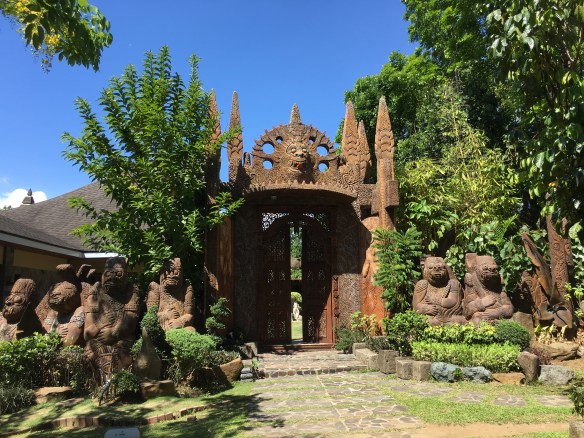
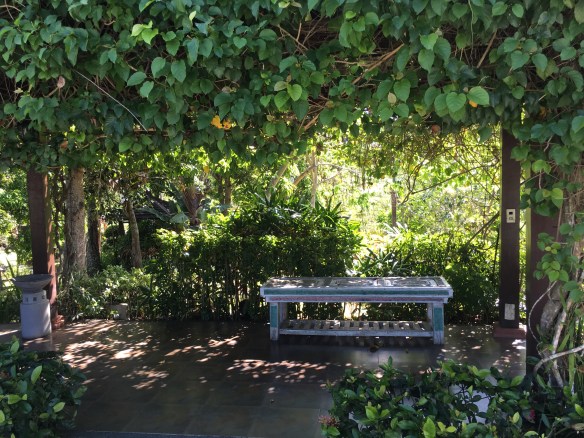
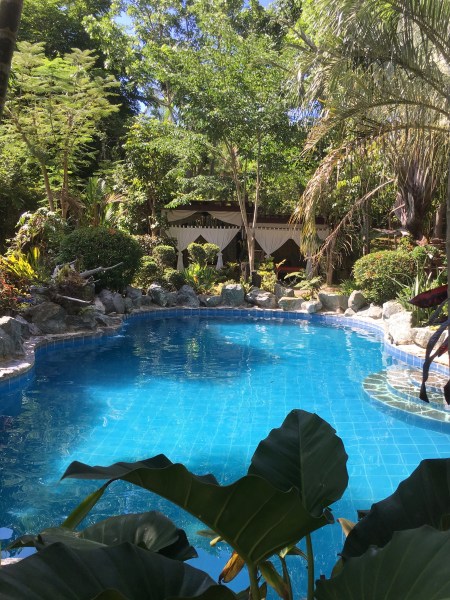
The Balete exit is one those innocuous detours that you’d take only if you really knew where you were going, and the narrow road that you get on leading to Cintai promises little beyond the shops selling honey along the roadside. Cintai itself doesn’t look like much from the outside—until you drive down the winding entranceway. The point of this long prelude is that you’d never imagine such a magical place to arise out of the Batangas countryside—a virtual Balinese-inspired Eden carved out of a rolling landscape that once might have been dotted by coconut and coffee.

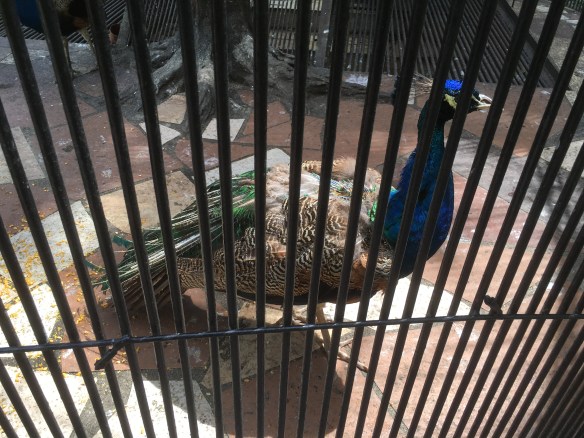
Cintai (which means “love” in Bahasa and is pronounced Chin-TAI) is a love offering to the late Corito of the place’s original name, the lady who inspired this outburst of Indonesian exotica in Southern Tagalog. It would be easy to think of the place as a theme park or resort—there are three swimming pools, and you’ll find peacocks, alpacas, roosters, and dwarf horses roaming the grounds—but other such places imply loudness, both literally and architecturally.

IMG_8415.JPG

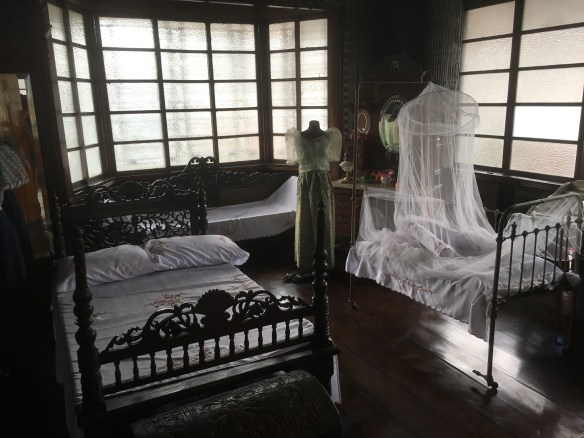
Cintai is anything but loud—visually impressive, for certain, but just on the right side of tastefulness. Given the easy temptation to go over the top, Cintai’s designer wisely decided to make just enough of a statement, but also to take care of the fine details and of their consistent employment, even the patterning of the rocks on the walkways and the Balinese carvings in the bathrooms.

In other words, as in Bali itself (which I had the pleasure of visiting 30 years ago), the appeal of the place is in its soulful serenity. The management could have hyped up the atmosphere by piped-in gamelan music, but they resisted even that, for better effect: the gamelan will tinkle in your mind. (One interesting discovery: the Balinese statues, figures, and accents in the complex were mostly made by Batangueño craftsmen.)

IMG_8784.JPG

The complex comprises 18 villas with variable capacities, two large halls, a spa, and a restaurant, among other facilities (for more details, visit http://coritosgarden.com). Beng and her UP High batchmates plan to have the place to themselves for an overnight stay, an ideal set-up for a big group, but walk-in day trippers are welcome, for a very reasonable rate that includes a sumptuous lunch.

IMG_8419.jpg

And that’s what we did on this scouting trip—tour Cintai and have lunch with its amiable manager Francis Salanguit—but I had another suggestion for the group, which they gamely took up: go a bit farther down the highway to Taal, about a 40-minute drive away, to give everyone (especially the balikbayans) a special treat of history and heritage. I’d also been to Taal before and had visited one of its fabled heritage houses and its cathedral; I wanted to see more. So we set out after lunch and were in Taal shortly after.

The historicity of Taal was immediately apparent in the old Spanish-era houses lining the approach to the town. But what also accentuated (I was going to say “sharpened”) Taal’s uniqueness were the shops hawking a fearsome array of bladed weapons—specifically the balisong, the fan knife of many a boyhood fancy, ranging from the mini to the outsized version. Batangas, of course, and Taal in particular can look back to a proud revolutionary tradition, and the balisong seems to exemplify that don’t-mess-with-me attitude Batangueños are famous for.

IMG_8809.JPG

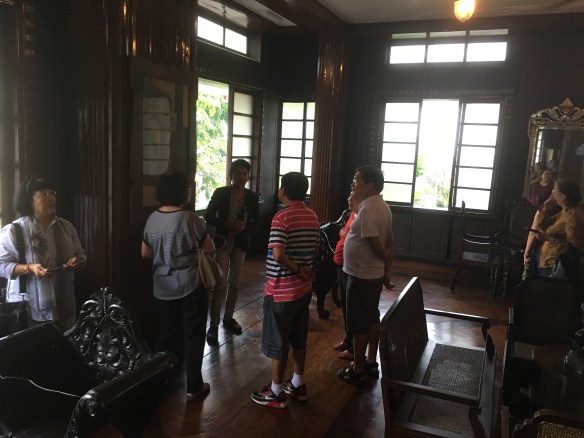
We didn’t stop that day to buy any knives—imagine the alarms they’d trigger if someone forgot about them on the plane ride Stateside—but we pressed on to our main destinations: the Apacible and Agoncillo heritage houses, both of which can be found on Agoncillo Street. I’d seen the Apacible house on my previous visit and had been charmed by its wonderfully preserved furnishings, but I was pleasantly surprised to see how the National Historical Commission, which manages the two historic houses, had taken pains to provide visitors with a more enlightening and rewarding experience.

Guests (who may come in for free, but are encouraged to leave a donation) are met and led by a knowledgeable guide; the AV show that introduces the place, its previous owners, and its history was one of the most artistic and professionally produced I’d ever seen. Markers, captions, and child-friendly installations were provided where necessary, and additional information was contributed freely by our young guide. The Apacible brothers—Leon and Galicano—were cousins and confederates of Jose Rizal, who came to their house to talk revolution; Leon was a lawyer and soldier and Galicano a doctor and propagandist, and though less known in the pantheon of Filipino heroes, they come alive in the exhibits that pay due homage to their contributions.

IMG_8812.JPG

The Marcela Marino Agoncillo Museum and Monument a couple of blocks down the street was just as well kept and well introduced with its own AV production (my kudos to Dr. Maris Diokno, whose dual backgrounds as teacher and historian—not to mention her own proud lineage as the descendant of true heroes—can be seen working here to best effect). Marcela was the wife of diplomat Felipe Agoncillo, but came to be known on her own as the co-creator of the first Philippine flag while on exile in Hong Kong.

Just as Cintai’s gardens had appealed to the spirit, Taal’s heritage houses touched both heart and mind—and it took just a few mouthfuls of the local suman, washed down with barako coffee, to complete our Batangas experience with a boost to our famished stomachs. I’m not knocking Tagaytay, but one of these days, you just may want to go a little farther down the road and try a bit of the best that Batangas has to offer.

IMG_8802.JPG

Penman No. 215: An Explosion of Graphic Talent


IMG_9307.JPGPenman for Monday, September 5, 2016


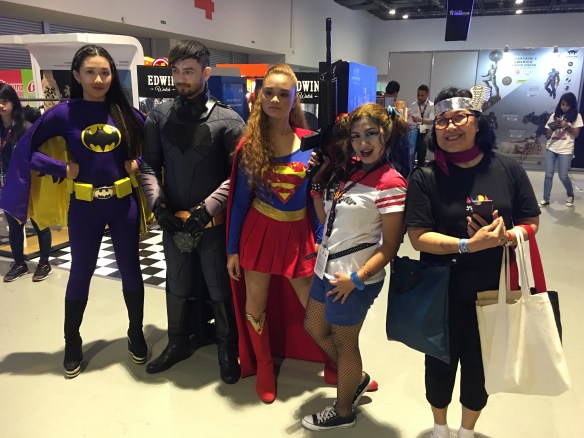
THERE WERE plenty of attractions at this year’s AsiaPOP Comicon, held August 26-28 at the SMX Convention Center at the Mall of Asia—chiefly the presence of such popular stars as X-Men’s Nicholas Hoult, The Vampire Diaries’ Claire Holt, Game of Thrones’ Joe Dempsie, and Stranger Things’ Millie Bobby Brown, and comic book artists Whilce Portacio, Mike Zeck, and Ken Lashley, among others. But what drew my attention and my wife Beng’s the most was the explosion of talent among Filipino graphic artists who displayed their work at the far end of the exhibition hall.

Let me take a step back and recall that just last July, thanks to the sheer luck of being in the right place at the right time, Beng and I found ourselves attending the San Diego Comic Con—the original and still the biggest pop-culture gathering of its kind. The sortie revived my juvenile interest in comics and all things strange and wonderful—an odd detour from the stodgy realism of my own work, but surprisingly refreshing. It was at the SDCC’s Artists’ Alley that I ran into the Fil-Am comics legend Whilce Portacio, and I interviewed him on the spot (the full interview will appear in a forthcoming issue of Esquire Philippines), during which I learned that he was coming to Manila soon for another pop culture event.

That event turned out to be AsiaPOP. AsiaPOP Comicon Manila was organized by Universal Events & Entertainment, a subsidiary of the Singapore-based Al Ahli Holding Group, whose head of Marketing and Business Development Abdulla Mahmood was glad to share the fact that AsiaPOP’s first Manila outing last year attracted 30,000 attendees—a more than respectable figure considering that the San Diego original typically brings in about 130,000 people over four days. “Pinoys are immersed in pop culture,” Abdulla told me, explaining why his group decided to launch their first such event in the Philippines. “They’re among the heaviest users of social media, too, which helps spread the word. From here, we’re bringing the show to Dubai, and from there on to other cities.”

New TV hit series like Stranger Things are central to that pop culture—Beng and I spent two sleepless nights binge-watching on Netflix, and now can’t wait for the next season to meet the Demogorgon (whom everyone seems to think is…). The senior citizen-professor in me has to wonder how Beng and I can so easily succumb to the seductions of superheroes and their ilk, but then I’d have to admit that with nothing much else to do outside of work, we’ve become TV and movie addicts who must’ve seen every nearly sci-fi and fantasy flick that’s been shown over the past five years (with some notable exceptions—we’ve yet to watch a single episode of Game of Thrones).

So we can understand all the buzz about Millie Bobby Brown, but as newcomers to the comics supershow, we’ve come to realize that the fun isn’t in chasing after individual characters and stars as much as imbibing the sheer variety and spectacle of the experience—everywhere you look, there’s something else to catch the eye, whether it’s the X-Men’s shapeshifting Mystique or a new superhero named… Lolang Tsora?

IMG_9290.JPG

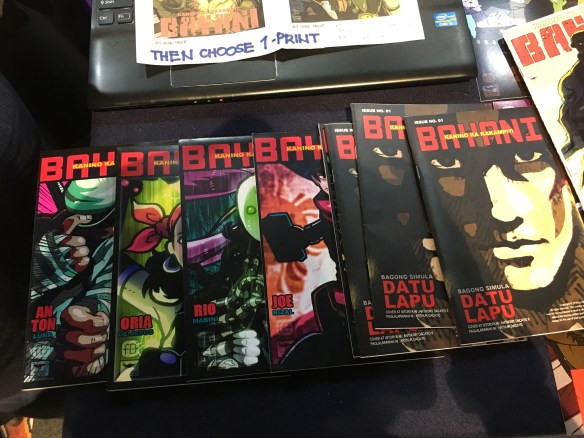
That was Tandang Sora as we knew her from our history books, but in her reincarnation in Anthony Dacayo II’s Bayani series, she employs a spinning dreamcatcher to thwart her foes. We found Anthony and his merry band of artists in AsiaPOP’s own version of the Artists’ Alley, which hosted exhibits from dozens of the most gifted comic book artists in the Philippines. Anthony himself works on stories (and some of the drawings) for his Bayani project, which has since been developed by Ranida Games into a phone-based game that employs Filipino heroes as characters with special skill sets (Joe Rizal uses a quill sword, for example, and Rio Mabini his Verdadero Decalogo). It was his way, said Anthony, of bringing our national heroes into the consciousness of a new generation.

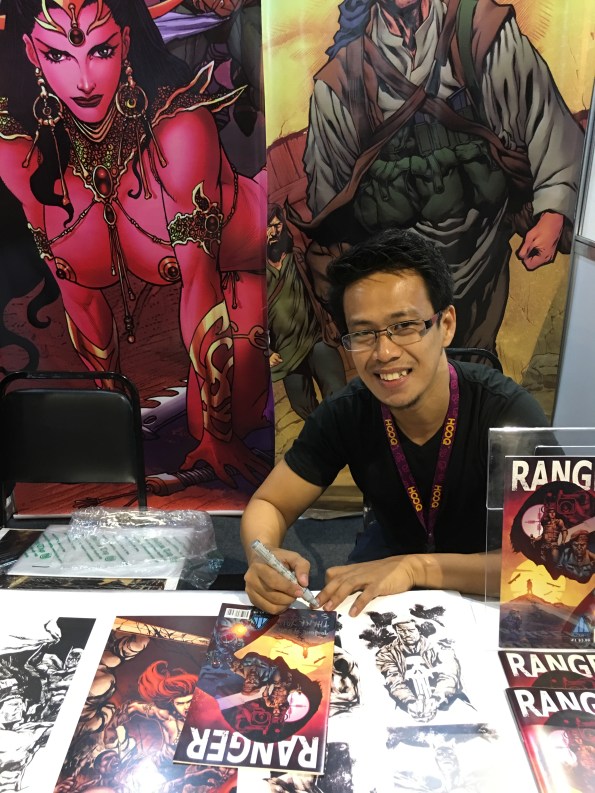
In another booth, we found Iloilo-born Jann Galino, who’s already done penciling work for Virginia-based Azure Multimedia’s “Ranger” comics. Jann exemplifies the Pinoy artist on the brink of the big breakthrough. He’s gone back to school to finish his Fine Arts degree while putting together a portfolio that he hopes will be good enough to show the scouts from Marvel and DC the next time they come around. On the other hand, Bukidnon native Harvey Tolibao has already done work for Marvel, DC, and Japanese game companies, among others, co-founding HMT Studios with some friends to expand and speed up the work.

IMG_9285.JPG

I was especially happy to run into a former student, Paolo Herras, who has published a series of Strange Native comic books for Quezon City-based Meganon Comics after stints in advertising and indie films, drawing on history and folklore to interrogate the present. Beside him was another young author and artist named Tepai Pascual, whose Maktan 1521 is a graphic retelling of the encounter between Magellan and Lapu-lapu.

IMG_9313.JPG

The biggest Pinoy names in the comic-book industry may now be too busy to appear at AsiaPOP—like Leinil Yu who trained with Whilce Portacio in the 1990s and is now one of the world’s most sought-after artists, and Budjette Tan, who now works for Lego in Denmark as a creative director in Lego’s ad agency. (A week after AsiaPOP, I ran into the California-based animator Jess Española, who won an Emmy in 2008 for his work on The Simpsons; he missed AsiaPOP but was in town to help motivate younger artists at his alma mater, the UP College of Fine Arts.)

But there’s no lack of younger Filipino graphic talent eager to follow on their heels, and events like AsiaPOP and the big Comicon in San Diego can provide the best launch pads for these Wacom-wielding wizards. (To know more about Filipino comics and their creators, check out http://www.philippinecomics.net.)


WITHIN DAYS of each other, two dear friends passed away last week—gallery owner Norma Crisologo Liongoren and retired professor and children’s book author Sylvia Mendez Ventura.

Norma was a memorable character whose eye-catching fashions lent more than a dash of color to her exhibition openings and parties in Cubao’s pioneering Liongoren Gallery. Most importantly, she was a generous spirit, lending artists both new and old her unflagging support and outright charity. Beng was especially close to Norma, and when I found her weeping and praying in our gazebo in the garden early one morning, I knew Norma had passed on in the night.

Sylvia was my Shakespeare teacher when I returned to school in the 1980s, and after one of her subjects, I was hooked on Shakespeare and the English Renaissance for life. Impeccably coiffed, this New York-educated diplomat’s daughter was a style icon who, like Robert Graves’ White Goddess, could lay bare your ignorance and cut you down with a single phrase. For some reason (and much to my classmates’ annoyance), I became her pet in class, and she would sometimes hand the lesson over to me to teach—which helped me decide to stay on and become a teacher myself. Sylvia was also a gifted painter, and I don’t think we ever told her, but for these past ten years, one of her flower paintings has hung over headboard. Good night, sweet princess, and flights of angels sing thee to thy rest!

Penman No. 213: Artisanal Delights at Salcedo

IMG_9208.JPG

Penman for August 22, 2016


LIKE MANY Manileños, my wife Beng and I had heard of the famous and fabulous Salcedo Weekend Market in Makati but had never gone there, being staunch northerners who refuse to brave the EDSA traffic, even on weekends, if we could avoid it. But curiosity and circumstance finally forced us to relent a few Saturdays ago, the circumstance being a friend’s offer of a room at a nearby hotel that she and her husband weren’t going to be using.

That sounded to us like “Staycation!” so we jumped at the chance. This same friend—she’s in the travel business and gets around—had done us a similar favor a few months earlier as a Valentines’ Day treat for a pair of arthritic lovebirds. Since the room was huge and free, Beng promptly called her sister Mimi and Mimi’s kids and granddaughter Sophie to share the day with us, the idea being to walk a couple of blocks to the Salcedo Market, pick out whatever we wanted for lunch, then lay it all out on the long table and dive in.

IMG_9209.JPG

And that’s exactly what happened. The Salcedo Market opens at 6 and closes at 2, so Beng and I decided to take a sneak peek right after breakfast, before the rest of the family arrived all the way from Tierra Pura. Sure enough, even at that hour and with a slight drizzle threatening, scores of vendors had already set up shop under canvas tents spread out on what, on weekdays, is a parking lot close to the Makati Sports Club.

As I often point out in this corner, I’m no foodie—I’m an instant-ramen and canned-sardines sort of fellow for whom a trip to a food market might be like that of a heathen to the Vatican—but I’m addicted to food shows on TV the way some people can’t get their fill of horror movies, and am always curious to see what’s out there. Beng, on the other hand, will try and eat anything short of the rotten shark that seems to be all the rage in Iceland, and she has to catch me in a good mood so I can graciously agree to step into a restaurant where they serve pizza (I hate cheese), so the Salcedo Market sortie was, for her, sheer, exultant liberation.

What immediately struck me, despite what I just said about my aversion for fine dining, was how many options there were for plain-food folks like me on offer—burgers, lechon, smoked fish, pancit, siopao, barbecue, and such familiar staples. What lifted them above the ordinary was the freshness and sometimes uniqueness of the ingredients—many were cooked on the spot—and the assurance that you weren’t going to make hourly runs to the bathroom later in the day. Knowing that I had a mound of work waiting for me in our hotel, I loaded up on lechon, corn on the cob, fresh jackfruit, and breadsticks to nibble on, while Beng chose the fresh Chinese lumpia. Mimi and her brood arrived, and I let the sisters drool over the fish curry, the lamb kebab, the laing with daing, the vodka tinapa, the malunggay pesto, and the other more exotic fare.

That was the Salcedo market scene for the most part—good food done well (and whether I liked it or not was irrelevant; seeing Beng’s eyes light up at the culinary pageant was well worth the trip), and home-cooked and artisanal food you just can’t order from a fastfood joint. I hate to think about what had to happen to produce my take-home kilo of tapang usa—Beng didn’t appreciate my Bambi jokes—but it was heaven on the tongue.

This was where a short walk back to the dinner table rounded out our Salcedo experience. There’s a cluster of tables in the center of the weekend market where you can gorge instantly on your selections, but given how many of us there were and how much food we’d amassed, we appreciated the luxury of a long table with complete cutlery in our lodgings just minutes away.

IMG_9222.JPG

That abode, not incidentally, was Fraser Place Manila—and to call it a “hotel” frankly wouldn’t do it justice. Sometimes you just want a room, any room, to crash into for the night. Some other times, you want more than just a hotel—a place not just to stay but to actually live in, for a few days to weeks to months, maybe even years. (I’d learn from the staff that a couple upstairs checked in ten years ago—and liked the place so much they never left!)

The Fraser—part of a Singapore-based global chain—calls itself a “serviced apartment,” and as soon as we stepped into our two-bedroom suite, we could see why: the 180-sqm enclave was really a virtual house, with a complete kitchen, laundry, three toilets and baths plus another john for guests, and quarters for a housekeeper or caregiver. All your needs were attended to by the staff, the wi-fi was free and strong, and aside from the Salcedo Weekend Market, a host of other restaurants and facilities could easily be accessed in the neighborhood.

But who needs restaurants when, like us, you could bring in loads of choice take-out meals and groceries? It made me smile to see a guest cross the lobby with a bag of veggies and what could have been fresh fish—as only a hotel with a full kitchen could allow. (I also heard dogs yapping faintly in the hallways—the Fraser is pet-friendly, but no cobras please.)

IMG_9221.JPG


There were a couple of downsides to consider, and it’s best to put them out front. Fraser Place Manila isn’t exactly located in what you’d call Makati’s trendiest corner. It stands across a row of office buildings, separated from them by a parking lot. It doesn’t have a penthouse bar or restaurant with a 360-degree view where you can party with your gang until the wee hours. (Cravings does operate a restaurant on the 33rd floor, beside the pool.)

But it’s these very “minuses” that guarantee peace and quiet, which Beng and I appreciated later that evening after our visitors had left and as I typed away on a book project and Beng worked on a painting for a forthcoming exhibit. It also means (of course I had to ask) that we could’ve gotten our princely suite for less than what we recently paid for a small room at an airport hotel near LAX.

Some days, Makati might as well be as far as LAX for us Dilimanians, but we’ll be sure to be back for more of Salcedo. Watch out, Bambi!


IMG_9203.JPG

Penman No. 212: A Lovely Place to Be

IMG_8775.JPG

Penman for Monday, August 15, 2016


IT WAS a few Sundays ago when I joined a group of artists and friends for lunch at a place that has to be on the must-see list of any Filipino art lover, especially those within driving range of Antipolo. We had been invited for lunch by Dr. Joven Cuanang, whose Pinto Art Museum we had visited once before, but this time it was the founder himself who was going to walk us around the place, so we all looked forward eagerly to meeting him and having a chat.

For those who’ve never heard of it or never been there, the best way to describe the Pinto (people, including myself, have been heard pronouncing it as PIN-to, but it’s really Pin-TO as in “door”) is to call it an art complex—mostly gallery, but also museum, restaurant, theater, library, and, apparently, research center. It’s also, quite simply, just a lovely place to be, with its buildings and galleries set on seemingly terraced hillsides leading naturally from one to the other, offering spectacular panoramas of the metropolitan skyline from every high point. Not surprisingly, it can get very busy on weekends, with as many as a thousand visitors streaming in through the gate (admission fees range from about P100 to P200).

IMG_8097.JPG

The Mediterranean-styled complex has that pleasing, thoughtfully curated ambience, the visual and sensory assurance of a well-managed experience. But of course, it wasn’t always so. The place began as a rough and weedy wilderness, which a young but visionary Dr. Cuanang bought up, patch by patch, more than four decades ago. “I started in 1972 with 1,000 square meters,” he reminisced. “Real estate prices fell after martial law and I was gradually able to acquire more land in the area.”

After EDSA, Joven fell in with a committee of prominent Antipolo residents and community leaders eager to spearhead the town’s cultural renaissance, but the good doctor soon decided to go it alone after an unpleasant brush with government corruption. He must have seen art and nature as the best cleansing agents, and he began supporting a posse of local artists, buying their work when they needed cash. Those artists later became the Salingpusa group, which considers Pinto its physical and spiritual home. “We didn’t have much then so the artists first exhibited their work by hanging them on a clothesline, and that practice became known as Sampayan,” said Cuanang.

Today that clothesline spans six buildings spread over 1.2 hectares, operated by the Silangan Foundation for Arts, Culture, and Ecology. Designed by Tony Leaño, the buildings blend effortlessly into the landscape, which is no accident because they were built around natural objects like the huge rocks that dotted the hillside. “We observed three principles in designing the place,” Cuanang noted. “First, don’t cut any trees. Second, follow the landscape. And third, minimal maintenance.”

As much as possible, Pinto’s buildings also employ natural ventilation, a notable exception being the air-conditioned library (where I was secretly pleased to find a couple of my books on the shelves). You’re never too far away from being reminded, however, that human whimsy is at work on Nature here, with oversized sculptures of mythological figures such as Icarus, Sisyphus, and Ariadne scattered about the greenery or soaring on rooftops.

While some come specifically for the scenic grounds, which are often rented for wedding shoots, most visitors flock to Pinto, understandably, for the art, which represents many of the most vibrant and brilliant works of our younger if lesser known artists. “You won’t see a single National Artist here,” Dr. Cuanang said, smiling and gesturing at the paintings and sculptures around him. “I keep my Bencabs at home!”

It’s refreshing and encouraging, in a way, not to see the usual parade of Amorsolos, Manansalas, Ocampos, and Botongs on display, and instead to find works by the likes of Elmer Borlongan, Jason Moss, Plet Bolipata, Tony Leaño, and Rodel Tapaya—at no diminution of quality, as these names could well be those of the National Artists of tomorrow. Salingpusa’s breathtaking 40 x 12-foot mural “Karnabal” is arguably the centerpiece of collection.

IMG_8049.JPG

Despite the plenitude of art offerings at Pinto and his obvious passion for art, Dr. Cuanang won’t think of himself a collector, the kind who spots and buys fine new work on the cheap for future profit. “I’m not here for the business,” he emphasized. “Too much art and discussion about art today is centered on the market.”

What truly interests the Harvard-trained neurologist, who still practices medicine after serving for many years as medical director of St. Luke’s, is wholeness of mind, body, and spirit, which he hopes to promote through the Pinto Academy of Arts and Sciences, a complex of facilities in a corner of the compound that comprises a large indoor theater, an amphitheater, a library, a function room, open decks, and gardens.

In a manifesto of sorts, Cuanang explained that “In medicine, healing is currently dominated by pharmaceuticals and technology, oftentimes to the detriment of the wholeness of a human being: mind, body, and soul. This perception is pervasive in our society. Fortunately, new knowledge in neuroscience research is affirming that the Arts and Sciences are in fact interconnected and mutually useful in preserving our wholeness, and together are powerful in the relief of our maladies.” The Academy, he added, “was built to promote conversation across disciplines to create, innovate and to pursue activities that celebrate this thought.”

The bridge between medicine and art, he pointed out, is neuroaesthetics, a branch of study that fascinates Dr. Cuanang. One of its chief proponents, Dr. Anjan Chatterjee of the University of Pennsylvania, poses its main concerns thus: “What in the brain triggers aesthetic experiences? And how does knowledge of basic brain mechanisms inform our understanding of these experiences? These questions are at the heart of an emerging discipline dedicated to exploring the neural processes underlying our appreciation and production of beautiful objects and artwork, experiences that include perception, interpretation, emotion, and action…. Neuroaesthetics is both descriptive and experimental, with qualitative observations and quantitative tests of hypotheses, aimed at advancing our understanding of how humans process beauty and art.”

It’s a lot to think about, for sure—but there’s no better place to ponder the glorious if sometimes dark mysteries of the human imagination than Joven Cuanang’s hilltop sanctuary.

Pinto Art Museum can be found on Sierra Madre Street in Grandheights Subdivision, Antipolo, and is open Tuesdays-Sundays, 9 am-6 pm.

IMG_8774.JPG