Qwertyman No. 95: Till Divorce Do Us Part

Qwertyman for Monday, May 27, 2024

IS THERE anything about divorce—a bill legalizing which will soon be taken up in the Senate—that hasn’t already been said, or that most people don’t know? This was on my mind last week as I walked to school, wondering what my class of 20-year-old seniors thought about the issue. As young people likely to get married within the next five to ten years, they’re the ones who stand to be most affected by the outcome of the current drive to get the bill passed.

So I brought it up—we’re taking up argumentative or opinion writing, and how to handle contentious topics, and divorce was right up that alley. I didn’t tell them which side I stood on, although, knowing me to be a flaming liberal, they could have guessed that. I let them speak. Given that this was the University of the Philippines, and even factoring in the possibility that students tend to dovetail along with what they think their teachers believe, it was no big surprise that everyone who spoke up in that room did so in favor of legalizing divorce; if there was anyone in opposition, which I rather doubt, he or she chose to remain silent. 

Clearly, a majority favored the move, for the very reasons cited by the bill’s supporters. One student had a very personal take on the matter: “As the child of parents whose marriage was annulled,” she said, “I can remember all the things they had to do to get that annulment. The poor can’t afford it.” And economics aside, what did divorce offer that annulment didn’t? “The freedom to remarry!” everyone chimed in. (Correction: annulment allows for remarriage, but legal separation doesn’t.)

But—I said, just to probe a bit further—what about the argument that divorce will contribute to the break-up of marriages? “Those marriages are already broken,” said a student. 

But the Vatican opposes divorce, doesn’t it? (It’s the only other country in the world, aside from the Philippines, which doesn’t recognize divorce.) “Priests don’t get married. What do they know about marriage?”

At this point, I found it useful to introduce a fact that was news to everyone in the room. “Did you know that we used to have divorce in the Philippines?” No! Really? “Yes, a divorce law was enacted under the Americans in 1917. It was even expanded under the Japanese Occupation, and continued after the war until the Civil Code of 1950 abolished absolute divorce and replaced it with legal separation. Go on, look it up. I don’t know how many Filipinos actually availed themselves of divorce when it was legal—it would be interesting to see the statistics—but it’s not like we never had the option. It was there, but Church-supported politicians took it back.” Did the Filipino family collapse back then because of the availability of divorce? Show me the proof.

If this exchange sends chills up the spine of ultraconservatives who still think of UP as a haven of rebels, atheists, and devil worshippers, I’m happy to tell them that religion is alive and well in UP—the services in both Catholic and Protestant chapels are usually full. But so are reason and critical thinking, which to me remain the best antidotes to doctrinaire dogmatism, whether from the left or from the right. 

The Catholic Church’s steadfast resistance to legalizing divorce and my students’ apparent willingness to push back against that bulwark reminded me of a critical period back in the 1950s when UP was torn by a struggle between religious forces allied with the popular Jesuit Fr. John Delaney such as the UP Student Catholic Action and those who, like Philosophy Prof. Ricardo Pascual, believed in maintaining UP’s non-sectarian character. In the end, secularism prevailed, but at the price of Pascual and other liberal-minded professors being denounced as “communists” before the House Committee on Anti-Filipino Activities.

I’d like to think that a lot has changed since then, although sometimes things seem pretty much the same, given how the Red-tagging continues despite the sharply diminished power and influence of the CPP-NPA. One thing that has changed, at least in the public’s perception, is the presumption of moral superiority once claimed by a Church now embroiled in sexual and financial scandal. Its invocations of “divine law” or “natural law” in matters relating to homosexuality, contraception, and divorce sound almost medieval in a world that has largely moved in the opposite direction—something the conservative faithful will see as all the more reason to hold on inflexibly to their core convictions.

We can’t argue with those convictions, to which everyone has a right, but conversely, our people as secular citizens shouldn’t be subject to any religion’s doctrines when it comes to personal decisions that are no prelate’s or imam’s business. (And just for the record, I have no plans of divorcing my adorable wife, with whom I just celebrated 50 years of a typically mercurial but happily enduring marriage.)

I’ve written previously about my disaffection with organized religion, so that may provide some context; I do believe in God and in the value of faith and prayer in our lives, and in the right of others to practice their religion—for as long as they don’t insist that theirs is the only right way forward, and impose their way of life on me. If you want to stay married in mutual and lifelong misery because you believe it’s the right thing to do, fine; but don’t expect others to do the same, because their lives aren’t yours to mess up. Happiness is hard enough to find in this dystopic world we live in; let’s not make it harder for others looking for another chance at love and peace. 

I doubt that they’ll change the wedding vows—“For better or for worse, till death do us part” is always worth two people’s best shot, until worse comes to worst. But divorce should be an option better left to the individual’s God-given intelligence, conscience, and emotional honesty to sort out than to institutions more concerned with abstractions than reality. It’s ultimately a reminder of how human we are—people make mistakes, which can’t be corrected by prolonging them; we learn, we do better, and we live on. I think that’s what a just and kind Almighty would wish for his creations.

(Image from montanoflamiano.com)

Qwertyman No. 94: Artificial Intelligence

Qwertyman for Monday, May 20, 2024

DR. CHICHOY Carabuena had a problem. He wanted the school he owned and ran—the Generoso Carabuena Academy of Pedagogy in Santa Vicenta—to place higher in both national and international rankings, partly so he could raise tuition fees, and also so he could claim bragging rights among his university-president friends and drinking buddies. He had inherited the school from his grandfather; Generoso Carabuena was a banker who had collaborated with the Japanese and stolen the money they left behind to open a school for teachers, which was his wife’s dream, becoming a war hero in the process for outsmarting the enemy. 

The school had done well enough to the point that Chichoy’s dad Ramoncito could buy a Mercury Capri that he regularly drove to Manila to carouse in its nightclubs. Chichoy was the product of one of Ramoncito’s dalliances with the agreeable ladies, and it fell on him to rescue both the business and the family name from ruin and disrepute. He had been managing a carinderia for Pinoy workers in Dubai when the call came, and always wanting to become someone of substance, he returned to Sta. Vicenta to turn the daughters and sons of hog butchers and vegetable growers into teachers, like he imagined himself to be. Surely higher education wasn’t all that different from running a restaurant and coming up with the right menu at the right price for your customers. He had secretly dreamed of becoming a mayor, a congressman, or even governor, but first, he had to make a name for himself and make money.

Somewhere along the way he picked up a “Dr.” from a diploma mill and dressed the part, coming to his office even in the warmest of days in coat and tie. “More than anything else,” he would lecture his new recruits, “first impressions count, so before you even become a teacher, you have to look like a teacher, walk like a teacher, and sound like a teacher!” He had a faux marble statue made of his grandfather to greet visitors at the school entrance, and another one of Jose Rizal standing behind Generoso, as if looking on in approval. 

But lest people think he was beholden to the past, Chichoy Carabuena peppered his speeches with 21st-century mantras like “disruption,” “innovation,” “sustainability,” “customer-centric,” and, yes, “21st-century.” “The great challenge to higher education today,” he would often declaim, “is to produce graduates attuned to a global climate of disruption and innovation, mindful of evolving needs and opportunities in the marketplace of ideas while seeking sustainable and synergistic 21st-century solutions to problems rooted in our feudal and neocolonial history.”

Those speeches were written for him by his former executive assistant named Mildred, a UP graduate whom he had to fire when his wife discovered them smooching in his office—an act he vehemently insisted to be no more than a paternal gesture, much like  former President’s public bequeathal of a kiss on a married woman, a defense that gained no ground. His wife personally chose his next EA, a former SAF commando named Dogbert; making the best of the situation, Chichoy paraded Dogbert around as his bodyguard, spreading the rumor that his life was under threat from unspecified enemies determined to keep the quality of Philippine education down. “We can give them no quarter,” he declared at the last CHED event he attended. “We must resist, with all impunity, those who aim to keep our poor people shackled to the twin pillars of ignorance and idiocy!” He missed Mildred in those moments, but he felt quite pleased with his growing self-sufficiency in speechwriting, thanks to his new discovery, ChatGPT. Of course it never quite came up to his standards, so he tweaked the prose here and there, like that reference to Samson that he hoped would bring the house down.

But now, reading the reports of top Philippine universities slipping in their rankings in the usual Times Higher Education and Quacquarelli-Symonds surveys, Dr. Carabuena saw an opportunity for his modest HEI to rise. “As their mystique diminishes, so our aura will grow,” he informed an indifferent Dogbert. “We just need to come up with sustainable innovations that will disrupt the status quo.” Dogbert handed him a slim folder. “Sir, someone wants to see you, to apply for the position of Academic Vice President.” It was a position that Chichoy himself had held concurrently to save on salaries, but now he felt obliged to pass it on to a real expert. He flipped the folder open and saw the picture of a cute Chinese-looking woman going by the name of “Dr. Alice Kuan.” Chichoy was mesmerized. “Send her in—and get out!”

When Dr. Alice Kuan stepped into Chichoy’s office, he felt himself enveloped in a miasma of jasmine, peonies, and five spices—everything good he remembered from his only visit to China many years ago. Her lips were lotus-pink, her skin ivory-white, and here and there dumplings suggested themselves to his imagination. “Good morning, Dr. Kuan! Please, have a seat! You’re here to apply for the AVP job?”

“Yes, Mr. President,” she said with a quarter-moon smile, “and I come with many ideas for both improving your curriculum and raising revenues through academic innovations.”

“Innovations! I like that! Like what?”

“Why artificial intelligence, of course! We could use AI to teach many of our courses, reducing costs. Also, we could bring in more foreign students from—uhm—friendly neighboring countries, while creating part-time employment opportunities for them in—uhm—online entertainment, for which we could even lease out some of your campus property. It would create a huge economic boost for Sta. Vicenta!” 

Temple bells rang in Chichoy’s mind. Not only was she fetching; she was smart! Suddenly he could see his political future brightening. He wanted to know more about this adorable avatar, and only then did he notice how patchy her resume was. 

“Your birth certificate was filed when you were…. 17?”

“Was it? I don’t remember.”

“Which elementary school did you go to?”

“I don’t remember. Maybe homeschooling?” She threw him an exasperated sigh. “Look, Dr. Carabuena, does it matter? I can have AI do a perfect resume if that’s what you want. If not, I can take my ideas to the Fontebello Institute of Technology in San Bonito just an hour away, and maybe they’ll be more receptive to disruptive innovations—”

“No, no, no! Disruptive, I like disruptive! Please, Dr. Kuan, stay in your seat! I’ll have somebody prepare your contract. Dogbert!”

(Image generated by AI.)

Qwertyman No. 92: The Return of the Old Normal

Qwertyman for Monday, May 6, 2024

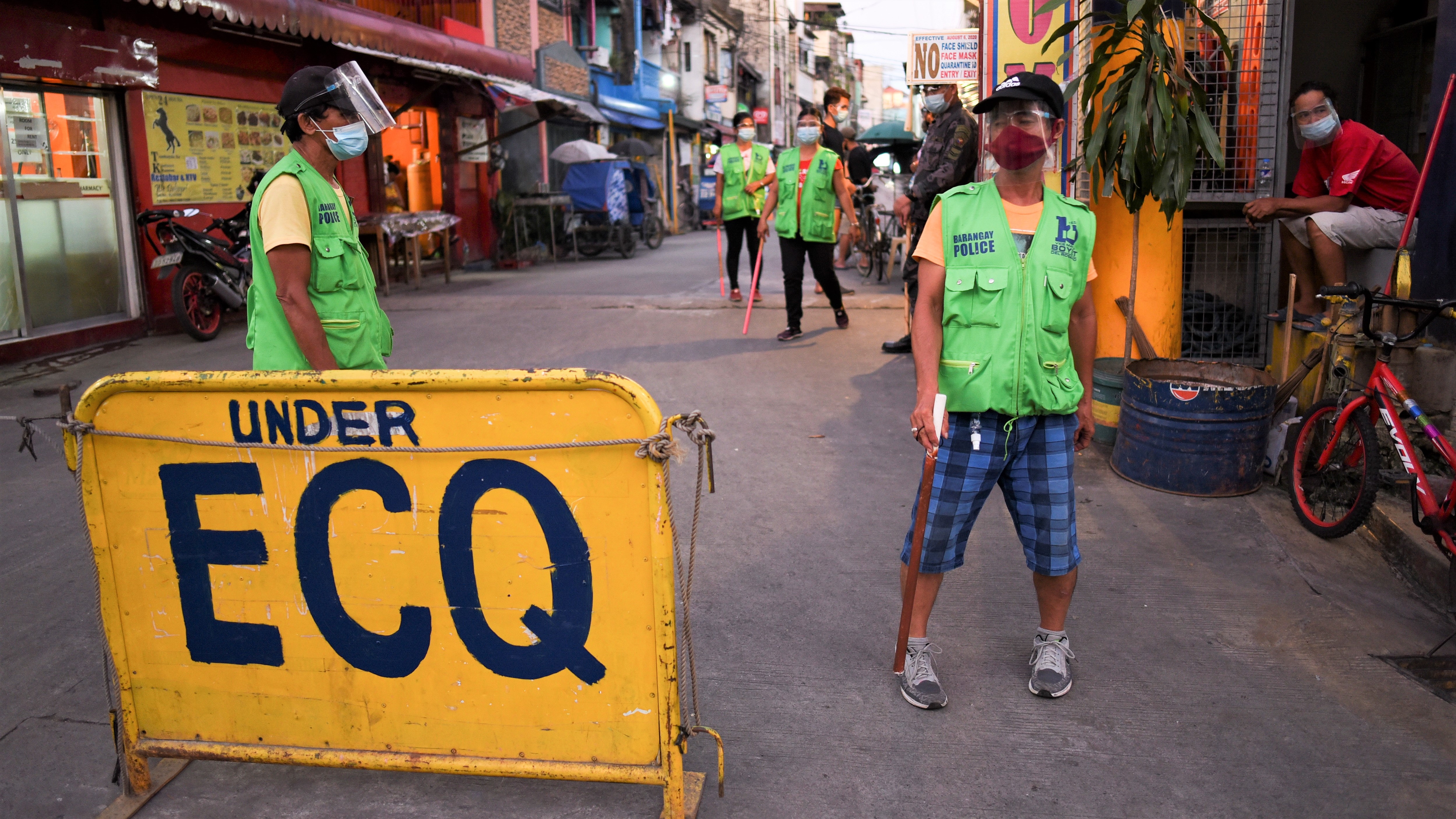
FEW WILL remember it, but yesterday, May 5, marked the first anniversary of the official end of the Covid-19 pandemic as a global health emergency, as announced by the World Health Organization. Of course it didn’t mean that Covid was over and gone—it would continue to mutate into thankfully less lethal variants—but the worst was over. It had infected more than 765 million people around the world, and killed almost 7 million of them; in the Philippines, as of last month’s latest figures, over 4 million of us caught Covid, and we lost more than 66,000 friends, family members, and neighbors to the disease.

It’s amazing what a difference a year makes. The pandemic rules had been relaxed long before May 5 last year, and much of 2023 and 0f the present year had been spent by us trying to get back to life as we knew it pre-Covid at a frenetic pace—engaging in that new term, “revenge travel,” buying new cars, building new homes, and as of last week, complaining about the infernal heat wave like it was the worst thing to have plagued us in decades (maybe it was—since Covid). For the most part, we seem to have willed Covid out of our minds, eager to replace its bitter memories with fresh and happy ones—an entirely human thing to do, to cocoon ourselves against the pain of loss. Are we in the “new normal,” or have we returned to the old?

I remember most vividly the paranoia that gripped the country during the pandemic’s early days—the first reports of people we knew dying horrible deaths in isolation, the terror following a sudden and suspicious onset of coughing and fever, the constant fear of carrying the virus home to the innocent and the infirm in one’s shoes, one’s clothes, one’s merest touch, the rapid disappearance of disinfectants and bread from the shelves, the inevitable closure of cinemas and restaurants, the anxious eyes peering above face masks and through face shields, the physical boundaries beyond which only a select few could cross—and, of course, the near-endless wailing of sirens announcing the imminence of death and dying. Unfamiliar words and phrases entered our vocabulary: co-morbidities, social distancing, quarantine, lockdown, ECQ, EECQ, RT-PCR, community pantry, antigen, remdesivir, hydroxychloroquine, Ivermectin, Sinovac (and anti-vaxx), etc.

Like many others, I lost friends to Covid, from very early on when no one knew what was really going on and what could be done to save patients who were turning up feverish and could hardly breathe. One of them was my own cardiologist, who reportedly assisted a patient whom he didn’t know carried the virus. Others were academics and senior officials returning from conferences overseas. Fortunately, no one in our families died of the disease, although many of us, myself included, later caught it at some point despite all precautions. When I did catch it, I have to admit that it was with a strange sense of relief, not only because I could now count myself a participant in a grand if horrible experience, and also because I imagined, perhaps foolishly, that I would be rewarded with some kind of immunity from further and worse infection.

Those of us who survived Covid hopefully did so with a more profound appreciation of the gift and value of life, and of the need to do good in the time we have left. But the 2022 elections only seemed to prove the power of political patronage, which became even more keenly felt during the pandemic, when local officials down to the barangays held sway over their constituents like never before. Covid sharpened the already stark contrast between rich and poor, from access to what were seen as the most effective vaccines to self-declared exemptions from certain restrictions like liquor-lubricated parties and literal hobnobbing. In the end, the virus didn’t discriminate, scything rich and poor alike, although the poor, living in cramped communities, were always more likely to fall ill and die.

What the public often failed to witness—and therefore can’t remember—were the stories of the frontliners who met Covid head-on and served as heroes behind the scenes. I’m now working with Dr. Olympia Malanyaon—a pediatric cardiologist who also served as Director of the Information, Publication, and Public Affairs Office of UP Manila—on a book she’s writing to document the efforts of UPM and of the Philippine General Hospital (which is part of UPM) to respond to the Covid crisis. The PGH, the country’s largest public hospital, was designated a Covid-referral hospital almost as soon as the pandemic broke, and its people found themselves in the vortex of an unprecedented medical and social crisis, and we want to tell their stories in this forthcoming book.

The word “hero” gets bandied around a bit too easily these days, but if there was a time for heroes to emerge, it was during the pandemic, when what used to be the most routine decisions (“Should I report for work today?”) could mean a matter of life and death. When the death toll mounted, many PGH staff resigned for fear of infecting their families, but many more stayed on, with nurses pulling 16-hour shifts and some doctors remaining on duty for as long as 30 hours.

Even utility workers recalled how pitiful the plight of the afflicted was. One said that “They had no one with them, not even when they died. They would be put into body bags, which could not be opened. Then they would be cremated the next day, without being seen by their families.” And then, the staff felt shunned by society when they went home as ordinary neighbors. “When we ordered at the fastfood, the guard shooed us away when he learned that we worked in the Covid unit,” recalled another. “I was very upset. It felt very degrading to work so hard, to line up for food when you got hungry, only to be turned away.”

Thankfully, the crisis also brought out the best in some other Filipinos, such as those who poured their time and money into community pantries that served the hardest hit. For a while back there, we saw and felt the glimmer of our inner heroes. It was a spirit that I hoped would be sustained into a broader and more enduring wave of change in 2022, but as the pandemic receded, we realized how much of the old normal yet remained.

Covid made us aware of the precariousness of our health as individuals. Looking forward to 2025, I wonder what it will take for our people to value their well-being as a society and as a nation.

(Image from Reuters/Lisa Marie David)

Penman No. 461: A Parisian Interlude

Penman for Sunday, April 7, 2024

WHY IS it that just when you think you’ve begun to figure out a foreign city’s transport system, it’s time to come home? That happened again barely two weeks ago when my wife Beng and I flew to France for some speaking engagements in Paris and Le Havre. We were there for work, not tourism, and more work waited for us as well back home, so we couldn’t stay for as long as we would have wanted to. We’d been to Paris three times before and had done the obligatory Louvre and Eiffel Tower visits, but it almost seems criminal not to linger and loiter around such a beautiful city.

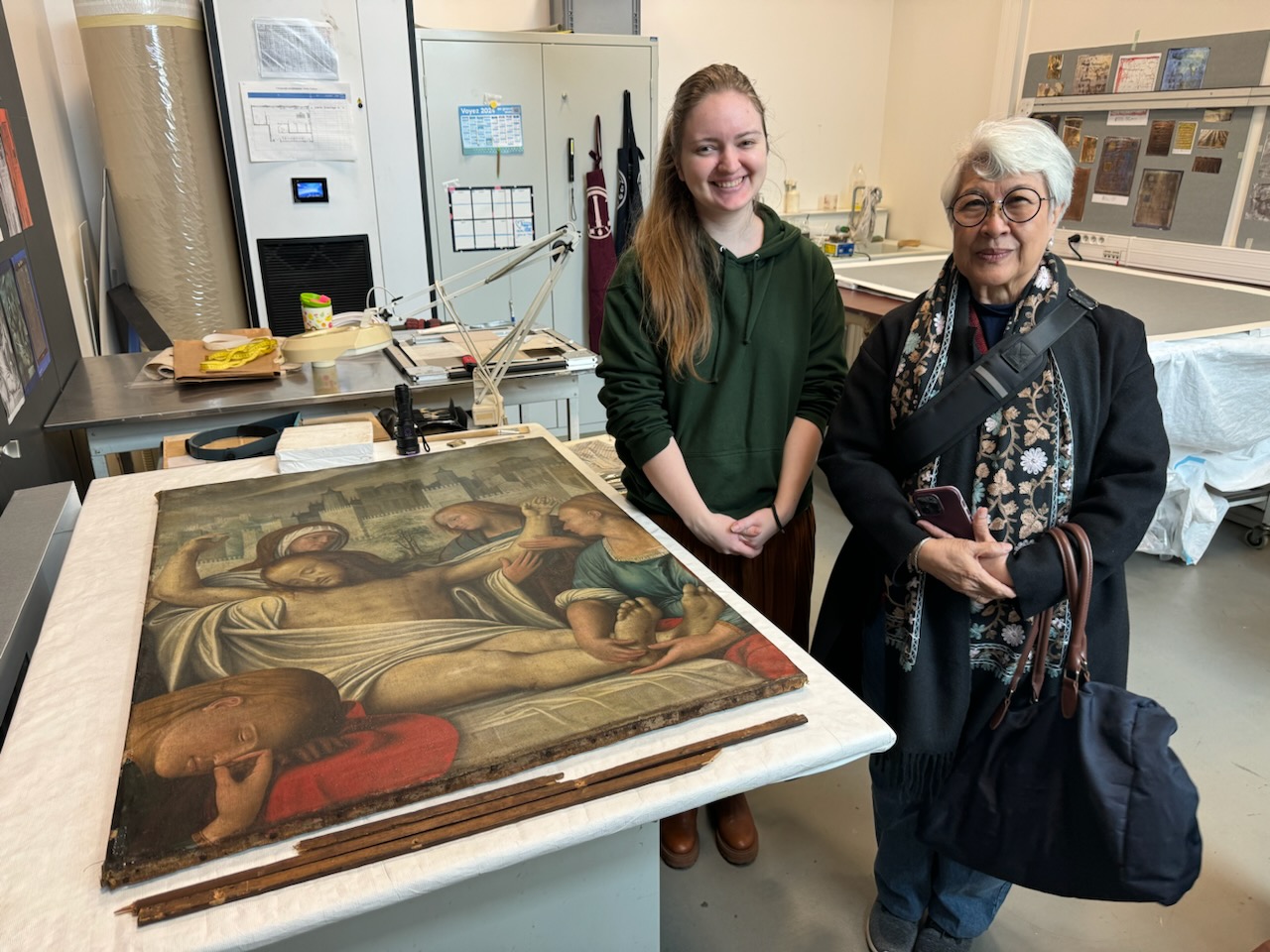
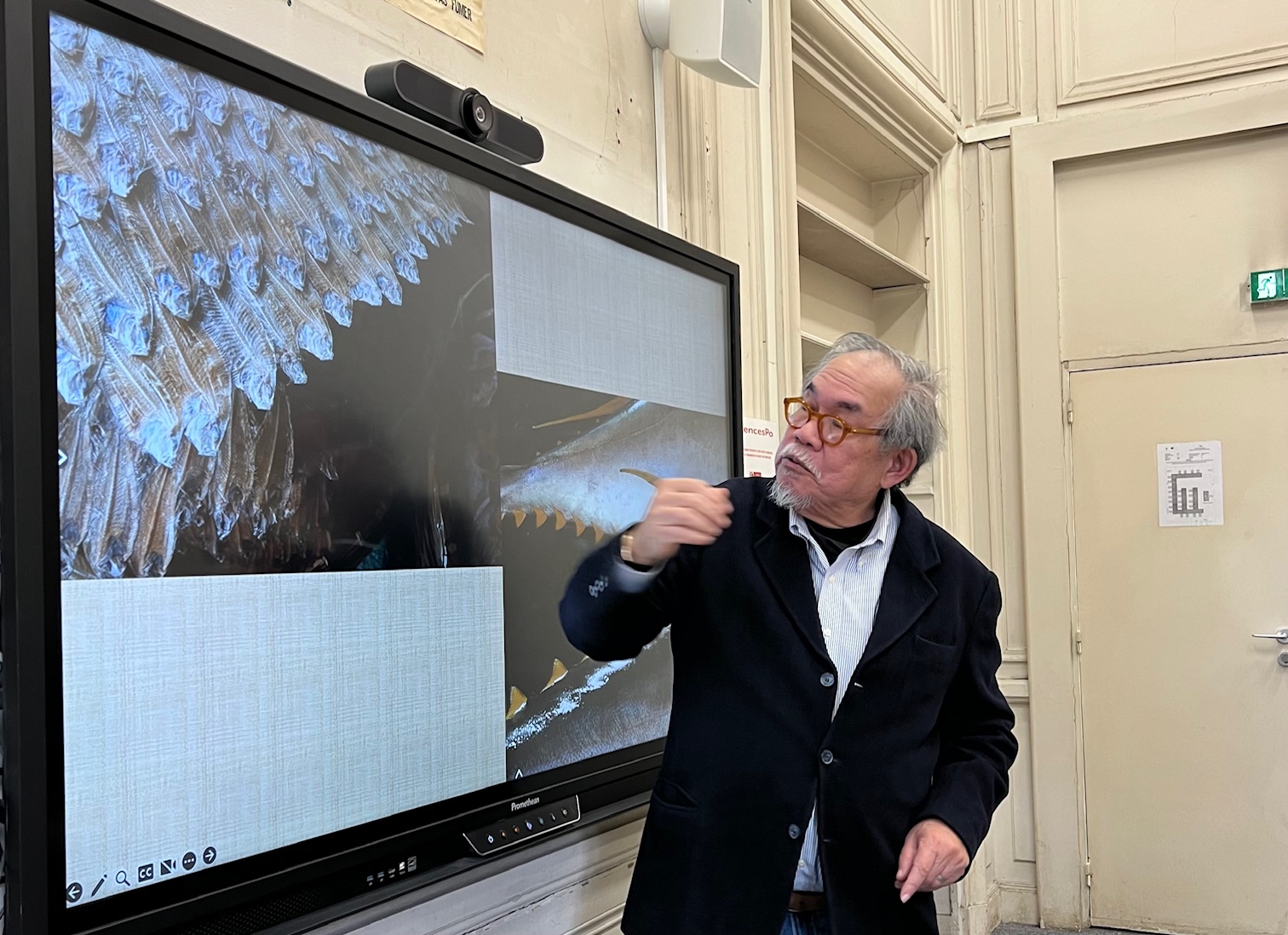
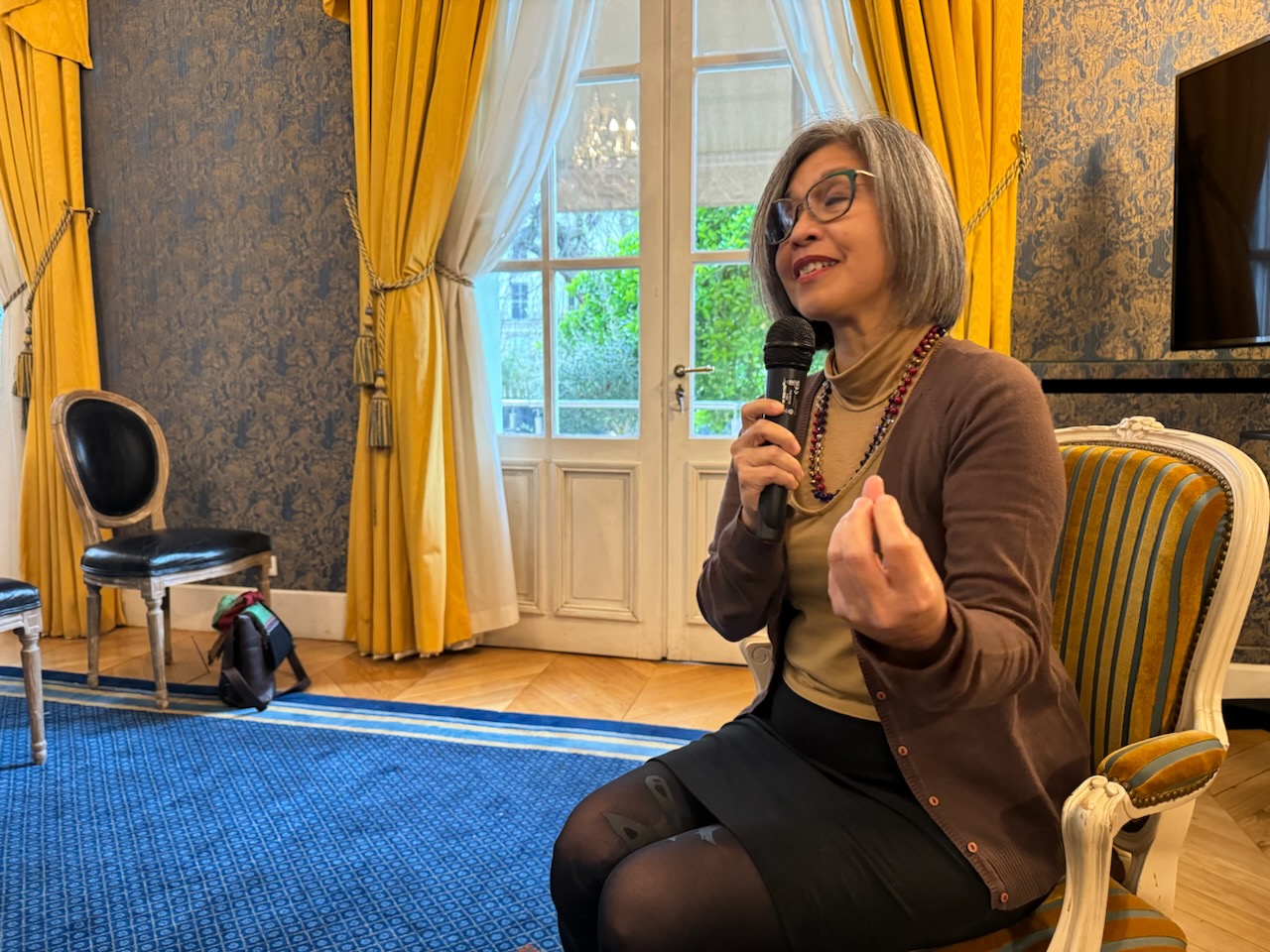
We were there at the invitation of SciencesPo, France’s leading social sciences university, for a series of talks on Philippine literature and art. Along with France-based writer Criselda Yabes, I gave a reading as well at the Philippine embassy in Paris at the behest of our most gracious ambassador, Mme. Junever “Jones” Mahilum-West, an avid amateur painter and supporter of Philippine culture. Our host at SciencesPo, Dr. Pauline Couteau, also arranged some events for us at their campus in Le Havre and sponsored a special screening of Lino Brocka’s classic “Maynila sa mga Kuko ng Liwanag” at the Entrepot Theater in Paris.

It was a hectic week that left these footloose septuagenarians exhausted but exhilarated at the same time, warmed up in France’s unseasonably chilly weather (often falling below 10C) by the enthusiasm of our new friends, both French and fellow Filipinos. 

Again, however, we had a sweet problem to deal with even before we flew to Paris: with such little time left on our schedule for more casual diversions, what places or experiences would we put on top of our list for our relaxation and amusement, given Paris’ almost inexhaustible offerings of wonder and delight?

Anthony Bourdain, bless his soul, famously advised short-term visitors to Paris not to make a mad dash to try and see everything all at once, but to just relax, have coffee, imbibe the neighborhood culture, stay in bed (and for those able and inclined, make love). Beng and I recalled, with both fondness and regret, how we had first seen Paris a quarter-century earlier from the back of a bus on a 99-pound budget tour from our base then in Norwich, England. The bus went by the city’s landmarks so fast that Beng missed Rodin because she was in the on-board restroom then. Subsequent visits afforded us a bit more time to see the Mona Lisa (of course) and to go up the Eiffel Tower (of course) but our happiest memories came, as Bourdain suggested, from just walking in the city gardens and along the Seine.

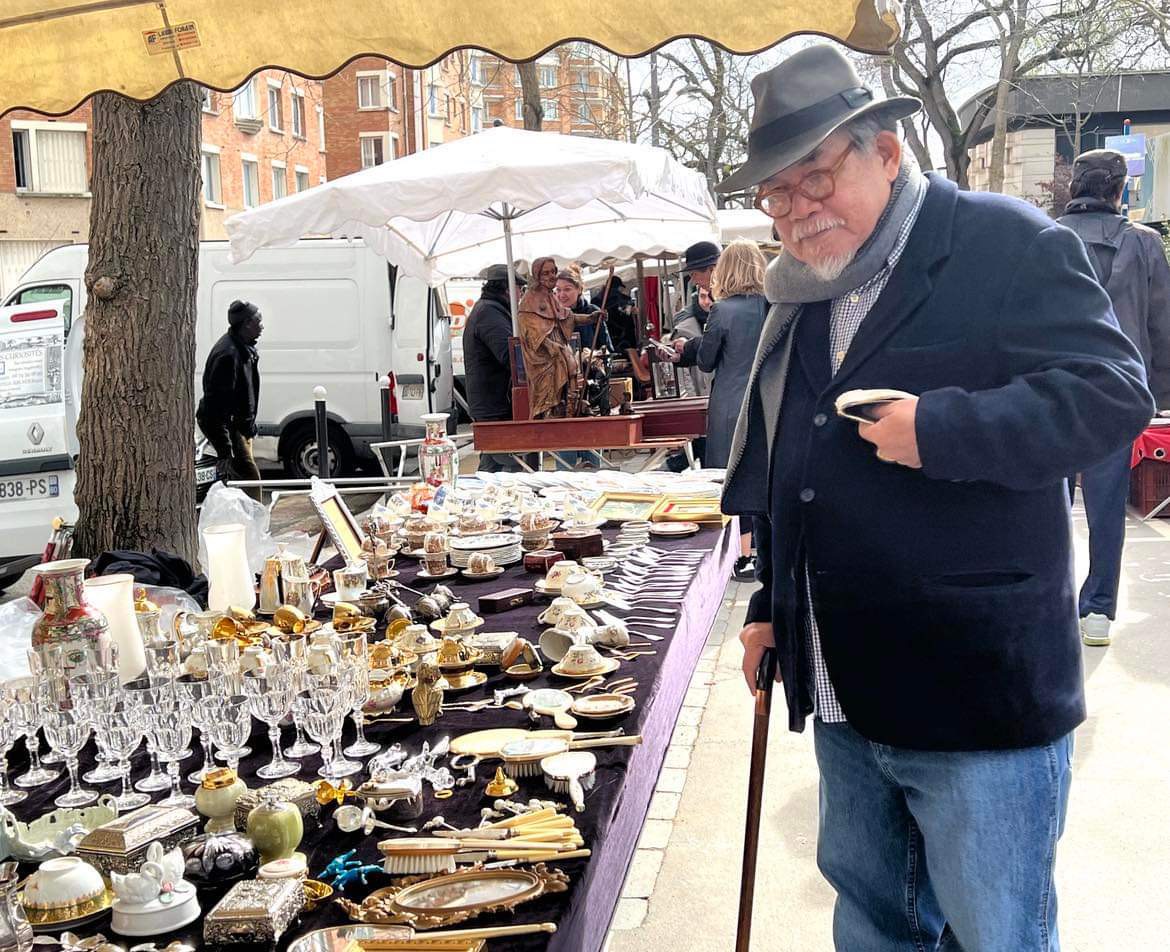
This time, we decided to do just two things with our limited free time: visit one museum, and hit the flea markets. This follows a pattern that Beng and I have observed over decades of traveling together, from Amsterdam, Barcelona, and London to New York, Tokyo, and Shanghai. The museums capture and preserve the glory of the past, and if you’re lucky, rather than pay for made-in-China miniatures at the museum gift shop, you can find some genuine article from that past in the flea market. 

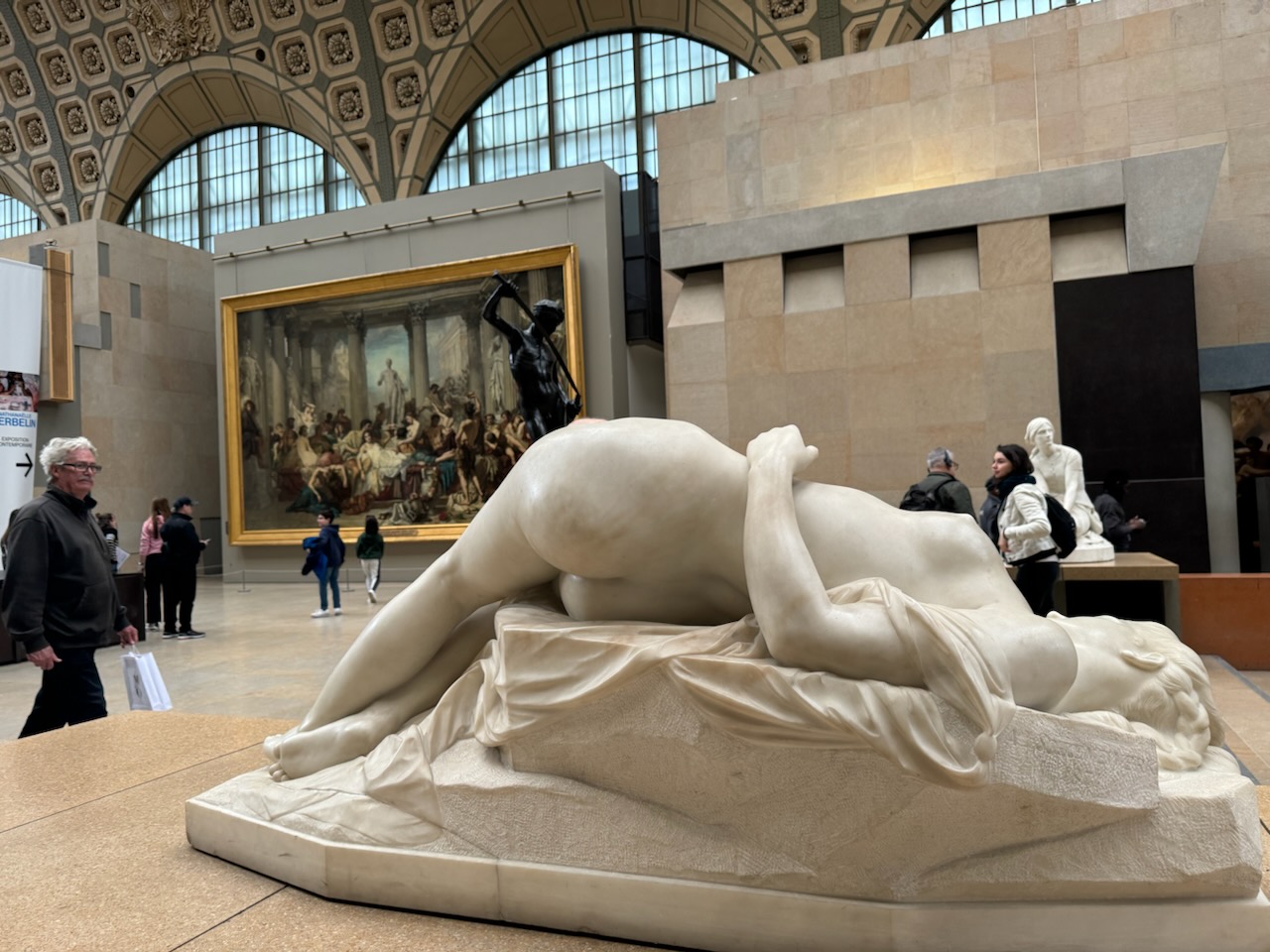
Our choice of museum was easy: Paris has dozens of fantastic museums—and you’ll never, ever finish the entire Louvre in one visit—but the great one we’d never been to was the Musée d’Orsay, the former train station that’s become France’s cathedral of Impressionism. Finally, this time, in the few hours we had just before boarding the train to Le Havre, we managed to step into the Musée d’Orsay, and what a divine experience e that was, to find room after room filled by the masterworks of Renoir, Monet, Manet, Seurat, Degas, Redon, Courbet, and so on, like walking into a book of pictures. 

Understandably, hundreds of other people had the same idea, so the best time to visit may have been after 6 pm—the museum closes at 9:45—when admission rates are also cheaper. Not a few friends have remarked that they found the Musée d’Orsay much better than the Louvre, perhaps because of its relative compactness and its delivery of proven crowd-pleasers in its collection.

Our flea-market sorties proved just as wondrous, with the additional thrill of unpredictability, as each table will be different from the one before it and you need a quick, trained eye to spot the jewel in the junkyard. As flea-market addicts from decades back when we used to scour the yard sales and antique barns of the American Midwest for things we could drag home, Beng and I have developed a routine of scan-and-scrutinize, looking for our respective grails (old fountain pens for me, old bottles and costume jewelry for her).

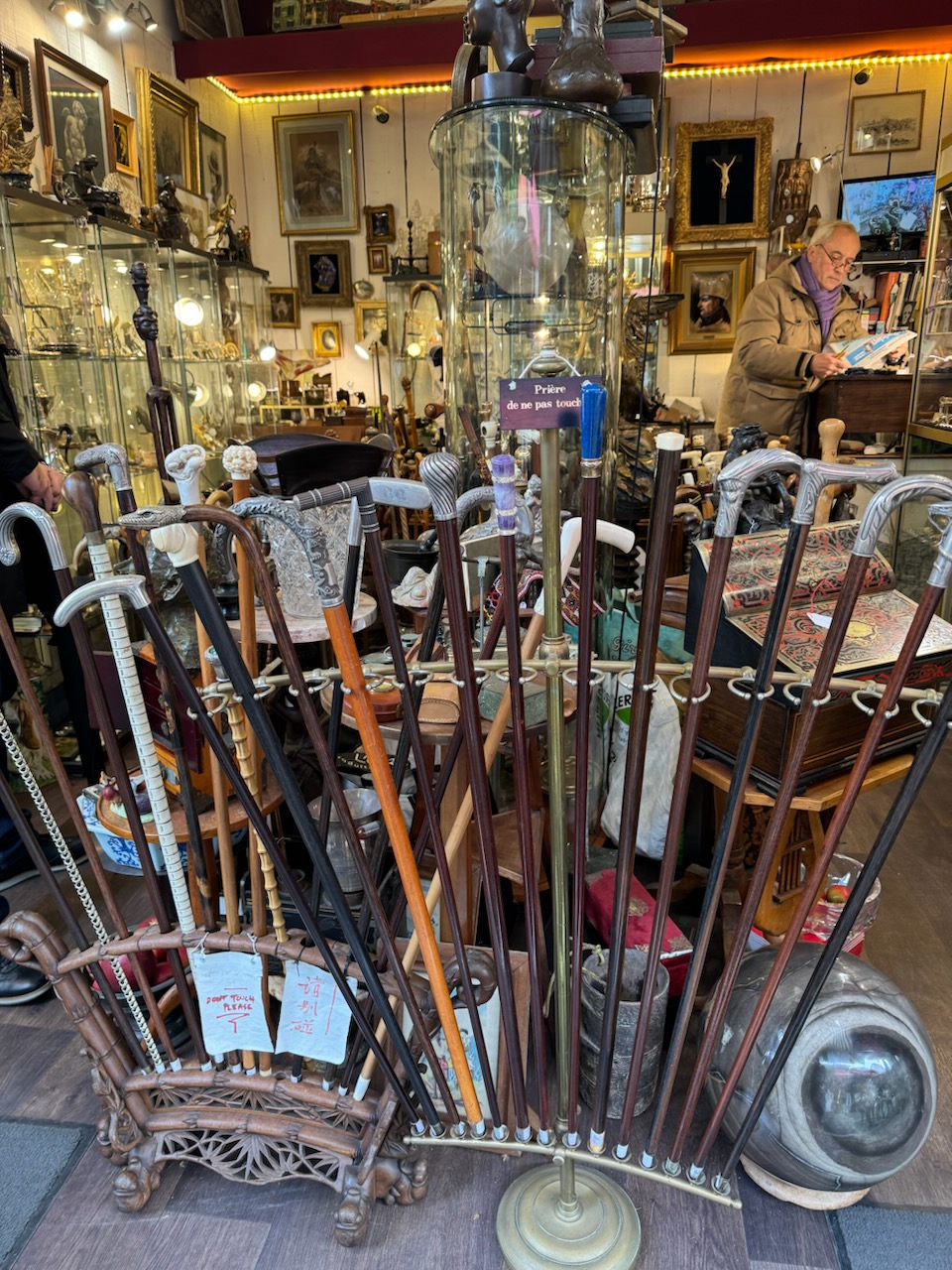
We were lucky to be billeted near our first flea market, the one at Porte de Vanves, which has about a hundred dealers strung along a large city block selling all manner of goodies from 18th-century books and Christofle silverware to walking sticks and paintings. I searched in vain for that lost Juan Luna and that stray copy of the Fili (which Rizal finished in Paris), but the flea-market gods blessed me instead with an early 1900s “safety” fountain pen sheathed in gold, perfect in every way, lying all by its lonesome on a table of bric-a-brac. “Combien, madame?” I asked in my schoolboy French, my throat dry with anticipation. “Cinquante euros,” she said; it was easily worth five times that, but I gathered up all my courage and countered, “Quarante?” “Okay,” she said, “A quick “Merci!” and 40 euros later, I was a happy boy with a new toy—what could be a better memento of this short trip than a gorgeous century-old pen with the word “Paris” on its 18-carat nib?

Of course, this luck was not to be repeated on our visit to the big flea market of St. Ouen in Clignancourt—reputedly the largest of its kind in the world—a few hours before boarding the plane back for home, but we rewarded our labors with a late lunch in a Chinese restaurant. After a week of French cuisine, immersed in the grandeur of French art and culture, huge platefuls of Cantonese fried rice sounded just about right. It was as if we were being told, “You’ve had your Parisian interlude and your souvenirs, it’s time to go home.” Au revoir!

Qwertyman No. 86: The Real Pasaways

Qwertyman for Monday, March 25, 2024

THE LOCAL Internet came down hard last week on an anonymous teacher who was caught on livestream giving her students a scorching tongue-lashing for what she claimed was their lack of respect and discipline. Almost hysterical, Teacher X called them good-for-nothings without a future. Predictably, netizens deplored her derogatory language, which they equated with child abuse, and called on the Department of Education to investigate the incident and impose some disciplinary measure on the teacher concerned.

I agree that Ma’am seems to have gone overboard in expressing her displeasure over her students’ misbehavior, and that she could have been more circumspect in her choice of words. I’m certain that DepEd—which happens to be headed by someone who doesn’t mince words herself when it comes to court sheriffs—will use her case to remind teachers of the need for exemplary behavior, if not some sweetness and light, in classroom management. 

At the same time, having been a teacher myself for forty years, I can imagine and understand the exasperation that must have gone into a titanic diatribe like that. I’ve never taught in elementary or high school, where these aggravations come in spades on both sides of the teacher’s table, but I’ve heard and read enough to know what a cauldron of high emotions a Filipino classroom can be in the worst of circumstances. 

Let’s pack a room meant for twenty students with twice that number or even more, with the heat from a tin roof bearing down on everyone (or, in another season, rain leaking down onto desks and textbooks). The teacher recites her lesson in a funereal monotone, expecting her students (who keep themselves awake by sneaking glances at TikTok on their phones) to regurgitate what she has just said: “Class, how do you pronounce a-DO-le-scent?” 

Not that she truly cares what they say, because her mind’s on the box of chocolates she has to buy for the supervisor whose signature she needs for her salary loan. She’ll spend half that loan on a fence around her garden to keep the roaming pigs and pissing drunks away, and the other half on a new cellphone because her arch-rival Mrs. Buenafe has one that can take selfies without the blemishes. Maybe, if she took better pictures of herself, she could win back her husband Temyong from that tramp in Trece Martires.

Just then a fight breaks out at the back of the room because Etoy has dropped a ballpen to sneak a look at Corito’s underwear, in full view of Corito’s alleged boyfriend Mikmik. “Stop that, quiet, gademet, you imbecile a-DO-lescents, I order you to behave or I’ll squeeze your little balls until they pop! You have no future, you worthless pasaways! You’re going to rot in this living hell they call a classroom!”

Now, when Teacher X says “You have no future,” I take it to mean that Ma’am has read the Edcom II report on the sad state of Philippine education, which puts our young learners practically at the cellar of global achievement. Unless some systemic reforms are put in place by the same DepEd that will now trumpet the virtues of better decorum in the classroom, we might as well have cursed those kids that caused Teacher X to blow her top—and by “curse” I don’t mean the use of foul language, but rather a hex such as a witch might put on some unfortunate soul. 

Philippine education is full of pasaways, many of them more than ten or even fifteen years old. Some have been in the system for so long that they have mastered its ways and means (e.g., how to make good money off bad textbooks) to a level of proficiency worthy of a doctorate. Secretaries of Education come and go—some more lamented than others—but these pasaways remain, as they do in certain bureaus dealing with government revenues, because they ensure continuity, which everyone but the occasional and hopelessly naive reformer appreciates. They may even be well-mannered, with the nicest smiles and mildest dispositions you ever saw, because of their contentment with the world as it is and their philosophical acceptance of human frailty.

This brings to mind another kind of pasaway, a certain man of God—no, make that Son of God—who has steadfastly refused to honor a summons by a Senate committee looking into sex trafficking, of which this pastor has been accused, among other crimes and misdemeanors. Let me judged by the proper court, he has argued through his lawyers, although—if he is who he claims to be—then no one but God the Father will qualify for that privilege.

God must have been a prolific babymaker, because this prosperous preacher is but one of many around the world proclaiming themselves to be Sons of God. Nearly all have landed in some kind of trouble with the law, usually in matters of sex and money, paltry and mundane emoluments that Sons of God seem to feel especially entitled to, in partial recompense for the heavy burdens of divinity.

Someone should have assured our good pastor that the Senate is a decorous institution, exceedingly kind to its guests, as a recent hearing involving police officials being questioned by a former police official showed. A senator who walked out of that hearing out of disgust over the “babying” shown the witnesses by their inquisitor now himself stands accused of discourtesy. Notwithstanding the presence of a chairperson known for her intolerance of untruths, our Son of God can surely count on the professed and unshakeable friendship of some of her honorable colleagues to shelter him from the slings and arrows of earthly justice. We are a much kinder people than that apoplectic teacher might suggest.

Qwertyman No. 84: An Advocate for IBD

Qwertyman for Monday, March 11, 2024

YOU’LL FORGIVE me this “proud papa” moment if I preface this week’s column with the news that our unica hija Demi Dalisay Ricario, who’s unbelievably turning 50 later this year, represented Asian-Americans—and indeed the Philippines—on Capitol Hill in Washington, DC recently to lobby for changes in US health laws on behalf of patients. That’s an ocean and a continent away and doesn’t really affect us, but what’s salient here is that Demi went there on behalf of the American Gastroenterological Association (AGA) as an advocate for Inflammatory Bowel Disease (IBD) concerns—and that touches on our lives as Filipinos.

IBD is one of those little-known and often misunderstood diseases that can turn life into a living hell for its sufferers. It comes in two variants—ulcerative colitis (UC) and the more severe Crohn’s disease (CD), both of them involving inflammation of parts or all of the intestines. Often accompanied by bloody diarrhea, UC and CD and can be extremely painful and be lifelong burdens—or even turn fatal. 

Their causes remain unknown, but genetics, environmental factors, and immune responses seem to be active factors. Remedies include strict dietary changes and employing colostomy bags. Patients can find their social lives diminished or even be stigmatized. It’s not that common—according to the IBD Club of the Philippines, UC hits 1.22 out of 100,000 Filipinos and CD just 0.35, but it’s that same obscurity that makes it difficult to recognize, diagnose, and treat properly. In our culture where people tend to ignore or diminish their ailments—especially embarrassing ones—and consult doctors only as a last resort, the problem gets magnified.

It was on one of our visits with Demi in San Diego ten years ago that she fell terribly ill with blood in her stool, and despite all the tools available to modern American medicine, no one could tell why. Only months later was she positively diagnosed with UC, bringing both relief and radical lifestyle changes, especially to her diet (she can’t eat anything with wheat like ordinary sliced bread, among others). She held a high-pressure job as a frontliner in one of San Diego’s premium hotels, and stress is a high inflammatory factor.

“People often struggle to understand that IBD is an invisible illness, which means that sufferers might look healthy outwardly yet still experience significant health challenges,” Demi says. “This misconception is particularly challenging for individuals like me, who worked in high-end environments like the US Grant hotel, where maintaining an elegant appearance and managing demanding clients was part of the job. The contrast between looking ‘well’ and feeling unwell led to misunderstandings, as people would say, ‘But you don’t look sick!’

“The unpredictability of IBD symptoms significantly impacts mental health and daily life (it makes me anxious sometimes). Fluctuating symptoms such as frequent restroom visits and pain can hinder social interactions and activities. The inconsistency of the disease makes it difficult to commit to plans, as fatigue is a common issue. Additionally, managing a career can be problematic; frequent medical appointments and unexpected flare-ups often disrupt regular work schedules. This was my experience at The Grant, where I had to forego managerial opportunities to avoid exacerbating my condition. Additionally, managing relationships and friendships can be complex with IBD.”

IBD patients have a hard time at parties and social events, especially in the Philippines, where pakikisama is part of a strong food culture. People with colitis can’t eat ordinary bread or drink milk (think halo-halo). Demi has had to be adept at declining offers of food—a no-no for Pinoys—and explaining her unusual condition.  

“Before heading to any event or restaurant, I take a look at the menu online to figure out what I can eat. I’ve even gotten into the habit of giving the host a heads-up about my diet to make sure there’s something on the table I can actually enjoy. When it’s time for those long flights to places like Manila, I pack a stash of gut-friendly snacks in my carry-on (usually gluten-free bread, granola bars, nuts, and fruit). Whenever available, I pre-order gluten-free meals for my flights. After dealing with IBD for almost a decade, I’ve learned the hard way what foods are my friends and which ones are foes, such as gluten and lactose.”

To help her fellow Pinoys deal with IBD, Demi created a “Dear Colitis” Facebook page, also to encourage them to come out in the open and realize that they have a virtual global support group. Her advocacy continues online and with various entities like Pfizer, the Academy for Continued Healthcare Learning, and the Crohn’s Colitis Philippines FB group. Last year she was invited by the American Gastroenterological Association to join six other advocates as part of their pilot Patient Influencer Program to help promote IBD awareness, giving her the opportunity to participate in this year’s Digestive Disease National Coalition Public Policy Forum in DC. 

She explains that “Filipinos dealing with IBD should be well-informed about their condition and discerning about the reliability of information sources they encounter. It’s crucial for patients to be their own advocates, boldly voicing their needs and concerns whether at home, in the workplace, or in social gatherings. This self-advocacy is key to maintaining a good quality of life. Cultural concepts such as hiya (shame or embarrassment), pakikisama (camaraderie or fitting in), and the fear of being a pabigat (burden) can pose significant challenges. These factors might discourage individuals from speaking out about their condition, but overcoming these barriers is essential for their well-being and mental health. By confidently communicating their needs and educating those around them, Filipino IBD patients can navigate their condition more effectively while fostering understanding and support in their respective circles.”

Spoken like, well, a spokesperson, but I think a good one for the job.

(Illustration from Johns Hopkins Medicine)

Penman No. 460: The Fil-Canadians Speak

Penman for Sunday, March 10, 2024

WE’VE BECOME quite familiar by now with the writings of our Filipino-American brethren across the Pacific, thanks to the success of such breakthrough works as Jessica Hagedorn’s Dogeaters, Ninotchka Rosca’s State of War, R. Zamora Linmark’s Rolling the R’s, Marivi Soliven’s Mango Bride, and Gina Apostol’s Insurrecto, and to the bridging efforts of such literary stalwarts as Luis Francia, Alfred Yuson, and Cecilia Manguerra Brainard. Of course, they had many antecedents, going back to at least Carlos Bulosan, followed by Jose Garcia Villa, Bienvenido Santos, NVM Gonzalez, and Alberto Florentino, among many other expatriates. 

But hardly a whisper has been heard from our Filipino-Canadian cousins, as if their experience—whatever it’s been—were simply an extension or an echo of their southern compatriots, with no distinguishing qualities. There’s a reason for that, which we’ll get into shortly, but first let me announce, with both joy and relief, that the long silence is over. Filipino-Canadian literature is introducing itself to the world—and to us in particular—with the publication of the landmark Magdaragat: An Anthology of Filipino-Canadian Writing (Toronto: Cormorant, 2023), edited by Teodoro Alcuitas, C. E. Gatchalian, and Patria Rivera.

I was first alerted to this hefty 390-page volume by one of the editors, Patty Rivera, an old friend from way back who developed into a fine, prizewinning poet when she, her husband Joe, and their family migrated to Canada decades ago. Arriving in Canada in late July 1987, Patty recalls that moment pregnant with both hope and not a little dread that every FOB immigrant seems fated to step into: 

“The air steamed with purpose when summer meant another life to live. From every corner, a mirror to reflect on. Outside our window, the children’s park, though trees, appeared bruised from the dark slits on the windowpanes. Thorny Vineway. Did our new street name augur of tomorrows yet to come? Would our life in this new country lead to a path laid with thorns? We were young at the time, and everything looked promising. We were alive in this new country and were no longer afraid, the years in the future distant and to be savored. We were ready to be every person we chose or wanted to be.”

Today there are nearly one million Filipinos in Canada, which itself is inching close to 40 million. Some years ago, Filipinos edged out the Chinese as the largest group of immigrants in Canada. Many are highly educated, and many work in health care, leading perhaps to a kind of stereotyping of the Fil-Can as caregiver. To be fair, that’s probably how we home-based Pinoys ourselves imagine our Canuck brethren to be, followed inevitably by “Now why did they go to Canada and not America?”

Magdaragat’s editors try to answer that: “It’s the American Dream, after all, that Filipinos chase; Canada is the consolation prize if America, for whatever reason, doesn’t pan out. While, according to historical records, the first Filipinos arrived in what would eventually become the United States in 1587, Filipinos didn’t arrive on Canadian shores (Bowen Island, BC, to be exact) until close to three centuries later, in 1861. In addition, Canada’s population is a tenth of the United States’. Filipino-Canadian history is, thus, of a smaller scope than Filipino-American history. But within that scope are issues unique to Filipinos in Canada that makes Fil-Can history a distinct subject in its own right, not merely an ancillary of Fil-Am history.”

There are, we discover, subtle but important nuances to the Filipino-Canadian experience:

“Another, more insidious, survival issue Filipinos in Canada have to navigate: the passive-aggressive racism of white Canadians. The brazenness of white American racism is well documented (and spotlighted and hyper scrutinized because of the United States’ status as an imperial power); in contrast, white Canadian racism often slips under the radar because it is more typically characterized by microaggressions. The favorite Canadian refrain vis-à-vis racism—‘We’re not as bad as Americans’—constitutes what might be called “maple-washing”: the relentless washing over of all instances of Canadian racism with the claim that it’s still not as horrible as what has transpired in the United States. Accordingly, the racism Filipinos in Canada experience—and which makes its way into some of the pieces in this anthology—is more insidious than its American counterpart and is characterized by shocking ruptures in a strenuously maintained politesse.”

But what about the literature of that experience? Magdaragat provides ample and eloquent proof of the Filipino-Canadian’s desire to reconnect with the homeland while charting their own course in the new country, as this passage from Deann Louise Nardo’s “Where Do You Come From” illustrates:

“I come from dirt and sand, the scribbled writing of an ancestor in a trance, the sound of droplets on skylights, unopened buds on trees, and the sleep dust in my mama’s eyes. I come from cacao beans and the callouses on fishermen’s hands, the arthritic crackle of my grandmother’s hands as she tends to the garden and mends nets. I come from the silver iridescence of stretch marks, the swirl pattern inside tree barks, the razor-thin whiskers of cats, and eerie creaking of Maplewood floors. I come from lengthwise half-cut bamboo wall sheathing, river mud and buried shards of broken glass, of broken tsinelas and confused roosters singing tik-ti-la-ok at three in the morning.”

There’s a long story by Nathalie de los Santos that alone may be worth the price of the book for its sweeping, multigenerational narrative of the immigrant experience from Bohol to New Brunswick, and from Filipino to Filipinx. The young Kay laments that “Even my relatives can be like this, they remind me how I’m not Filipino enough when I don’t know something about our culture. But then some people here believe I’m not Canadian just by looking at me. When I’m asked, ‘Where you from?’ it implies that. Who am I then?… But, maybe all of this is coming from the same place of hurt?” 

The Fil-Cans have spoken, and theirs are voices worth listening to.

Penman No. 459: Spartan but Splendorous

Penman for Sunday, February 11, 2024

WE OFTEN think of ecotourism in terms of swimming with whale sharks or encountering rare species of flora and fauna in some faraway forest. But not too far from Metro Manila lies a natural haven that will satisfy adventurers and conservationists alike—and the ecotourists who are both.

That haven is the Masungi Georeserve, a 3,000-hectare tract of largely reforested land marked by sharp karst or limestone shards jutting out into the sky amid bamboo groves, exotic orchids, and Benguet pine.

The unlikely remainder of an aborted housing project for DENR employees, Masungi now serves as home to hundreds of species, many of them rare and some even unique, such as the purple jade vine and the Masungi microsnail.

These sightings alone would be well worth the trip—a pleasant 30-kilometer drive from Quezon City through Masinag and Antipolo on the Marikina-Infanta or Marilaque Highway, on some of the country’s best and widest roads. (On the weekday morning we went there, it took us just a little over an hour from UP Diliman.) 

Masungi straddles the Sierra Madre boundary between Baras and Tanay, Rizal, much of which is occupied by the Upper Marikina Watershed, across the Kaliwa Watershed on the northern side. Its name comes from the Tagalog sungi, meaning sharp, a reference to the profusion of limestone outcrops looking like sharp teeth across the mountainous landscape.

The georeserve—now being managed by the Masungi Georeserve Foundation—wasn’t set up as any kind of pleasure park. Indeed “pleasure”—except the visual kind—was the last thing this septuagenarian thought of when he went up the steep trails to a vantage point that afforded a spectacular view of Laguna de Bay and the surrounding metropolis far below. Younger and fitter visitors, however, will surely find the challenge pleasurable and even exhilarating.

When the housing project with the DENR failed to materialize—the DENR couldn’t evict the squatters already there and the land, in truth, was simply too steep and inhospitable to permanent human habitation—engineer Ben Dumaliang and his Blue Star company (the housing project contractor) took it upon themselves to rehabilitate what land they could and regrow the forest that would have been lost forever. In 2015, Ben’s daughters established the Masungi Georeserve Foundation to oversee the place, and in 2017, the MGF entered into a contract with the DENR under then Sec. Gina Lopez for the georeserve’s replanting and conservation.

Masungi now features a Discovery Trail for hikers aged 13 and up that takes about three to four hours to complete, although it can be shortened depending on the hikers’ preference. The challenging trails feature hanging bridges, a giant spiderweb, rope walls, caves, and other points of interest (or maybe not, for acrophobes like me). Protective headgear is provided.

Typical reviews on Tripadvisor include comments like this one, from a Singaporean visitor: “Perfect day at Masungi Georeserve. The hike was well-organized and well-paced with sufficient rest stops. Our guide was knowledgeable and friendly, allowing us to take our time and helping to take our photos. You do need a certain level of fitness and daring to tackle the ropes, steps, and hanging bridges, but you will be rewarded with stunning views of the limestone karst formations. There are alternative paths to take for those who have a fear of heights but these detours may take longer. Best not to rush and go with people who won’t judge you if you feel like dropping out! Well done to the Foundation and for educating the public on biodiversity and sustainable tourism. Book ahead and pray for great weather.”

This one came from a repeat visitor, Ronald R: “Had the privilege of visiting Masungi Georeserve for the ninth time (six times on the Legacy Trail, thrice at side trails and once on the Discovery Trail) and every visit was a memorable learning and life-changing experience. All dedicated forest rangers are well versed in the changing landscape and diversity of flora and fauna. The experience differs depending on the weather. I prefer windy, cloudy weather when going up there. The Sierra Madre is more dramatic with rain clouds. Beyond the transformations, the team behind Masungi Georeserve is focused on restoring the lost and abused part of the Upper Marikina Watershed Area. Masungi Georeserve is a platform to make anyone fall in love with nature in a much deeper level. The Masungi Georeserve experience should be in every nature lover’s bucket list.”

Experienced rangers—most of them recruited from the local community, including indigenous Dumagats—serve as guides for these treks. To support the place’s upkeep—it gets no funding from the government—the georeserve charges guests P1,500 each on weekdays and P1,800 on weekends, covering the tour and simple but satisfying snacks (including a refreshingly minty tea made from the kayumanis, a native plant; a set lunch buffet is also available at the hilltop Silayan restaurant). The number of daily visitors is strictly controlled to minimize wear and tear to the area, and groups are kept manageably small. (For more helpful and detailed instructions, as well as photos of the various features along the trail, visit willflyforfood.com and look for “The Masungi Georeserve Survival Guide.”)

It’s a spartan but bracing experience, minus the spa, the massage, the gourmet menu, the uniformed attendants, and all the other amenities we associate with more genteel and patrician hideaways. This is nature in your face—but what a splendorous sight it is to behold, a painterly tableau of rock, tree, bird, and flower set against a radiant blue sky, 640 meters up and far removed from the smog and sludge of the metropolis. 

It’s sad and alarming that Masungi continues to be threatened by powerful landgrabbing syndicates as well as by the indifference if not hostility of the government people who should be supporting it, but that’s another story (check out my Qwertyman column last January 29, “Fighting Windmills at Masungi”). In the meanwhile, avail yourself of this chance to encounter nature like you never have before, and enjoy Masungi while it lasts.

Qwertyman No. 77: Taylor Swift 101

Qwertyman for Monday, January 22, 2024

THERE WAS a lot of snickering around the local Internet a couple of weeks ago when the University of the Philippines announced that it was going to offer a course on the American megastar Taylor Swift. “Why???” seemed to be the most common hair-trigger response, expressing consternation over the need or rationale for such a course. “This is where your taxes go,” lamented another netizen.

The clear suggestion was that spending a semester—that’s 16 weeks—on a pop phenomenon like Taylor Swift was a grandiose and frivolous waste of teaching time and people’s money, scarce resources better allocated to studying worthier topics like, say, Gomburza, the South China Sea, endemic species, and sovereign wealth funds. (Not incidentally, all these other topics are already covered in other UP courses, so no one need worry that they’re being sacrificed for in-depth analyses of “Cruel Summer” or “You Need to Calm Down.”)

Before we go any further, I have to declare that I’m no Swiftie, as her adoring fans call themselves, and I had to look up and listen to those two titles I just mentioned. At my age, my idea of a diva I’d pay good money to listen to is Barbra Streisand, Laura Fygi, Lisa Ono, and Dionne Warwick, none of them below 60. I have to admit that the only Swift song I was aware of before she exploded into global stardom was “You Belong with Me,” which my then-teener niece Eia used to bounce her head to (an effect that, I’ve since discovered, many Swift pieces tend to induce). 

Still, my instinctive reaction to the announcement of the UP Swift course wasn’t “Why?” but what I suppose is the academic’s default of “Why not?” When I looked into how the course was going to be taught by its instructor—Cherish Aileen Brillon, a mass communications specialist who had previously published a paper on, among others, “Darna and Intellectual Property Rights”—I could see that this wasn’t going to be just party time for 15 kids listening through Taylor Swift’s ten albums (yes, I counted) over a semester, but serious study connecting material from the singer’s songs and of course from her life as a 21st century celebrity to our reception of her and whatever she represents, as Filipinos. 

The course—an elective under the BA Broadcast and Media Studies program of the Colle of Mass Communication—will focus on “the conception, construction, and the performance of Taylor Swift as a celebrity and how she can be used to explain our and, of course, media’s relationship with class, politics, gender, race, and fantasies of success and mobility…. Gender should be part of the discussion because Taylor is a woman operating in a highly patriarchal and misogynist entertainment industry,” Brillon told the STAR in an earlier interview. “Transnationality is also a large part of the discussion,” she added, defining the term as a “media-driven flow of goods, products and services from various nations” in this globalized age. “Celebrities have always been transnational anyway. The class will look into the transnationality of Taylor and how Filipinos are appropriating their relationships with celebrities.” 

If you know anything about what’s being taken up in universities worldwide today as media and cultural studies, that mouthful I quoted above is heavy-duty academic work of the kind I myself may not be too keen to undertake, but the results of which I’d be deeply interested to find out. And that because there’s nothing more pervasive and influential in our world today than the media, which includes the Internet, TV, radio, and newspapers, plus all the advertising, the tweets, the Facebook feeds, the Spotify music, and the Amazons, Lazadas, Shopees, and eBays you find in them. How the media draws our attention and often subliminally persuades us into buying certain products and ideas can’t be worthier of academic research and investigation. 

And it’s not as if this hasn’t been done before. New York University, Stanford, Arizona State University, the Berklee College of Music, Rice University, UC Berkeley, the University of Florida, the University of Delaware, and Brigham Young University are among the American universities offering Taylor Swift courses from different approaches ranging from the music itself to social psychology, marketing, and literature.

So, okay, they’re Americans—why us Filipinos? Because the singer has a huge Pinoy fan base, despite the slight that local Swifties felt when she left the Philippines out of her 2024 Southeast Asian “Eras” tour, for which well-heeled Pinoys then rushed online to book expensive ticket packages for her shows in Singapore. (She’s been here twice before, in 2011 and 2014.)

But never mind Taylor Swift. Back in 1995, scholars attending the first International Conference on Elvis Presley at the University of Mississippi’s Center for the Study of Southern Culture got academia “all shook up,” according to reports, with papers bearing titles like “A Revolutionary Sexual Personae: Elvis Presley and the Acquiescence of Black Rhythms,” which discussed sensuality and spirituality in Elvis’s acts.

And then, of course, there are all the college courses on Frank Sinatra at Suffolk University, and on the Beatles at MIT and Oxford, among many other places. At Carnegie Mellon University, flautist and Prof. Stephen Schultz alternates teaching 18th-century Baroque music with a class on the Beatles; guess which class attracts 200 students a semester.

I’m sure that, despite these precedents and rationales, there will remain many skeptics who’ll still believe that all this academic mumbo-jumbo is just an excuse for both professor and student to kill an hour and a half doing nothing but nodding their heads to pop tunes and chatting about which song’s lyrics were cooler. (Don’t be too surprised, but that’s also basically what happens when we discuss poetry and fiction, sans the rhythmic nodding.)

But then you could be talking about Taylor Swift and her songs—or you could be talking about how Adolf Hitler and his deadly message were packaged and sold to the German people, not to mention Donald Trump and other despots closer to our time and place. This is what media and cultural studies are ultimately about—the power of media and other cultural forces to shape our minds, our purchases, our votes, and therefore our history. 

Perhaps our students can even learn more from a semester of Taylor Swift, BTS, and Justin Bieber than the Shakespeare they’ll merely turn to AI to write papers on. Like I told one naysayer, “We keep studying history, religion, law, etc., and yet we seem to learn nothing—just look at how a former human rights lawyer suddenly justifies EJKs.” So there may yet be more to Taylor Swift 101 than meets the eye. As another Swift—Jonathan—put it, “Vision is the art of seeing what is invisible to others.”

(Image from Sky News)

Qwertyman No. 76: What I Have Learned

Qwertyman for Monday, January 15, 2024

PARDON ME if I wax a bit personal today, as I turn 70, much to my great surprise, coming from a generation that didn’t expect to live past 25. I’ve often noted that in your 20s, you seek purpose and direction; in your 30s, stability in terms of love, family, and work; in your 40s, professional success and serious money; in your 50s, acclaim and reputation; and in your 60s, good health and comfort. Now, on the threshold of my 70s, I find myself accepting and preparing for the inevitable, the average life expectancy of the Filipino male now hovering at 72.

More significantly, my wife Beng and I are also celebrating our 50th anniversary. I’ve never quite resolved if it was a good idea to get married on my birthday—and just my 20th at that—but there was never any doubt that marrying Beng was the smartest decision I ever made, and that waking up beside her every January 15 is the best birthday gift I could ever ask for.

But I’ll spare you the love story, which, like all good love stories, has had its fragile moments. For now, let me share some lessons and insights I’ve learned from surviving the First Quarter Storm, martial law, EDSA, GMA, Ondoy, Yolanda, tokhang, and, for the moment, BBM. They’re by no means complete, and I still have a lot of learning to do in what I hope to be at least another decade of avoiding the lyres up there (or the pitchforks down there). But they’ll serve for now, hopefully to encourage newlyweds and young ones to hang on for the long and bumpy but also often exhilarating ride. 

First, survival matters. Fifty years ago, my comrades and I were all prepared to give up our lives for our cause, but today I’ll have to ask, “Must I?” Heroic self-sacrifice is symbolically important and can inspire others to take personal risks for the greater good, but a genuine and strategic movement for change cannot consist solely of martyrs willing to die in combat; its core must be formed of patient plodders willing and able to undertake the mundane tasks and chores of nation-building within their families and communities. For that one will need to co-exist with evil, if need be, if only to survive it and be able to do better. Co-existence does not necessarily mean surrender or acceptance, merely an affirmation of one’s right to live as well as anybody else. Resistance can take many forms, not all of them fatal; we need to be clever and resourceful in championing the truth, which is often starkly simple and clear but sometimes also just as complicated as the well-fashioned lie. 

Second, tolerance and cooperation are key to every successful relationship, whether it be a marriage or co-existence in a deeply fractured society. But also key to this idea is self-knowledge, which builds self-confidence and a greater willingness to understand and accept the other, and to educate oneself. Many early marriages falter because the protagonists are simply too young, too vulnerable, and still struggling to define themselves. Growing up on one’s own is difficult enough; growing up together is even more challenging, but necessary. I was 20 when I became a husband, and later that year, a father, and didn’t really know how to be either. Thankfully Beng and I had good role models in our own parents, and enough love to work things out and see things through. Eventually, we learned to define ourselves in terms of the other—so that today, for me, no trip is worth taking without Beng, and her joys and successes are mine as well. Forgiving oneself and accepting one’s imperfections are not only as important as acknowledging the other’s, but are prerequisites to mutual self-improvement.

Third, “compromise” is not a bad word, if we are to survive as a nation together and as individual citizens. In our 20s—much surer of our convictions than of our own squishy selves—we viewed the world in black and white, certain that the enemy was out there, was not us or within us, and had to be rejected and battled in all arenas, on all levels. I’ve since learned that life can’t be lived on an all-or-nothing, take-it-or-leave-it basis, and that one has to negotiate with oneself as well as with others to keep whole and sane. An absolutist will never find peace, nor satisfaction, and likely never happiness. Learning to take things as they are—and working from there—can be harder than to merely insist on things as they should be, and to do nothing when they are not. Just as important as highlighting our differences are finding and building on the things we can agree upon—like resistance to foreign encroachment on our territory, which helps clarify our self-image—regardless, though still mindful, of our suspicions of the other’s motives. Opportunistic politics can sometimes be the inadvertent handmaiden of good outcomes.

Fourth, I’ve learned my limitations, and to do my best within my foreshortened horizon. I’ve realized that I can be happy in not trying to do too much, living in the moment, and finding fulfillment in small achievements that bring change and hope to other people. I haven’t given up my dreams for a more just, progressive, and provident society, and will continue to fight for those ideals, but I will choose activities and means that will lead to something I can see and hold (and that others can repeat, improve upon, and grow for the future). Big ideas are great, but small deeds can be just as valuable. I want to make a difference in someone’s life today. 

And finally, there is an afterlife. I frankly don’t know if there’s a heaven or a hell as the colorful posters in my grade-school religion class depicted them, but what I’m sure of from having attended countless funerals is that an important part of that afterlife and of its very proof is the life of those you will leave behind. When you die, others live on; they’ll talk about and even shed tears for you for a few days, and then they’ll move on to more pressing matters like tax amnesties and next Tuesday’s price of gas. Now and then your name will come up over morning coffee or a late-night beer, and the smile, the laugh, the sigh, the wince, or the cuss word that your memory will provoke will say everything about who you were and what your life was all about. I’ll be happy with a smile—maybe a bit regretful, but mostly pleased to have crossed paths with and even to have learned something from me. Mabuhay!

(With many thanks to May Tobias-Papa for the illustration)