Qwertyman No. 39: My Mother Emy

Qwertyman for Monday, May 1, 2023
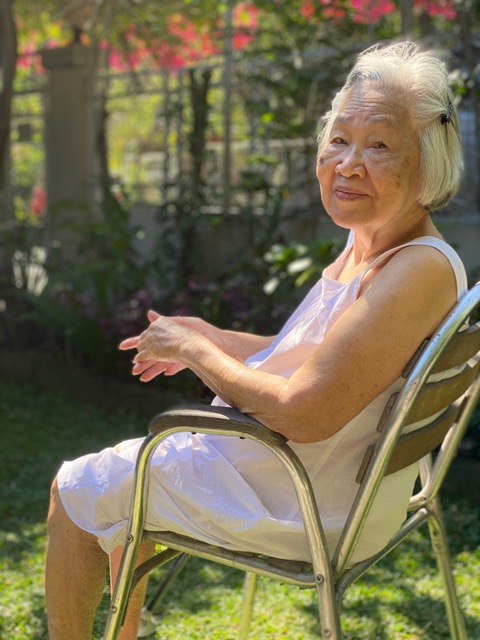
Pardon me if my column this week is a bit personal, because its subject is my mother Emilia, who will turn 95 next week, against all odds and through the grace of the One she prays to every night and every morning, and in the loving embrace of her five children and many grandchildren and great-grandchildren.

In this age of murderous Covid, rampant cancers, devastating disasters, and political turmoil, to reach 95 is extraordinary. To be 95 and be reasonably healthy, free of dementia (but for a few memory lapses that even I at 69 am prone to), able to walk a few hundred meters for her daily exercise, read without glasses, and comment tartly on the day’s political and entertainment news is almost superhuman. 

Like today’s children, my mom Emy can’t be removed from her iPhone and her iPad; she loves to play word games, beats my wife Beng at Scrabble, devours Netflix by the series, and has her telenovela programming graven in stone. She has daily Facetime audiences with our daughter Demi in California and my sister Elaine in Toronto. She even gave up her US green card to spend, she says, the rest of her time at home. In her “Tuesday Circle” of elderly friends, she is now the most senior, but hardly the most infirm. Best of all, she looks forward to reading my books and columns, and although I suspect that they sometimes bewilder her as much as they do my other readers, she invariably likes them because they were written by her first-born, who cannot possibly write anything badly. (This week’s surprise column, I think, will be a hit with her.)

A quarter-century ago, shortly after my father Jose Sr. died, we thought we were going to lose her as well. That’s what they say often happens—one dies, and then the other follows, in the utmost expression of devotion and sympathy. Emy was diagnosed with tuberculosis, so serious and advanced that we felt we were gathering at her deathbed, her sheets spotted with the blood she was coughing up. I had never seen her so frail and so helpless. She was missing my father terribly, and I’m sure she wouldn’t have minded leaving us to join him at that moment. 

Theirs had been a storybook, whirlwind romance. She was the youngest daughter of a landowner in Romblon, the only one in their brood of twelve whom her father had trusted to study and go to college in UP in Manila. She was her father Cosme’s pet, a girl who rode horses on his farm and who accompanied him when he took a boat to the big city to off-load his copra harvest and to buy necessities and a few baubles for his large family. It must have pained him when she decided to finish her high school in Manila (“I was walking on Padre Faura and saw UP High, and so I went in to see how I could study there,” she says) and to stay there so she could study to become a teacher.
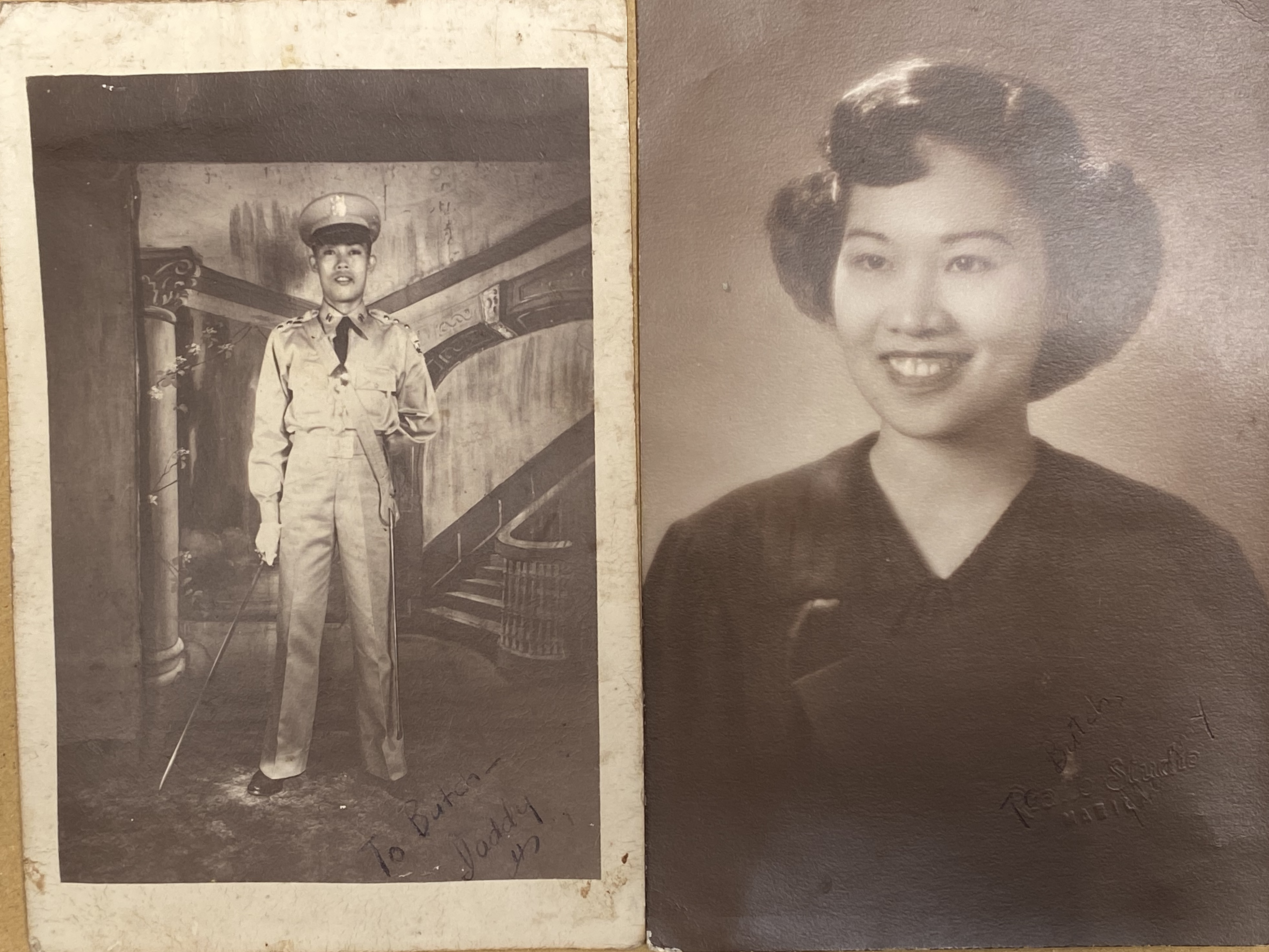
My father Joe was the brightest boy in his school and, so the local legend goes, in the whole province. He was an eloquent writer and speaker and cut a dashing figure. The only problem was, his family was poor—his grandfather had been a sharecropper, his father a farmer. His parents had separated shortly after he was conceived—another story that deserves a telling of its own—and lived about a kilometer apart for the rest of their lives. Raised by my grandmother Crispina, Joe seemed destined for great things far beyond Romblon. He already had a girlfriend, among the town’s prettiest bachelorettes (I met her once when I was a boy, unaware of why she was looking at me a certain way.)

One day Emy and Joe met at the pier in Manila waiting for other people and other things. Some sparks must have flown, because not long after, they were together and engaged to be married. I was the first outcome of that improbable union, born in a nipa house in Alcantara, Romblon, pulled out of my mother by a midwife (whom I would meet about twenty years later, walking barefoot on the asphalt road, and whom I would rather awkwardly gift with a pack of Marlboros in token thanks for my delivery).

The decades following would be a mixture of toil and triumph, of struggle and hope. Both my parents had enrolled in law school, but the need to sustain us foiled that dream. Joe had even gone to the police academy, in the class of James Barbers. He clerked for Public Works, became a Motor Vehicles Office agent with a shiny badge, and took on all kinds of jobs to support us. My mother Emy, despite her pride as a UP Education graduate, soldiered on beside him and sold stamps as a postal clerk. We went through some very rough times, constantly moving around the city with all our worldly possessions on the back of a truck in search of more affordable lodgings. Sometimes my father would be gone for long periods, working as far away as Mindanao to be able to send us some money. 

But one thing they always held up for us was the value of education. My parents slaved and my siblings sacrificed so I could go to a private school, thinking like most Filipinos of their generation that a facility in English would be my ticket to success. It was a huge relief for all (and a good excuse to buy our first TV) when I got a full scholarship to the PSHS. So it must have felt like a stab in my mother’s heart when I announced, shortly after entering UP on the swell of activism, that not only was I not going to be a scientist (my Math grades were miserable) but that I was also dropping out of college to find work (which I did at 18, to write for the Philippines Herald). Despite everything, I wanted to follow in my father’s footsteps and gamble on my talent.

But I did come to my senses and many years later returned to school, where I remain to this day, with a lofty title my wife Beng prefers to downplay to “Chauffeur Emeritus.” Instead of following Joe to his grave, my mom Emy fought back, miraculously recovered, traveled the world, and cradled her great-grandchildren. So good things do happen to those who persevere and survive, for as long as we’re willing to give life another chance.

I honestly don’t think I’ll reach 95 myself, but I have the privilege—and the challenge—of living with someone to inspire me every day. Happy 95th, with all our love, Nanay!

Qwertyman No. 38: Getting into UP

Qwertyman for Monday, April 24, 2023

(For this week, let me offer a little family drama about my favorite school, this being exam season, and before I get the usual calls from anxious friends.)

“HEY, UPCAT is back, they’re holding UPCAT live again!” Marides waved the newspaper in her husband Bong’s face. Bong was watching a car show on TV where they found old cars in barns and turned a bucket of rust into a gleaming, raging roadster. Somehow it gave him hope that, down the road when he became a senior and ached all over, they could ply him full of oils and sealants and make him go like a teenager again.

“What UPCAT?” At least the question proved he was listening. Marides had that godawful habit of intruding on his most blissful moments with some real-world problem, and then getting on his case when he ignored her. Twenty-five years of marriage, four kids, and she still didn’t know when to leave him be. 

“UPCAT—the University of the Philippines College Admission Test, the same one I took and passed thirty years ago, which led to me representing UP and meeting and beating you in an inter-collegiate debate, remember? After which you got my number and asked me out and proposed to me three months later, remember?”

Bong hated it when Marides reminded him of that first encounter and its outcome, which became a given of sorts in their household—she was smarter than him, she had all the better arguments, and who knows what she could have become—a corporate genius, a Supreme Court justice—if he hadn’t saddled her with babies and insisted on working for the both of them. He was good with the money, she had to grant him that, because he was the agreeable type who made all the right connections and who could hustle his way out of a guilty verdict if he had to, as he more than once had to. 

“So what if UPCAT’s back?” he asked for the sake of asking. On the TV, two mechanics were staring at a big hole where a Corvette’s engine should have been.

“Dondon is in his senior year. He’s supposed to be taking it soon. We need to make sure his papers are in order. Where’s that boy? Dondon! Come out for a minute, will you?” 

A teenager with frizzy hair and a phone glued to his ear straggled out of his room and deposited himself in the nearest chair, across the room from his parents, still mumbling on his phone.

“You know UPCAT is happening, right? Have you filed your application yet?”

“Yes, Ma—mumble mumble….”

“Will you please put that phone down while your parents are talking to you? Bong, could you teach your son some manners—”

Bong: “Mumble mumble….”

“I’m serious! You two listen to me—our family’s reputation is on the line!”

“What reputation, Ma?” Dondon grudgingly put his phone aside, and Bong yawned and stretched his arms to acknowledge that he was in for a long spell.

“The one I started, by passing the UPCAT, getting into UP, and serving the people any way I could!”

“But, Ma, all you ever did was to bear us babies, and look what we became—Ate Glo is divorced in the States, all Kuya Jeff does is drive Papa around, and Kuya Milo thinks more tattoos will make him a better rocker. And all of them passed the UPCAT because you told them to!”

“Well—that was my service—to them, and to our people. I give you the opportunity, and what you make of it, well, that’s your business….” Marides started sobbing, and Dondon ran across the room to embrace her.

“Aw, Ma, that’s not what I meant. I just wanted you to see that getting into UP doesn’t guarantee anything.”

“That’s what I’ve been saying all these years!” Bong added. “We’ve been sending our kids to a school for communists, and they don’t even make good communists anymore!”

“No, they don’t,” Marides shot back, “because those communists took the top five places in the bar exams!” She sniffled and Dondon handed her a box of tissues.

“Don’t cry, Ma. It’s all right, it’s all okay. Applications are done online now and my school sent all my papers in last week. I just didn’t tell you both because—well, Papa wanted to explore other options—”

“Other options? Like what?”

“Like sending him abroad to a school of his choice. We have the money—”

“What, you’ll be sending my baby, our bunso, away for the next four years?”

“Or he can pick any other school here he wants to! UP’s not the only good school for engineering or science in this country—”

“I don’t want to be an engineer, Pa….”

“What? You’re a science high school scholar! You have to be an engineer—or a chemist, a physicist, do something with numbers, you don’t have a choice!”

“I never did, Pa, you and Ma chose my high school for me, I just took the exam. Maybe I should have just failed it.”

“So what the hell do you want to do with your life? Who’s going to take over the business when I’m gone?”

“Maybe you should trust Kuya Jeff more. Keep him in the backseat with you. Me, I want to draw, to paint, to design, do something creative. I know I’m good—you’ve seen my sketches, you just haven’t paid much attention to them.”

“We just want you to be happy, son,” said Marides. “We’ll support whatever you decide—won’t we, Bong?”

“Uhm—yes, okay, sure, if it makes you happy, but will you stop crying? I’ll make sure Dondon gets into UP, even if he fails the UPCAT—”

“Pa!”

“I’ll call an old friend of mine, you know me, I know all the right people. He used to be a VP in Quezon Hall, I’m sure he can pull a few strings and get you in—”

“Pa, that’s not how I want to get into UP, that’s not what UP’s about—”

“Oh, you mean that guy who now writes a column about funny things like fountain pens and his wife Weng for a newspaper? Forget it. Chuchay called him last year to ask for the same favor, but he said sorry, no, he won’t do anything of the sort, that it’s just not done in UP!”

“Why, that useless jerk! Doesn’t he know how things work in this country? I’m sure UP’s just as full of jokers and crooks as Customs, Congress, the Palace, you name it! Don’t half the people in those places come from UP?”

“Maybe, Pa—but that’s why I want to go there, because it still has people like your friend who won’t let me in unless I pass the UPCAT! Don’t worry, Ma—I’ll do my best, I promise.”

“Oooh, my son’s going to be the next Amorsolo!” Starts singing: “UP naming mahal, pamantasang hirang….”

“I have a friend who owns a gallery….” Bong began.

Penman No. 449: Sharing the Joy of Pens

Penman for April 2, 2023

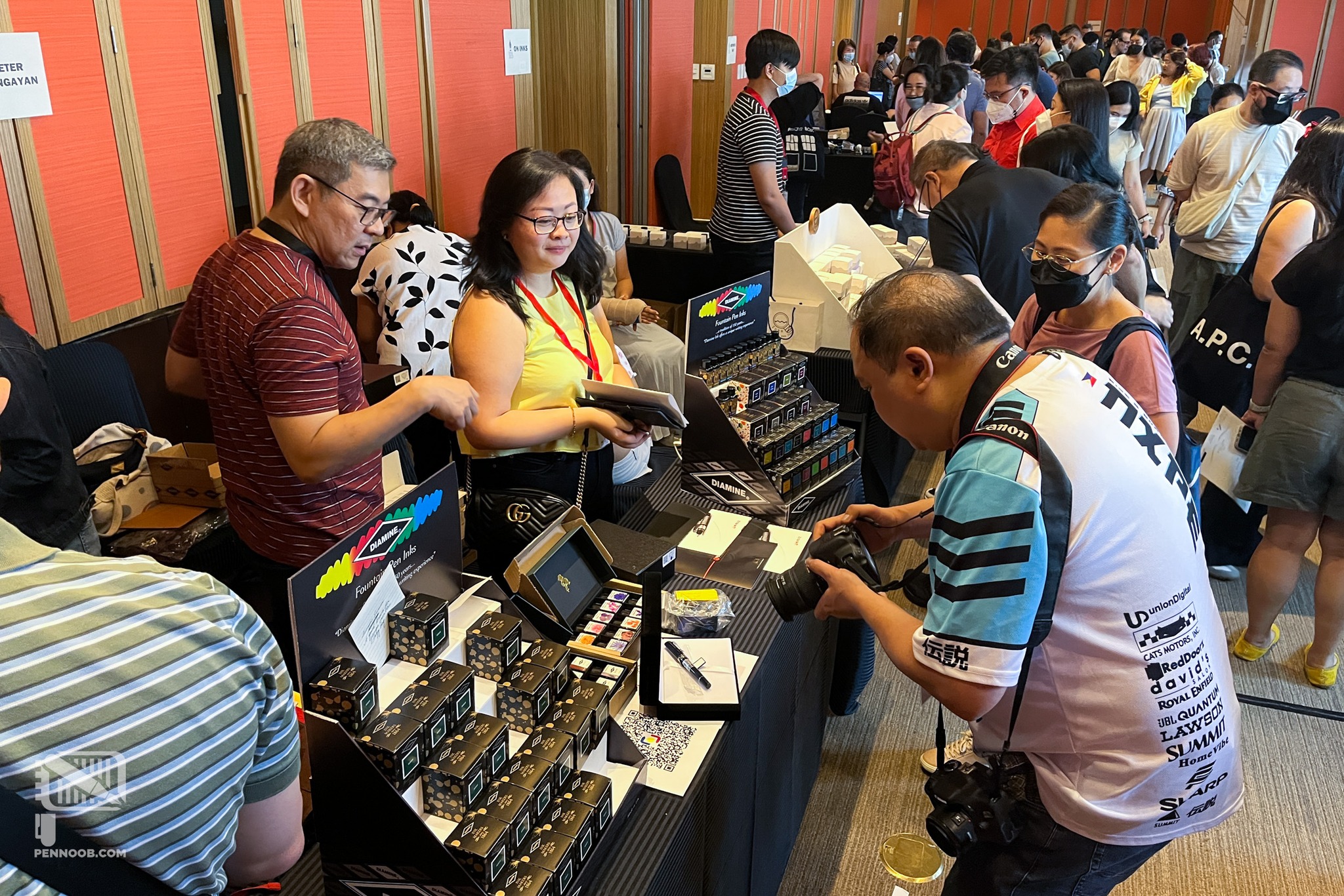
With the successful holding of the 2023 Manila Pen Show last March 18 and 19 at the Holiday Inn Makati, the Philippines firmly established itself as Southeast Asia’s Pen Central—the largest and liveliest marketplace of items and ideas related to one of the world’s fastest-growing hobbies: collecting fountain pens and other writing peripherals (inks, papers, and cases). 

The last MPS in 2019, just before the pandemic, had brought in 700 visitors. This year, that number was eclipsed on just the first day, and by closing time Sunday, over 2,000 pen lovers—from hardcore and advanced collectors picking up $2,000 Nakayas to eager newbies thrilled to get sub-P200 Wing Sungs—had showed up. The turnout wasn’t totally surprising, considering that Fountain Pen Network-Philippines (FPN-P), the pen show hosts and organizers, now counts more than 12,000 members on its Facebook page.

Aside from the country’s leading purveyors of writing paraphernalia—familiar names such as Scribe, Everything Calligraphy, Pengrafik, Stationer Extraordinaire, Leather Library, Leather Luxe, Shibui, Gav N Sav, JumpBid, and Kasama—foreign sellers from Singapore, Malaysia, and Japan such as Aesthetic Bay, Pen Gallery, Straits Pens, Musubi, and Toyooka Craft flew in just for the show. Nearly all the sellers reported robust sales at all price points.

As a longtime pen collector and co-founder of FPN-P, I’m proud of how the hobby has taken off in this country over the past decade, and also frankly amazed by how different our demographics are from the rest of the world. Fountain pen collecting, especially in the West, has long been the domain of predominantly old white men, inclined like I am toward vintage pens and high-end, limited-edition modern pens. 

FPN-P’s profile is distinctly different: mostly young professionals between 20 and 40, with far more women than men, happy to purchase the entire color range of inexpensive Chinese-made Jinhao 82s (and inks to match) but just as savvy about the latest Montblanc release, keen on using and enjoying their pens rather than keeping them in boxes. As the MPS attendance showed, ours is an exuberant, generous, and democratic community, with little sense of entitlement or competition, dedicated to sharing the joy of pens, of expressing your individuality and artistry with the ink on your nib, of doing something personal and authentic in this age of artificial intelligence.

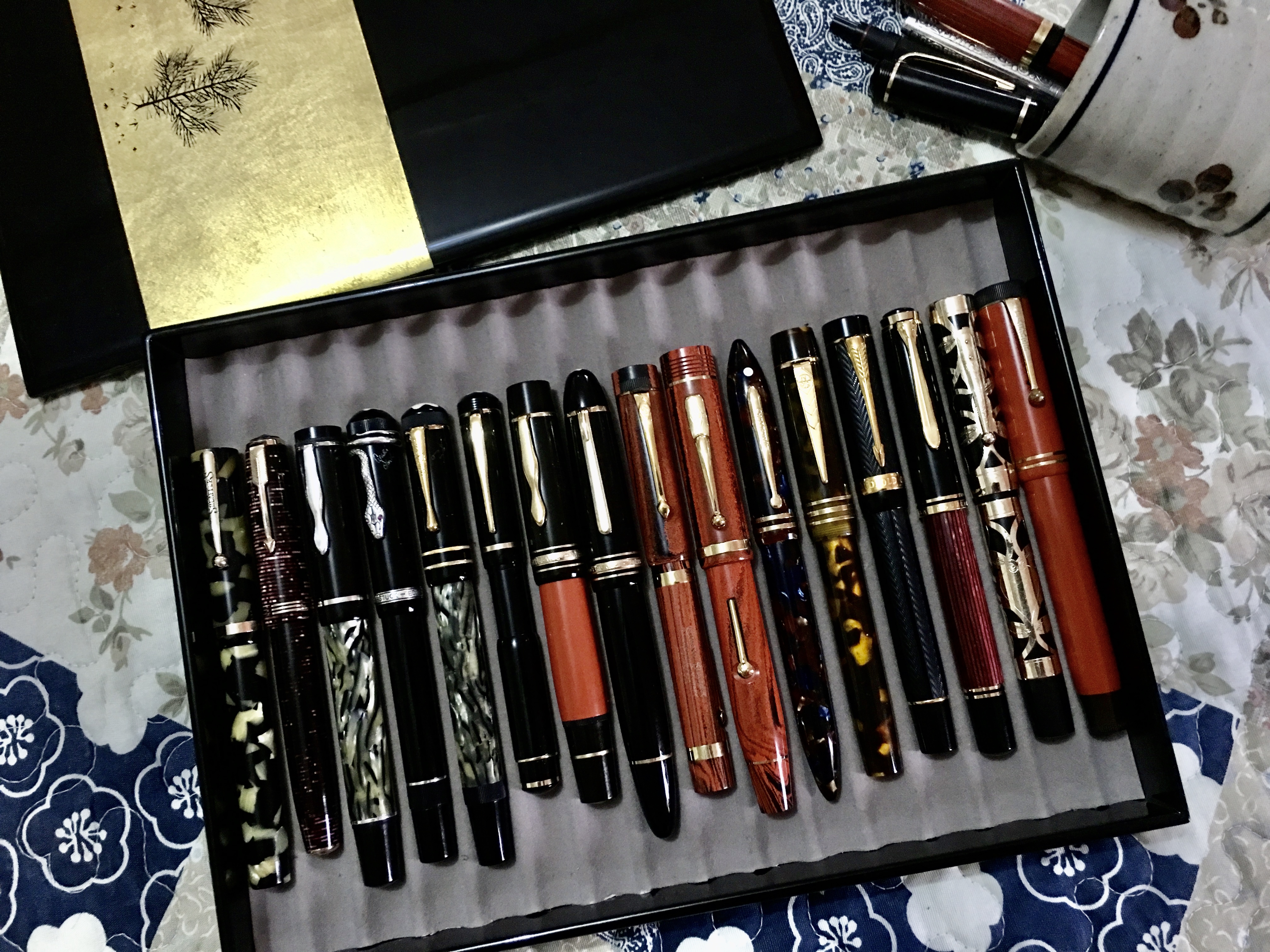
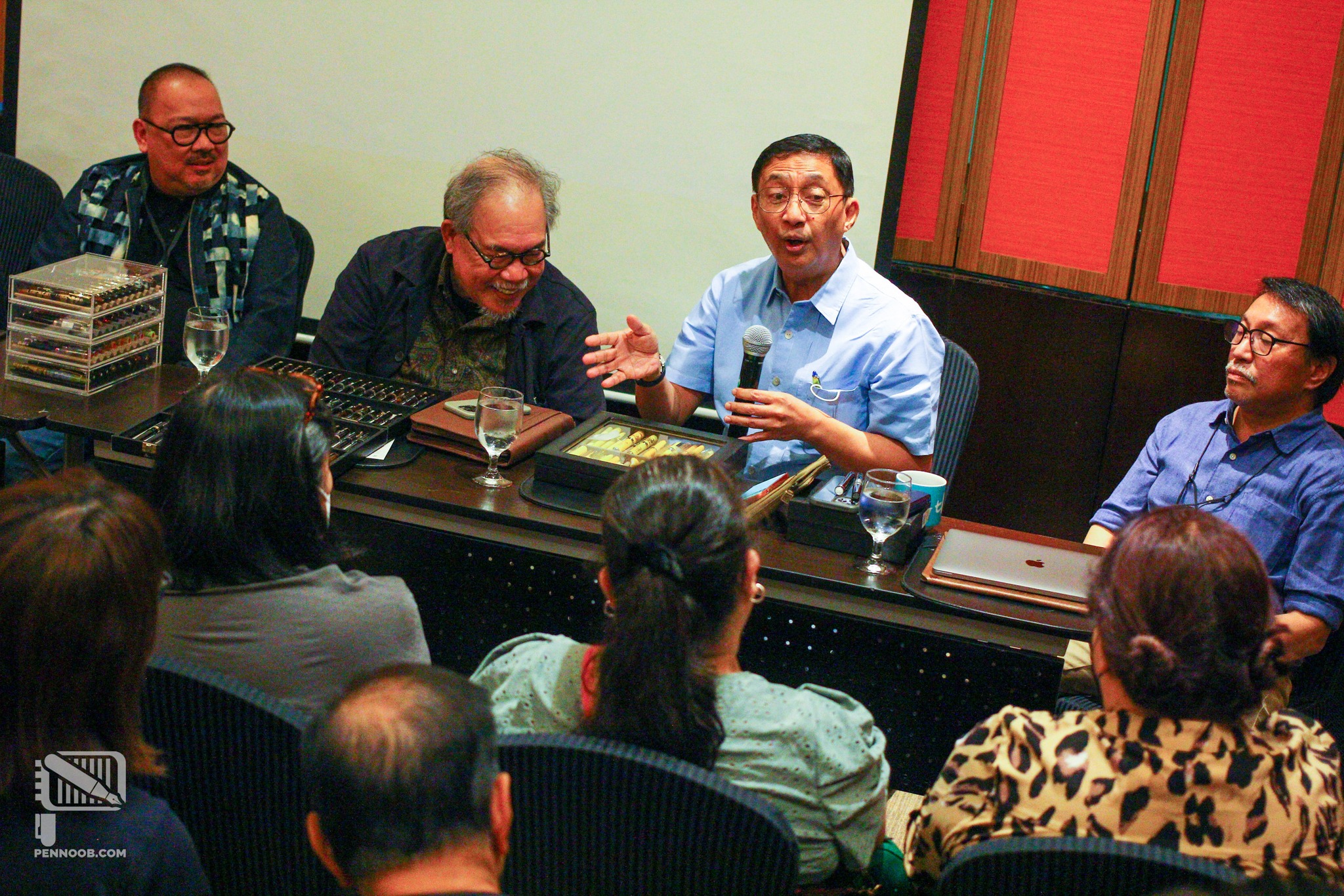
A highlight of MPS 2023 was a panel discussion devoted to the topic of “Curating a Fountain Pen Collection,” and I was privileged to share the table with fellow collectors Reggie Reginaldo, Amanda Gorospe, Jun Castro, Ronnie Geron, and Raffy Aquino. Each of us said a few words about how and why we put our collections together, given that each of us had a different focus: inexpensive pens, high-end pens, vintage pens, yellow pens, and so on.

Before talking about my passion for vintage pens (i.e., pens at least 50 years old, in many cases a hundred years old), I tried to explain what “curation” was all about. Here’s part of what I said:

Every collection begins as most love affairs do—with fleeting glimpses of the loved one, then seemingly chance encounters, then long chats over coffee before the steep and blissful freefall into a dizzying madness. 

For a moment, happiness and contentment reign. And then sadly follow the inevitable regrets, the disaffections, the “It’s not you, it’s me’s,” the parting with the old object of desire and its replacement by a new flame.

Today we’ll try to introduce some sense into this seeming cycle of bliss and despair. Curation means bringing some method into the madness, finding the inner logic that threads many disparate elements together.

The word “curation” is rooted in the Latin curare, “to take care of,” or to treat an illness, and here clearly the illness is in the collector, whom curation treats by providing guideposts to follow and guardrails against excess.

There are several kinds of collectors:

  1. Those who want anything and everything, although they might be more properly called accumulators (this describes 90 percent of us at the beginning);
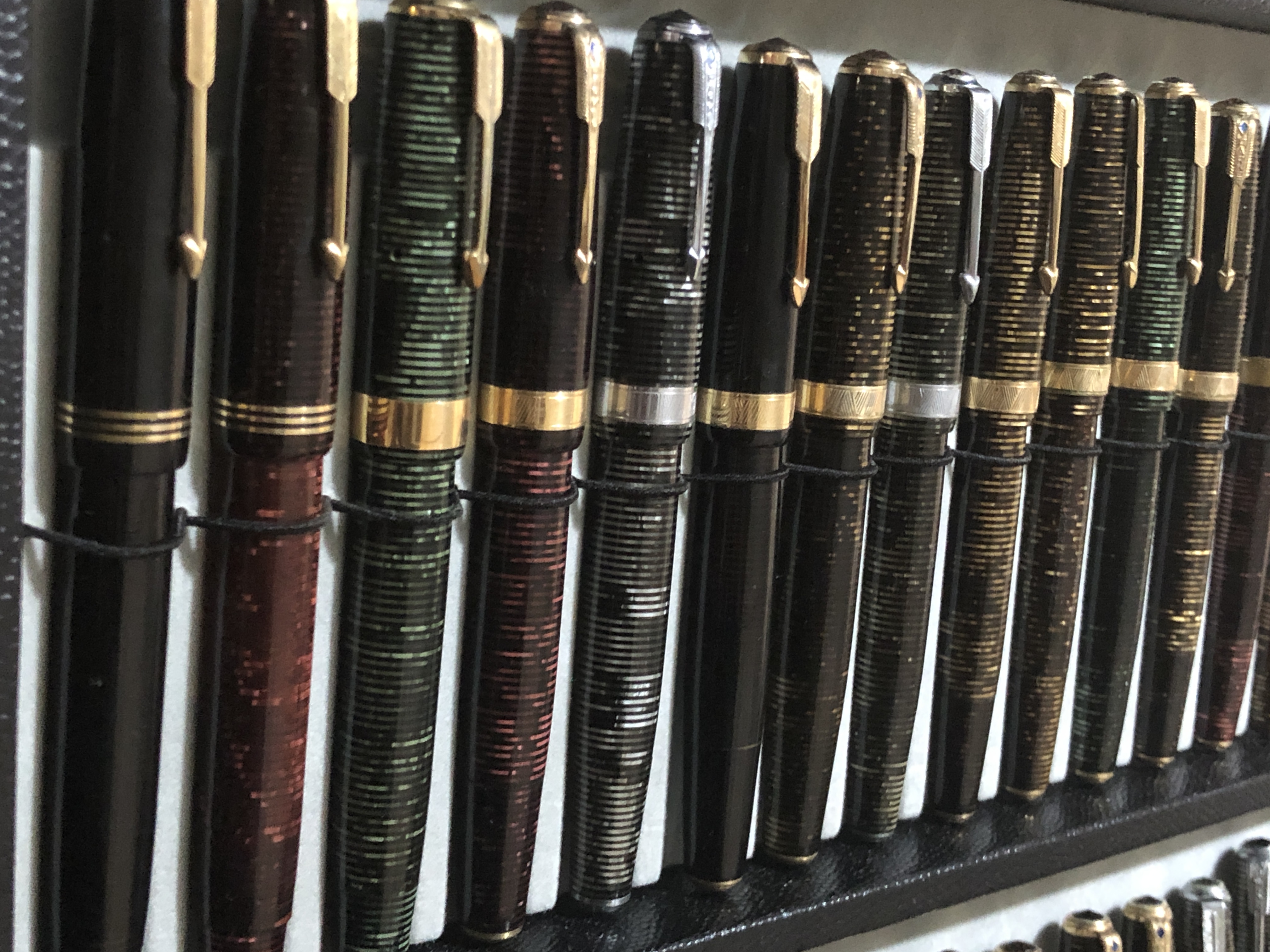
  2. Those who want everything of a kind (this applies to my fetish for Parker Vacumatics);
  3. Those who want the best or the most impressive of everything (this implies having the budget to go with your taste);
  4. Those who want some very specific things, for personal or even idiosyncratic reasons; and
  5. Those who get only what they need or can afford—perhaps the rarest of all collectors, the practical and disciplined kind.

Vintage collecting relies heavily on connoisseurship—on knowing the field and knowing what to look for. Surprisingly, it often involves less money than buying new pens. Of course there’s a cost to factor in for restoration and repairs, but even so few vintage pens reach the stratosphere of the thousands of dollars you would pay for a shiny new Montblanc.

You can collect based on brand, material, filling system, size, and of course price. For vintage you can add age and scarcity. Good working or repairable condition is presumed, although vintage collectors should always be on the lookout for cheap parts pens. 

Every quest for collectibles also involves what we might call “unicorns”—ultra-rare or one-of-a-kind pieces that exhibit some distinguishing hallmark of quality or technical innovation. These could be prototypes, custom jobs, or things in almost mint condition despite their age.

It also helps to know what you don’t like, or no longer like. For example, I generally don’t go for small and light pens, nor for blingy or too colorful pens. My pens are “lolo” pens—staid, conservative, almost severe, corny to most young collectors today.

Culling or cutting down is a good exercise, financially and mentally. I built up my collection over the years by selling five good pens to get one better pen. I have also sold very good pens that I once lusted after, but no longer spoke to me.

Curation, ultimately, is about knowing yourself. At a certain point in your collecting life, you have to take stock of your collection and ask yourself, “What do these objects say about me?” Is this the self-image I want to project, the one I’m happiest with? 

My answer to my own question is, I’m an old guy who likes old things, because they offer physical proof of life after death. We die, but our words—and the wording—go on. A vintage pen is an old guy lucky enough to find a new home. I’m happy to give him a shower and a warm bed, and all the ink he wants to drink.

Qwertyman No. 35: The Ultimate Casualty

Qwertyman for Monday, April 3, 2023

I’M SURE I wasn’t the only one who looked up from his breakfast coffee last week to see, on the morning news, that another mass shooting had ripped through the heart of America—in Nashville, a city that usually brings to mind the twangy plaints of country music, in mournful songs about prison life and cheating hearts. This time the pain was much more brutal and direct, devoid of all poetry: six people were killed, including three nine-year-olds, their bodies savaged by bullets from AR-15-style assault rifles.

According to the Gun Violence Archive—whose very existence should be disturbing—it was the 130th mass shooting in the US in the first three months of 2023 alone. Last year, 647 such events were recorded; overall, more than 44,000 Americans died from gun violence in 2022. At this rate, 2023 will almost certainly be a much bloodier year for America. There will be hundreds more Nashvilles, thousands more families ambushed by unspeakable tragedy, choruses of angry wails to heaven asking God to explain why.

Like any other parent who witnessed that carnage, my wife Beng raised the question on every sensible person’s mind: “How could they let this happen?” 

“This” here would mean not only the mass killing itself, but the means to do it. Two AR-15-style assault rifles were used by the 28-year-old shooter. The AR-15 has been the mass shooter’s weapon of choice. It can rip people to shreds. According to the Washington Post, “The AR-15 fires bullets at such a high velocity — often in a barrage of 30 or even 100 in rapid succession — that it can eviscerate multiple people in seconds. A single bullet lands with a shock wave intense enough to blow apart a skull and demolish vital organs. The impact is even more acute on the compact body of a small child.”


The mere thought of children being mowed down like carnival toys is horrific, but apparently not enough for America’s powerful and richly funded gun lobby, which has insisted on looking the other way, sanctifying the Americans’ Second-Amendment right to bear arms above all other human considerations. 

In Tennessee, where the shootings took place, it is legal for anyone over 21 to carry handguns without a permit; that holds true for 24 other states, making fully half of America gun-friendly. And despite the mounting deaths from mass shootings, politicians in many predominantly Republican states—including Tennessee—are sponsoring even more permissive gun laws, to do away with background checks and facilitate the sale and transport of lethal weapons.

President Biden has rightly said that he has done all he could to help stop the violence by calling for a ban on assault rifles, but the opposition to such gun-control measures has been stubbornly successful. The National Rifle Association (NRA), which has been bankrolled by the gun industry for generations, has lost some of its luster and bluster following the public outcry over the mass shootings, but it still wields enormous political power by supporting gun-supportive candidates in elections.


The gun lobby argues speciously that guns don’t kill—people do; and further, that the problem isn’t that there are too many guns on the streets (there can never be too many), but that mass shooters are certified lunatics who in no way represent the millions more of responsible gun owners who keep their guns for target practice, for the joy of collecting, and for the End of Days, when hordes of zombie-like strangers will come over the hill to invade their homes, steal their food, and rape their wives. Mass shootings, they insist, are a mental-health problem, not something to be blamed on the proliferation and easy availability of weaponry.

Why does this concern us in faraway Philippines? First, because millions of us have relatives in America—who, as minority citizens, are prone to racial violence, as the recent spate of maulings of Filipino-Americans has shown. Many mass shootings have been racially motivated, and it will be only a matter of time before some teenage White Aryan barges into a Pinoy wedding or fiesta to prove his superiority through the barrel of an assault rifle. I fear for our daughter in California, who could be enjoying a night out with friends or shopping for groceries when the shooting begins. (Much to Beng’s and my surprise, our daughter Demi joined the UP Rifle and Pistol Team and became a sharpshooter, but has never felt the need to own and carry.)

Of course, in truth, we knew about America’s bloody history a long time ago, if only from The Untouchables, The Godfather, and America’s Most Wanted. What was a cowboy, a frontiersman, or soldier without a gun? And let’s not forget that it was the Krag-Jorgensen rifle with which US Army troopers “pacified” Filipino “insurgents” from 1898 onwards.

The second connection is our own gun culture—which, though not as pronounced and as strident as America’s, nevertheless exists, with the gun seen less as a means of self-defense than as a symbol and enforcer of power. With no need for a Second Amendment, our politicians and other bigwigs assemble arsenals for their private armies, such as the cache of arms and ammunition recently uncovered on the property of the Teveses in Negros Oriental. 

Oldtimers will remember when people boarded jeeps and buses with .45s tucked into their waists; congressmen used to enter the Session Hall bringing guns. Ironically, it took martial law to mop up most of those vagrant firearms—when someone decided that only he and his henchmen could carry them—but yet even more ironically, it was the military bullet that assassinated Ninoy Aquino that took the regime down.

I’m not so naive as to believe that we’ll see a gunless world in our lifetime and sing “Kumbaya” until we fall asleep. As societies undergo even more wrenching tests of the values that keep them together, our animal instincts—fear, belligerence, and survivalism—will become even more assertive, and the most brutish and inarticulate among us will let their firepower do the speaking. Unless reason prevails, the insanity will continue.

Abetting the murder of children—whether in Nashville or Bakhmut—means condoning the death of our humanity. That will be the ultimate casualty.

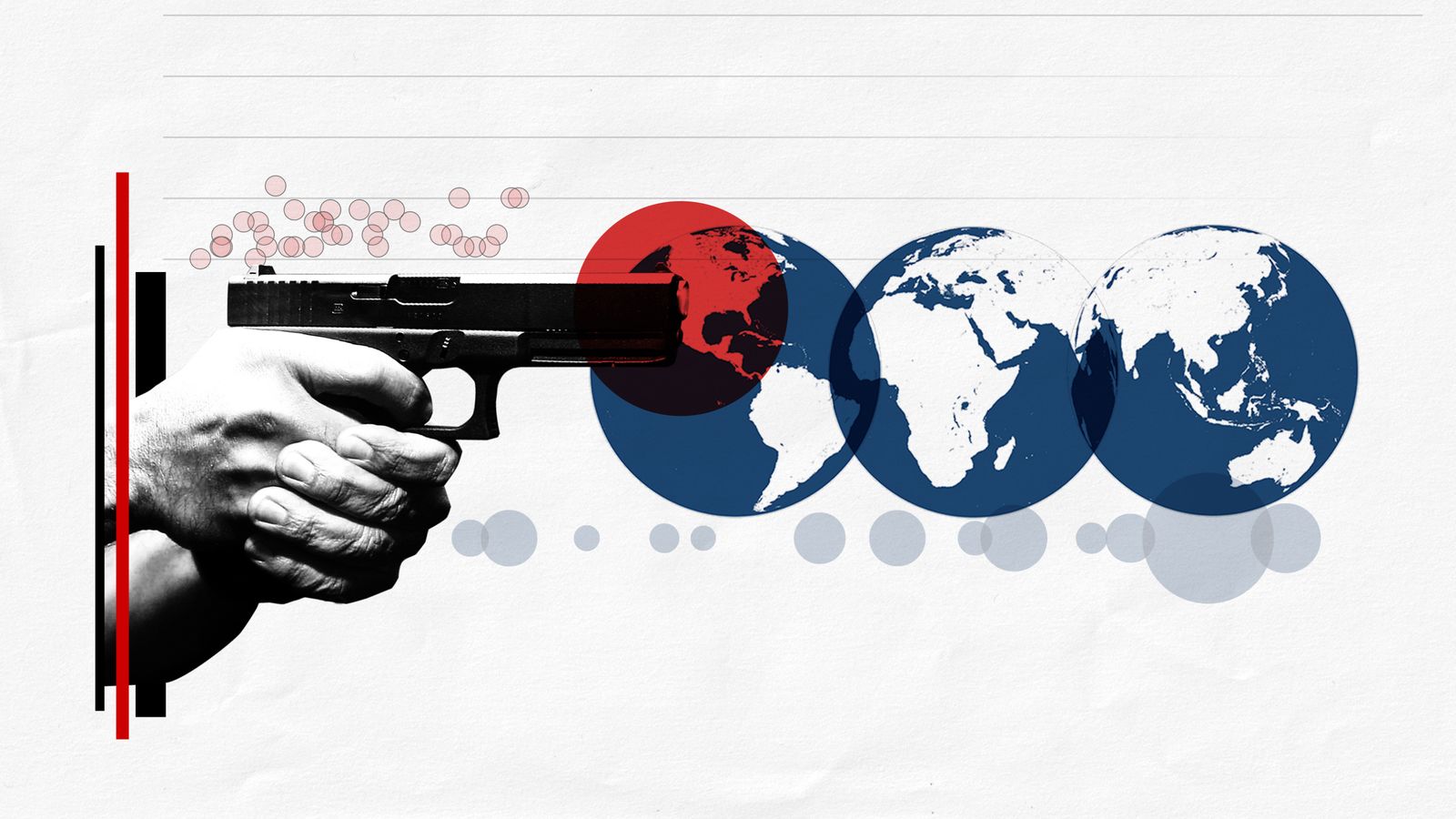
(Image from cnn.com)

Qwertyman No. 34: America the Paradox

Qwertyman for Monday, March 27, 2023

“AMERICA THE Paradox” was the title of an undergraduate paper I wrote on Carlos Bulosan for my class in Philippine literature, in which I observed—as many had done before me—that Bulosan felt deeply conflicted by the two faces that he kept seeing in America. On the one hand, it was the mother with open arms, calling out to the world’s orphans, and accepting of all brave and enterprising spirits. On the other hand, it was the hard fist of racism, viciously averse to all complexions other than white. 

Bulosan arrived in Seattle in 1930, a time of great economic turmoil, and he soon found himself fighting for the exploited poor, becoming a labor organizer and writing radical poetry. He would remain poor for the rest of his short life, despite achieving some degree of literary celebrity following the success of his semi-autobiographical 1946 novel America Is in the Heart. He died of tuberculosis in Seattle in 1956, never having been able to come home. I was so moved by Bulosan’s travails that I gifted our daughter with a signed first edition of his novel as her wedding present, and paid my respects at his grave when I visited Seattle some years ago.

Last Thursday, March 23rd, I joined several hundred other guests for dinner at the Sofitel to celebrate a joyful event: the 75th anniversary of the Fulbright program in the Philippines. Over that period, the Fulbright program, which selects and sends scholars from all over the world to study in the US, has sponsored over 3,000 Filipino scholars and 1,000 American scholars coming to the Philippines. The Philippines—through the Philippine-American Educational Foundation (PAEF)—has the longest-running Fulbright program in the world, dating back to March 23, 1948, hence last week’s big commemoration.

It isn’t hard to see why Sen. J. William Fulbright believed that such a scholarship program was a good idea then, with the Cold War brewing and America projecting itself as the champion of the Free World. For the Philippines, it was a continuation of the prewar practice of sending pensionados to the US, thereby ensuring a cohort of Filipino intellectuals and administrators sympathetic to the American cause.

I myself went out on a Fulbright twice—in 1986, for my MFA at Michigan and then my PhD at Wisconsin, and then in 2014 as a senior scholar at George Washington University. It would be an understatement to say that the Fulbright—especially that first five-year stint—was life-changing for me. The learning was exhilarating, but the living—away from home and family—was fraught with pain.

Still, we Fulbrighters had it much better than Bulosan. Most of our expenses were borne by the American taxpayer (although, because of a budget crunch, I had to teach and also to work part-time as a cook, cashier, and busboy at a Chinese takeout). Our return home was guaranteed (indeed, legally mandated). Most of us enjoyed the hospitality and support of new Fil-Am and American friends. 

Although here and there we had the inevitable brush with racism, we saw America in the best possible light, as a source of knowledge and of the democratic spirit. Arriving in Michigan just after EDSA 1986, I too was seen as living proof of the long and beneficial reach of America’s cultural influence: I could speak English like they did, and (mild boast coming) could write at least as well if not better than they did. 

I recall how, in one Shakespeare class, I was the only one who could explain the difference between “parataxis” and “hypotaxis,” and how, in another class, our professor wrote up a long sentence from one of my stories on the board to demonstrate “Jose’s perfect command of punctuation.” But all that was presumably because of my Americanized education—not even in America, but in the Philippines, where we had seemingly prepared all our lives to come to America, only to find ourselves more indoctrinated than many Americans. (I had memorized all the state capitals in grade school in La Salle, confounding my American friends at Trivial Pursuit.)

Ironically, I also belonged to the First Quarter Storm generation that railed against “American imperialism,” that learned about our colonial exploitation and about the primacy of American self-interest in its transactions with the world. We rallied at the US Embassy against the war in Vietnam and against the US bases in the Philippines. We denounced Ferdinand Marcos as an American puppet, and saw Washington’s hand in every instance of political mayhem around the globe. Where did all that militancy go? Was a scholarship to Hollywood enough to negate these accusations?

Seated at that Fulbright dinner and listening to the speakers extolling our special relationship with America, I thought about Bulosan, the FQS, my Fulbright experience, our daughter in California, my teaching of American literature, and such recent issues as EDCA and the Chinese presence in our territorial waters to sort out my emotions. 

The America that had been such a paradox for Bulosan remains, in many ways, a chimera for us today—speaking with moral authority against the Russian invasion of Ukraine, and yet still enamored in many places of Trumpian demagoguery; espousing peace and human rights while allowing assault rifles on its streets; and promoting education and global literacy while hosting the world’s biggest engines of disinformation. We want to believe in the America that believed in us, although the cynical can argue that “believed” should be taken as “invested,” of whose efficacy this column offers ample proof. 

In the end, I reminded myself of what I tell my students: (1) The American government and the American people are not necessarily the same; (2) The American people are many peoples; there is no single, monolithic America; (3) We study America and its literature not to become Americans, but to be better Filipinos; and (4) We often take the terms “America” and “American” in an ideal or idealized sense, a compound of expectations and aspirations shaped by Abraham Lincoln, Hollywood, cable TV, and Spotify.

We went to America not just to study there, but to study America, and that study continues. 

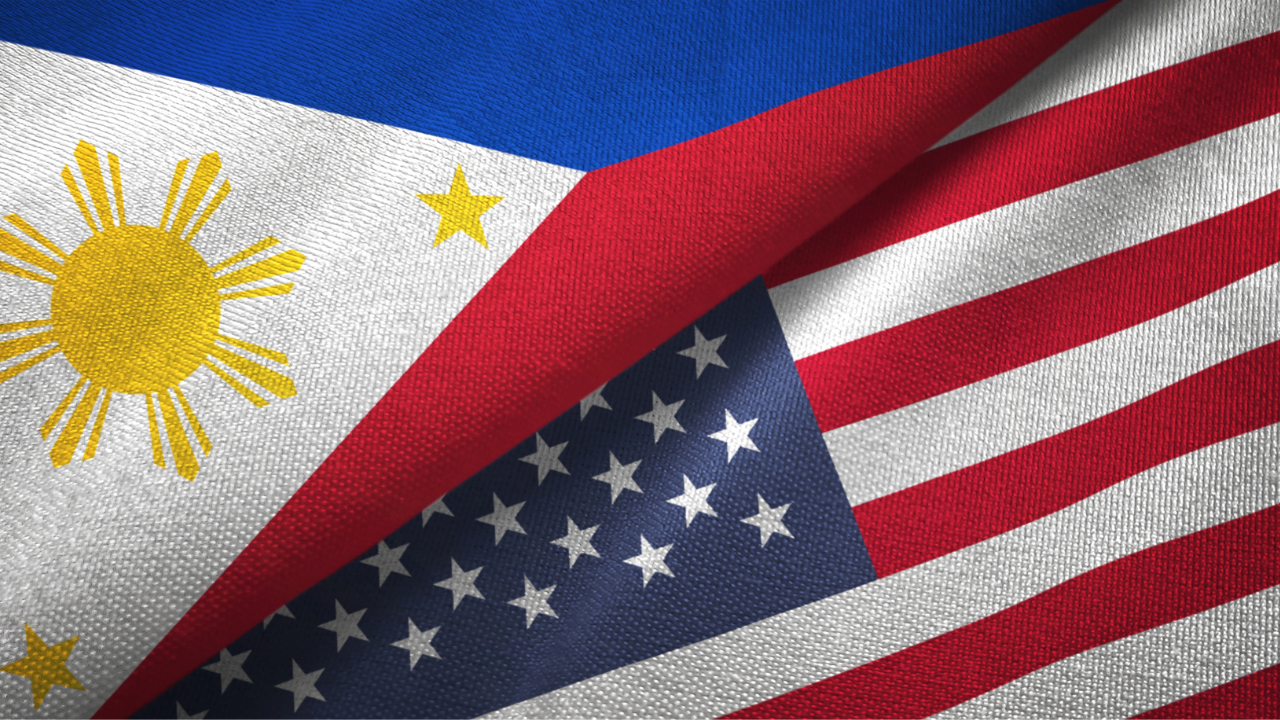
(Image from pacforum.org)

Qwertyman No. 33: The Gunman

Qwertyman for Monday, March 20, 2023

(This story may seem inspired by recent events, but it has nothing to do with the facts of specific cases.)

CPL. ELMER Kabigting heard the hornbill minutes before he spotted it on his PVAR, a kind of a honk followed by a murmur. He knew the sound from the long days and nights he had spent in forests, an almost hourly reminder of time passing, until human footfalls and gunfire broke the spell and sent the birds and monkeys scattering overhead. Through his gunsight, Kabigting watched the hornbill hop from branch to branch until it found just the right one to perch on, peering down at the landscape over its bright red mouth. 

He tried to imagine what the bird could see. A scientist he had befriended in Bukidnon once told him that birds saw colors that humans could not, and that their eyes worked well in the low light of dawn and dusk, enabling them to hunt while other animals stumbled around or waited for things to clarify. The corporal wondered if a gunsight could be made that could see like a bird. The sun was beginning to drop on the horizon, and in an hour it would be hard to tell one van from another, especially if they came in a convoy—not that it mattered, given what he had to do, but something in him revolted at the thought of unnecessary waste. There were things he did not care to see in sharp detail.

Even without pulling the trigger, Kabigting felt the power of the weapon in his hand. The Pneumatic Valve and Rod Rifle was almost new, and if he had had it in Marawi, he might not have lost so many friends. It was supposed to be superior in so many ways—less recoil, less muzzle rise, better accuracy, lower maintenance—and he had heard that it was favored by the Special Forces, which made him feel like he had been promoted, using it today. He didn’t ask Sgt. Galicia where the cache had come from; even while in service, the sergeant had been remarkably resourceful, finding extra rations, gin, and cigarettes for the men, bringing tears even to Capt. Reyes’ eyes. Reyes was an academy graduate who was honest to the core and whose men rolled their eyes when he spoke of “courage, integrity, loyalty” and had them kneel in prayer, but even he could not and did not ask Galicia to stop what he was doing.

Kabigting turned his eye from the hornbill to the road. He knew that, a kilometer up, where the road ascended from a deep valley, a spotter was waiting to let him—let them—know by radio that the convoy was coming. There were six of them, three on either side, two with grenade launchers, the last men a couple of hundred meters down, a gauntlet through which no one would pass alive. Elmer knew three of those men, Marawi veterans like himself whom Sgt. Galicia had located in the bars and slums of Ozamis and Dipolog, people who no longer had much to lose but everything to gain for themselves and their families. 

“What if we get caught—or if we die?” asked one of the six, when they had gathered together to discuss the operation in a carinderia in Dapitan.

“Then your families get everything. They’ll be set for life. If you don’t talk,” said Sgt. Galicia.

“We might be better off dead,” said another, with a chuckle. “If we die, we can’t talk.”

“I don’t have a family,” said yet another man, stubbing his cigarette onto his plate and burning a scar onto the cheap plastic. 

“Then we’ll divide your share among the others,” said the sergeant. “They’re your family now.” The other men laughed but the ex-soldier remained glum. He was one of those whom Elmer knew, and Elmer knew as well that the man’s wife had left with their children after he had broken her nose once too often. 

Elmer thought about his own family—his mother, his wife, and their five children back in Kabankalan, the youngest not even six, the eldest a high school senior who wanted to be a doctor. His daughter’s ambition made him laugh—they couldn’t possibly afford to send her to medical school—but he stopped laughing when she told him that it was for her to cure him if he ever got shot. He did come home once with a bandaged head, telling the children he had been grazed in a firefight with rebels, but he had been roundly bashed in a brawl with fellow soldiers over a card game debt. It wasn’t long after that incident that he found himself on the street and out of uniform, along with the sergeant and several of his buddies, after a local merchant complained to the governor—who happened to be his cousin—that a group of soldiers had broken into his warehouse and had carted away two truckloads of rice.

Yes—Elmer had admitted to his superiors—they had taken the rice, but everyone knew that it had been smuggled in from overseas, so who was the bigger thief? But nobody heard him, Elmer thought, they weren’t even listening.

So when Sgt. Galicia called for a gang of the boys to get together for some jobs, it was easy for Elmer to convince himself that they were still at war, except that this time the enemy was whoever Galicia said was as bad as the rice merchant, whose children went to private schools in Manila and whose wife served as the hermana mayor in the town fiesta. Their first target was the merchant himself, for no money but just to exercise their trigger fingers and feel good about themselves. This was followed by hits on a couple of rural banks, a vice-mayor, a radio commentator, and a regional bureau director, and despite some touch-and-go moments, it all became more routine, especially as the money flowed in and they began buying motorcycles, fishing boats, flat-screen TVs, and smartphones for the kids. Even Elmer’s daughter began to think he was serious when he teased her about taking up plastic surgery, so she could fix his cauliflower ears. 

But those targets were easy and never shot back. Today was going to be different—an armed convoy of a van and two SUVs, including a police escort. They said the vice-governor was going to be in the van in the middle. They knew he preferred to ride the HiAce instead of his armored Montero when he was with his family. Elmer had seen them in church once, at a friend’s wedding. The older boy had a cowlick in his hair. He heard the hornbill’s call again. His radio crackled. The corporal did not want to see whatever the bird could.

Qwertyman No. 32: This Business of Titles

Qwertyman for Monday, March 13, 2023

THERE’S BEEN a lot of buzz online recently about the use of titles like “Doctor” and “PhD,” a topic of inflammatory interest to Pinoys for many of whom those extra letters before and after one’s name can mean everything between abject inconsequence on the one hand and celestial esteem on the other.

While nobody seems to question why public officials from the president down to the barangay kagawad use their titles with gleeful abandon, academic degrees—which are arguably harder to earn honestly than votes—provoke much hand-wringing, notably among academics themselves who like to worry about things that would make ordinary people happy.

To put it simply, some people like using their titles, and others don’t. Those who do believe that they deserve it, having worked their posteriors off to gain them. Those who don’t apparently think that it’s unseemly to earn an exalted degree like a PhD and then to wear it on your T-shirt so nobody forgets to address you by your honorific, “Doctor.” The only “PhDs” I know who are above all this are those who got them for being, say, a generous taipan, and who feel elated to be called “Dr.” for the rest of their lives.

As it happens, I have a PhD in English, which I got more than thirty years ago from the University of Wisconsin-Milwaukee, after my Master of Fine Arts from the University of Michigan. As soon as I say that, I feel like I’m boasting, which I suppose I am. But I only brought it up to make the point that, well, I hardly ever bring it up. Nobody ever calls me “Dr. Dalisay” or “Prof. Dalisay” except in an academic or professional context (they do call me “the Prof” at my favorite poker hangout, where I play with guys going by monikers like Daga, Todas, Hot Sauce, and Paos). I pull it out now and then when I suspect it will enhance my credibility and maybe even my paycheck by 200 percent. But most of the time I’m quite happy to be just “Butch” or “Sir Butch” (or “Ho-zay” when I’m in the US, to save myself the long explanation for why my father Jose Sr. chose to call his first-born “Butch”). 

So for me, it’s entirely situational, and no one should be made to feel immodest if he or she insists on being called “Doctor,” as Dr. Jill Biden does. The only caveat I’ll make is that, among writers, nobody seriously gives a hoot about academic degrees, unless you plan on teaching, which is really what the PhD is for, practically speaking. In UP these days, particularly in the sciences, you can’t teach for long without a PhD—the idea being that going through a doctoral program pushes you beyond your practical experience and innate talent toward some appreciation of theory and into research. 

In the Philippines, for many reasons, it’s still easier for teachers in many universities to become professors before finishing their PhDs, and so there’s a tendency to value the “Dr.” above the “Prof.”—which is not the case in UP and in most foreign universities, where the title “Professor” (meaning a full professor and not an assistant or associate professor) remains one’s ultimate career goal. The presumption is that a PhD should be an entry-level qualification for higher teaching, an early step in one’s ascent to full professorship. (Which reminds me to say that there’s no such degree as “PhD cand.” or “MA units”, as I’ve seen on some CVs—you’ve either done it or you haven’t.)

Why do we fuss over these titles? Because, in a society that offers few material rewards and consolations for academics, they can assume inordinate importance, and invest their holders with an intellectual and moral authority that demands or at least deserves respect—never mind that academia, like the rest of our institutions, is home to any number of crackpots and charlatans in togas, as corruptible as every other traffic cop. Let’s not forget that Hitler’s propaganda minister, Joseph Goebbels, had a PhD in Drama from the University of Heidelberg, and that PhDs from Stanford and Harvard, among others, greased the wheels of Marcos’ martial law.

But lest we think we’re the only ones seemingly obsessed by the trappings of imagined power, there’s at least one other country more retentive down there when it comes to academic titles, perhaps for the opposite reason—not because they’re rare, but because they’re part of such a long and prolific tradition that an elaborate hierarchy has to be put in place. 

That place is Germany—where, until 2008, and thanks to a Nazi-era law, you couldn’t call yourself “Dr.” unless you secured your PhD in Germany itself or was the kind who could fix broken bones. Ian Baldwin, a molecular ecologist from Cornell, found himself charged with “title abuse” when he put “Dr.” before his name on his card, as were at least six other American PhDs working in Germany. The law was later relaxed, but you get the point—when it comes to degrees, Deutschland still thinks of itself as being über alles.

The Germans make one more formal distinction—the precedence of the professor over the PhD, again on the assumption that while PhDs can be had for a dime a dozen, professorship is a career-capping accomplishment achieved only by exemplary research, publication, and mentorship. And thus, if you were teaching at, say, Humboldt University of Berlin (which as of 2020 had 57 Nobel laureates and almost 3,000 PhD students), your full title would be “Prof. Dr. XXX.” And because some people can’t find happiness and fulfillment with just one PhD, they would be called “Prof. Dr. Dr. XXX.” (I kid you not—go ahead and Google it. The Guinness record stands at 33 PhDs for a guy from Hyderabad, whom I don’t even want to begin to address.) Some titles would include variants like “ir” for “ingeneur” or engineer, and “hc” for honoris causa (often conveniently forgotten by hc recipients). The Austrians, I’m told, can be even more particular than the Germans, and can legally use their titles on their passports. The Dutch, by the way, have a “Drs.” degree which can be a bit confusing—it’s short for doctorandus, which means you’re studying for your PhD.

But who cares, other than the title-holder? Certainly not the Quakers, who value equality between people to the point of eschewing all titles, including (until recently, and only in America) “Mr.” and “Mrs.” If you’re familiar enough with each other, you can use first names. If not, then full names will do. When I visited the Quaker HQ in Philadelphia many years ago, I was “Jose Dalisay.” British Quakers were said to have referred to the late Queen as “Betty Windsor.” 

But something tells me that notion of equality won’t work here, where calling people “Digong,” “Bongbong,” and “Sara” won’t bring you any closer to the kingdom of heaven (or some such dominion). 

Qwertyman No. 30: Alternatives to Cha-cha

Qwertyman for Monday, February 27, 2023

WE PINOYS know—as night follows day—that every time a new administration comes to power, a fresh initiative emerges to amend the 1987 post-EDSA Constitution. Fidel V. Ramos tried it with his ill-fated PIRMA campaign, followed by Joseph Estrada’s “Constitutional Correction for Development,” the attempt of Gloria Macapagal-Arroyo’s congressional allies to form a constituent assembly without the Senate, and even Noynoy Aquino’s reported openness to giving the President a second term. Rodrigo Duterte included “charter change” or cha-cha in his platform and tried to push it until Covid came.

Most Filipinos, let’s admit it, don’t even know what the Constitution contains, but a few of us seem hell-bent on changing whatever is in there. Never, of course, for selfish reasons like extending term limits (now why would we even suspect our politicos capable of such nefarious designs?) but for “economic provisions only” (although extending one’s term limit is a very healthy economic provision, as far as I can tell). 

Cha-cha is in the air once again, fellow citizens, going around the House and Senate like a marching band, despite President Marcos Jr.’s public disavowal of support for the proposal. 

Even the National Economic and Development Authority’s estimate that cha-cha—the convention and the plebiscite—could cost as much as P28 billion (yes, that’s a B) isn’t likely to deter its proponents from advancing their cause. With more than five years to go under BBM, a lot of plausible reasons could be found for coughing up that money. Why, even the President could change his mind over that period, persuaded perhaps by a groundswell of demand for cha-cha that he can’t possibly ignore. (Why am I suddenly thinking of that pool resort in Cavite with the artificial wave machine that we so enjoyed last summer?)

Perplexed by this insistence on the need for cha-cha now, I turned to my favorite chatmate, sounding board, and political counselor—ChatGPT—for some answers and explanations. (I know what you’re thinking—I’m just making all of this up—but no: I actually paid good money for this app, so I’m going to get  my money’s worth. If you don’t believe me, try asking it the same questions.) Here’s a transcript of my conversation with ChatGPT:

ChatGPT: Hello, How can I assist you?


Qwertyman: How important is cha-cha to the Philippines?


ChatGPT: Cha-cha is an important dance to the Philippines, as it represents their culture and traditions. It holds a special place in the hearts of many Filipinos and is regarded as a national dance. It is often performed in public gatherings and celebrations to bring people together and express joy and happiness.

(Hmmm, I don’t know where you got that, ChatGPT. Pinoys who remember Nestor de Villa and “Dancetime with Chito” might have a hankering for the cha-cha, but I don’t see any great demand for it from millennials or even their parents. Are you sure it’s that special to us?)


Qwertyman: Why cha-cha? Why not the twist or the shingaling?


ChatGPT: The cha-cha is a distinctive Latin dance with an easily recognizable beat, which makes it easy to follow. It’s also more graceful and flowing than other partner dances, making it well-suited to more formal events. In addition, its pattern of three steps forward and two steps back is easy to learn, making it a great choice for beginners.

(That’s what worries me, ChatGPT. As you say, it’s “a great choice for beginners,” which is probably why a rookie senator is on top of the process. Some of us are also worried that cha-cha will mean two steps forward and three steps back.)


Qwertyman: But what if people just want to sit down and not do the cha-cha?


ChatGPT: That’s perfectly fine! There are many ways to have fun and enjoy one another’s company without having to do the cha-cha. You could play board games, cards, watch a movie, listen to music, engage in conversation, etc. Whatever makes you and the people around you comfortable and entertained is the best way to go!

(Totally agree! Someone should tell our esteemed lawmakers that they can do this, too—play board games, cards, watch a movie, listen to music, engage in conversation—rather than tinker with the Constitution, especially if it’s beyond their comprehension.)


Qwertyman: What are the dangers of doing the cha-cha?


ChatGPT: The dangers of doing the cha-cha include: 1. Potential for pulled muscles or sprains due to improper form, which increases the risk of injury. 2. Risk of slipping and falling since the cha-cha can involve quick, sharp movements. 3. Risk of strain on the joints due to the fast, jumping nature of the dance. 4. Risk of overheating due to the amount of movement required for the cha-cha.

(To which we can add: 1. The potential for a further decline in the quality of our leadership, by the extension of political dynasties into future generations of inbred politicians, raising the genetic potential for imbecility. 2. Risk of slipping and falling back into old ways and faces of governance. 3. Risk of strain on the national budget. 4. Risk of overheating the political climate.)

Qwertyman: Is it better to do the cha-cha today or some other time?


ChatGPT: That depends on what you have planned for today. If you have other commitments or would like to save the cha-cha for another time, it is best to choose an alternate date.

(Other commitments? Hmmm, let me think. Defending our patrimony in the West Philippine Sea? Achieving price stability for basic commodities? Fighting corruption? Raising the competencies of our children in STEM? Dispensing justice, especially in long drawn-out cases like the Maguindanao Massacre, the tokhang murders, and Leila de Lima’s incarceration? Providing housing, livelihood, and adequate social security to the poorest Filipinos? Is this list long enough?)


Qwertyman: What are the best alternatives to the cha-cha?


ChatGPT: 1. Bachata 2. Salsa 3. Merengue 4. Cumbia 5. Samba 6. Paso Doble 7. Tango 8. West Coast Swing 9. Bolero 10. Contemporary Latin Dance.

(I have to admit you got me there, ChatGPT. I’ve never heard of the bachata—unless you mean “ban charter talk”?)

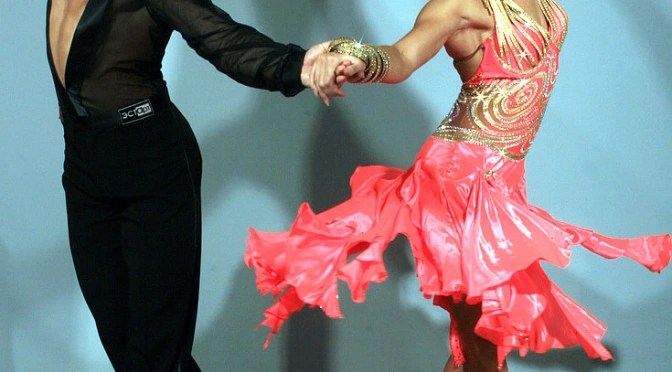
(Image from The Adobo Chronicles)

Qwertyman No. 29: Balloon over Boracay

Qwertyman for Monday, February 20, 2023

WHEN THE balloon was first spotted high over Boracay, some people thought it was a new ride, a welcome addition to the banana boats and paragliders that the tourists couldn’t seem to get enough of. 

“How much does it cost? Where does it land?” asked Akmal from landlocked Uzbekistan, whose belly was white as fish and whose hair reminded the locals of the red seaweed that sometimes strayed into the island’s waters. 

“Does it have a basket? I don’t see any people,” said Frida from icy Norway, who had actually flown on hot-air balloons where they were popular, as in Turkey’s Cappadocia and California’s Napa Valley. 

“It’s not from here,” said Gordo, the boy from Manoc-Manoc whose job it was to lash the ferry boats from Caticlan to their moorings and to take the hand of passengers stepping onto the pier. He had seen everything there was to see in Boracay in all of his seventeen years, from the shameless couplings on the surf to the occasional victim washed up on the shore, and all cuts of humankind from cigar-chomping Texans to barrel-chested Samoans, and he knew what belonged and what didn’t. This silver dot in the sky definitely did not. 

As if having a mind of its own, the balloon drifted north of the island to Yapak over Puka Shell Beach, then back down again over White Beach, where it attracted even more observers. Men who had been using their telescopes and cameras to focus on the usual bathing beauties turned their gear skyward to where people were pointing, and those with the longest lenses snapped pictures of the aerial intruder, for posting on Instagram and Facebook as the curiosity of the day.

Unknown to them, however, the balloon had been spotted much earlier by the government’s Aerial Surveillance Bureau, whose chief had hastily summoned his staff to an emergency meeting at the ASB’s secret command center, on the fringe of a golf course in southern Manila. The ASB’s Director O, a retired Air Force general, was still pulling off his gloves when his subordinates dropped into their seats and the lights went out. A blurry image of the drifting balloon appeared onscreen.

“This unidentified object entered our airspace above the Spratlys at 0423 hours, when it was too dark to be seen by our human spotters. It has since set course for Boracay Island, above which it has remained since 0933 hours, when it was finally spotted by one of our boys who was chasing a monkey up a coconut tree. Now the question is, what is it, who sent it, and why is it here? Is it friend or foe? The President expects me to report to him in the Palace in one hour and I need answers!”

“Sir, if I may,” said his Deputy Director M, “it looks exactly like the one they shot down over the USA and Canada. It’s a weather balloon from—from that country—equipped with advanced surveillance hardware and sophisticated communications capabilities.” It had been ordered since the previous administration not to mention “that country” by name in discussions of national security, so as not to give offense to a favored neighbor, and the habit had stuck, even in private conversations.

“Let’s not jump to conclusions!” said Director O. “There are many other countries perfectly capable of sending up these balloons. For all we know it could be a Lithuanian, a Ugandan, or a Wakandan balloon. I’m not going to upset the ambassador from that country with unproven allegations about his country’s behavior—however outrageous, obnoxious, and objectionable its actions are in the West Philippine Sea, just between you and me.”

“But why is it here, sir? And why Boracay?”

“Good question. Don’t quote me on this, but during the last National Security Council meeting, we were told that that country is preparing to reveal a new Thirteen-Dash Line map, supposedly drawn in the 16th century just before the Spanish came, that extends all the way to Boracay!”

“What?! But Stations 1, 2, and 3 are inalienable parts of our national patrimony! As Winston Churchill said, ‘We shall fight on the beaches, we shall fight on the landing ground, we shall fight on the hills, we shall never surrender!’”

“Yes, but in Boracay, people make love, not war. Imagine having to clean up all that white sand after an invasion. Another six-month lockdown! Can Philippine tourism afford it?”

“So what do we do, sir? Do we bring down this balloon?”

“With what? I already called the Air Force to see if they could fly by the object, but all of our fighters are undergoing maintenance—change oil, check battery, adjust brakes, etc.”

“What about kwitis?”

“Are you making a bad joke in a national emergency?”

“No, sir! The DOST and DND have a secret research program based in Bulacan called the Katipunan Weapons Initiative To Initiate Security, or KWITIS. It’s a multi-stage kwitis that can protect the archipelago against missiles, drones, asteroids, and UFOs like the Boracay balloon! It’s totally indigenous and sustainable, because it uses kawayan for the frame and kiping for decoration and employs out-of-work firecracker makers in the off-season—”

Just then another aide burst into the conference room, breathless with news.

“Sir! Turn on the TV! The balloon is down. The balloon came down!”

They switched to a live feed from CNN, which showed the balloon settled on the beach, its silver skin acting like a mirror for the dozens of kibitzers crowding around it, taking their selfies and groufies with gay abandon. A couple of local policemen who had tried to restrain the crowd were taking their selfies as well, flashing the “heart” hand-sign. “The balloon touched down about fifteen minutes ago on its own, and it is quickly becoming the center of what could become the biggest Boracay party ever! There are still no obvious indications of where it came from or why it is here, but this balloon seems to be totally harmless, so far, even ‘cute,’ according to Loujay, who’s visiting from London,” gushed the reporter. 

And then small puffs of red, blue, and yellow smoke came out of the metal box at the bottom of the balloon, and for a minute the people shrieked and began running away, but as the smoke dispersed and the people inhaled the fumes, their faces lit up in ecstasy and they began dancing. Music also poured out of the balloon—the frenetic techno club mix that brought even the masahistas and the barbecue vendors to their feet.

“I know that, sir! That’s Stefano DJ Stoneangels!” said Deputy Director M, whose shoulders began moving up and down. “This is even more mysterious than we thought. We are under attack!”

“Indeed we are,” said Director O. “We need to investigate further. Pack up, boys, and bring your trunks, we’re going to Boracay!”

(Image from madmonkeyhostels.com)

Qwertyman No. 28: Catching Fluffy

Qwertyman for Monday, February 13, 2023

(Disclaimer: Our story today has nothing to do with the recent capture and deportation of the Japanese criminal mastermind known as “Luffy,” for which we congratulate our brave and vigilant law enforcers, although I have to admit to being inspired by that diabolically fearsome alias.)

HIS PHONE rang at the worst possible time. The chief of the Metropolitan Investigation Division was just about to reach the climax of his story—the ladies around him all open-mouthed and wide-eyed in anticipation—when the Tiktok “Moonlight” song, which he had been using as his ringtone, broke the spell, instantly sending some of the girls into their habitual gyrations.

“Chief!” exclaimed Melanie, his special girl in the club, “I didn’t know you liked that song! You’re so cool! Come, let’s dance!” She took his free hand and tried to drag him to the dancefloor, but he resisted. It was unusual for Chief Tiny (short for “Agustin”) to resist Melanie’s persuasions, but she could see from his look that this was something serious.

Chief Tiny had spotted the name on the call—Bungi, his lead investigator—and he knew that Bungi knew not to call him at this hour for any reason less than to report the mysterious sighting of a bearded man walking on the waters of Manila Bay. If this was just to tell him that his wife was at the station looking for him again, for which Bungi was supposed to have had a dozen excuses at his disposal, why, he was going to make sure Bungi was demoted to jail guard in charge of sanitation. Tiny was especially annoyed because he had been trying to impress the girls with his story of how he had found and captured Don Waldo—the country’s most notorious drug and gambling lord, compadre to this senator and that congressman, master of a reputed harem of 100 women, and ruthless widow-maker dozens of times over. Tiny had geo-located him through the Facebook feeds of his then girlfriend, the previous year’s Ms. Matabungkay, and had negotiated his peaceful surrender, much to everyone’s relief. Of course, he wasn’t going to tell them that Don Waldo posted bail one hour after he was arrested, and that the two men had exchanged winks at the station after the media photographers had had their fill. It was all part of his standard MO: catch the bad guy, work out a deal, and let him off the hook on some technicality. 

“Boss,” said Bungi in a whisper over the phone, “we found him—Fluffy.”

“Fluffy!” Tiny screamed with all his 250 pounds, jolting everyone. “Are you sure it’s him, the Fluffy, ourFluffy?”

“Yes, sir. Of course they call him ‘Fruffy’ in Japanese, but I saw him myself—absolutely no doubt he’s our man.”

As Chief Tiny continued to chat with his caller, Melanie shrank back into her seat beside the chief, trying to catch as much of the conversation as she could while collecting her own thoughts. She knew this man called “Fluffy”—personally, professionally, biblically, in all kinds of ways. When the chief wasn’t around, Fluffy took his place in her private quarters, in a condo overlooking the Pasig River, from the other side of which she had triumphantly risen. Initially there had been a language problem—his vocabulary would have been considered coarse even in Japan—but what they needed to communicate did not require too many hand-signs. What didn’t need explaining was his nickname, made obvious by the two clumps of steel-woolly hair on his head, like a poodle.

From his Pinoy bodyguard, Melanie learned that Fluffy ran an extensive Japanese mafia in the Philippines, which controlled the distribution of everything from fake Japanese car parts, Ebisu dolls, Voltes V figurines, and ramen noodles. They competed with an equally vicious Korean mafia engaged in pushing fake Korean car parts, BTS coffee mugs, CLOY T-shirts, and kimchi, as well as a Chinese mafia flooding the market with fake American, European, and everyone-else’s car parts, imported galunggong, POGO workers, and tikoy. Sometimes the rivalry got too hot and blood was spilled on Manila’s streets, giving Chief Tiny unnecessary headaches that required a few hours with Melanie to cure. But now Melanie herself felt the onset of a massive migraine: if her two patrons found out about the other and their common interest, then all hell would break loose.

“Sorry, girls, but I have to go,” Chief Tiny announced, getting to his feet. “I have to catch a master criminal.” With that, he gave Melanie a quick hug, and hurried off.

Melanie had to think fast. Chief Tiny made her feel protected—not only when he encircled her in his ham-like arms, but more importantly when she or her friends ran into trouble or needed a big favor like a police escort for a relative’s funeral. Fluffy was strange but sweet, gifting her with exotic desserts like green tea cookies and mochi; she was scared but also thrilled by his insistence that she take on his tattoos. Whom would she choose? She thought of sending Chief Tiny an anonymous text message telling him where Fluffy was, but then they already knew that. She thought of sending Fluffy another message to tell him that Chief Tiny was on his way to get him, but if he ran away then that would only prolong her own predicament. She decided to let fate take its course and to stick by whoever survived. Meanwhile, she wasn’t going to waste her time, and moved on to the next cubicle to make the acquaintance of a Korean gentleman who reminded her of that oppa Gong Yoo.

Two hours later, Melanie and her new partner were happily warbling BTS’ “Butter” on the videoke: “Smooth like butter, like a criminal undercover / Gon’ pop like trouble breaking into your heart like that, ooh!”Suddenly she heard two all-too-familiar voices from the other side.

“You’re very hard to catch, Mr. Fluffy! You’re very good!”

“No, Mr. Tiny, you’re better because you caught me, haha!”

“Next time, don’t hide under the table, haha! That’s the first place we look!”

“Thank you for not shooting me, haha!”

“How can we be friends if I shoot you, haha! Now, let’s have a good time—I will introduce you to my very pretty girlfriend!”

“You also have a very pretty girlfriend, also here? Me, too! But my girlfriend is prettier, haha!”

The Korean gentleman in the next cubicle was perplexed. “Melanie! Where you go? Why you hiding under the table?”

(Photo from bbc.com)