Qwertyman No. 145: The Devil on My Shoulder

Qwertyman for Monday, May 12, 2025

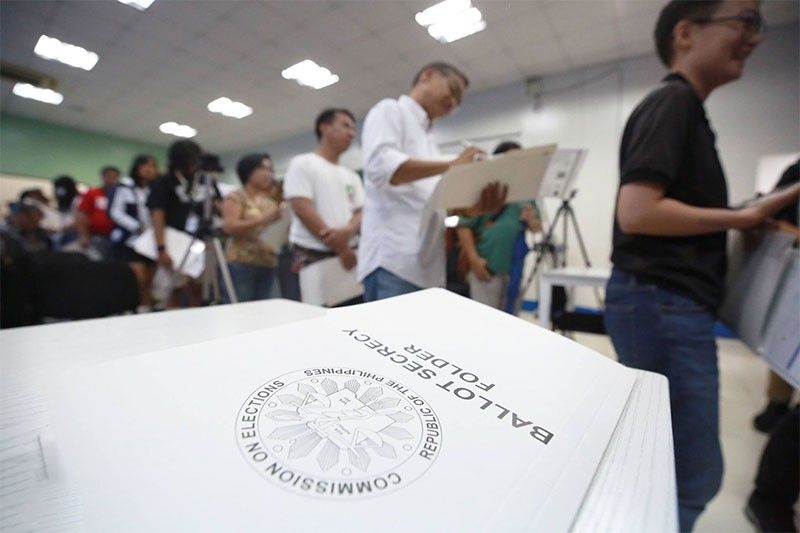
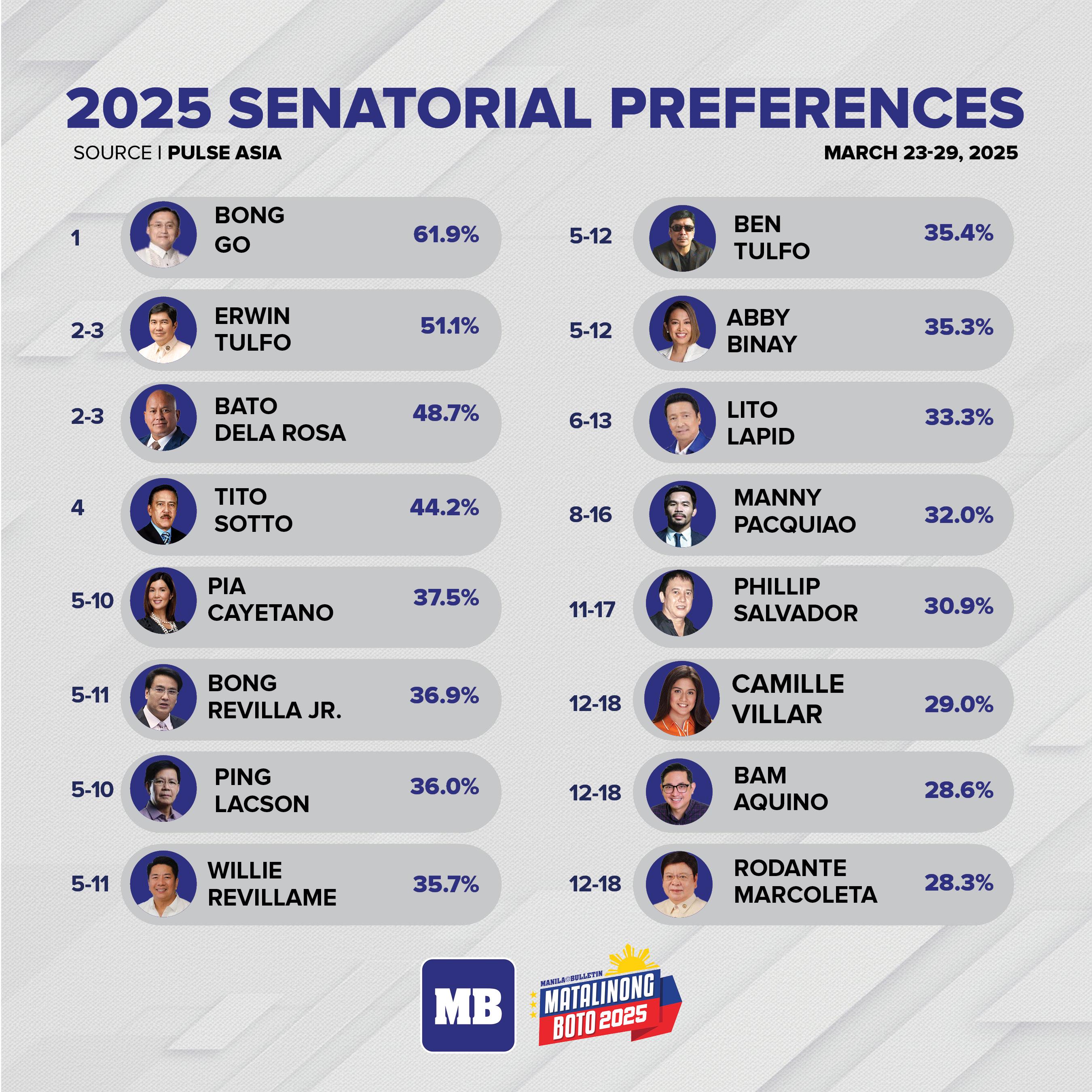
TODAY, ONCE again, we troop to the polling booths in the hope of making our votes matter—votes that, if the cynics are to be believed, might as well be dust in the wind. The surveys have spoken, the winners named. All that remains is for this day to be over, for the formalities to be done with, for the supposedly inevitable to play itself out. And then we’ll watch the new-old Senators of the Republic proclaimed in a ceremony that will showcase the state of our electoral mind. 

As absurd as it may seem, many Pinoys will actually be happy with the outcome—that’s what the surveys are all about, aren’t they? These are the senators we wanted—or most of us, anyway. “Most of them” is probably what you’re thinking, if you’re a regular reader of this column and agree with most of my views.

I can’t think of a more complicated election in recent times, in terms of an answer to the question of “What’s in our best interest as Filipinos, and how do we make that happen?”

The idealist in me has the simplest and probably the morally most unambiguous response: vote for the best candidates, period: the intelligent, the progressive, the principled, the proven, the humane, the hardworking, the uncompromised. Whether they win or lose, it shouldn’t matter—you’ve done your best as a responsible citizen; in a sense, you’ve won. I sorely want to believe this, and to do this today.

But persistently, impishly, like a little devil perched on my shoulder, a contrarian spirit urges me to temper my idealism with some consideration of its practical costs.

Last week in California, a Fil-Am friend asked me to explain the significance of these elections. In the US, midterms usually mean a referendum on the incumbent President’s performance, and next year will most definitely be one for the Orange Pope and his systematic dismantling of American democracy.

For us Filipinos, May 2025 isn’t that clear-cut—although it should have been, if the armies of May 2022 had remained in place, leaving us with a stark choice between the good and the bad.

But the ruling “Uniteam” alliance has since collapsed, with each side fielding its own troubled slate of aspirants, all seething with the most primal of motives: survival, revenge, profit, and opportunity.

The opposition seems to be a loose coalition of liberal, Left, and anti-administration forces. Among these, four names have consistently surged to the top in the kind of social media neighborhood I inhabit. I’ll call them my Triple A candidates, the ones I won’t have any second thoughts about, leaving me with eight more spots to fill.

It’s those eight that give me pause—not for any lack of qualified and virtuous prospects, but because there could be dire consequences for not filling up the rest of my ballot, as some have suggested, or voting for names without a prayer of winning, as a matter of principle (or, by this time, by force of habit).

It’s interesting to observe how, unlike in previous elections where voting straight for a party’s slate was the norm, various formulas and menus have emerged on social media—cafeteria or halo-halo style—to reflect this urge for some balance between the ideal and the practical in this three-cornered fight. Even opposition stalwarts, including Leni Robredo herself, have been excoriated for their previously unthinkable endorsements of certain candidates from the other side. Whatever happened to ideological purity? (It was always an illusion: note the Left’s earlier alliances with a notoriously bloodthirsty Digong Duterte and an unabashedly capitalist Manny Villar.)

I think many Filipinos understand what’s at stake in this election—not just who will compose the next Senate, but what that composition will mean. As I told my Fil-Am friend, Rodrigo Duterte may be safely imprisoned in the Netherlands, but his specter looms large and heavy over these midterms, through his proxies led by his daughter, VP Sara and their “DuterTEN” team (now more like DuterTWELVE, if you add one Marcos and one Villar). Sara was all set to be impeached for grave threats against the First Family and grand theft Piattos—which would not only have taken her out as VP but disqualified her from running for President in 2028. But that procedure—needing at least 16 votes in the Senate—got kicked down the road, after the election, leaving Sara’s fate up to the newly reconstituted Senate to seal.

So again, I told my friend, presuming that the BBM administration’s game plan here is to freeze Sara out of the presidency so it can install its own man, 2025 is really all about 2028. It’s a referendum, sure—not so much about the present President, but rather the past and maybe the future one. We’re not just—or not even—voting necessarily for the best candidates, but for senators who will push Sara out, or keep her in. Daddy Digong’s summary extradition to the ICC, while a relief for many, merely intensified that drama, raising the stakes to a matter of survival for the Dutertes.

It’s another sad and sorry spot to be in, for these elections to come down to choosing among the lesser or the least of 8, or 16, or 24 evils, against the statistical near-certainty of another wipeout for the truly good. Should I support this fairly familiar trapo, the devil I know, over that manifest idiot, just to help ensure that the latter stays out? Or, again, should I simply disregard all the surveys and scenarios, and vote from my purest and most innocent of hearts for the best people on that ballot? (Was this how the cardinals chose Pope Leo XIV, or did more pragmatic considerations come into play?)

By the time you read this, I shall have cast an early vote as a senior in my barangay. Like we often say, we are whom we vote for, and there’s a part of me that fears what I’ve become or may have to be. I need some of that Holy Spirit with me today—we all will.

Qwertyman No. 141: Purity and Perfection

Qwertyman for Monday, April 14, 2025

LAST WEEK, former Commission on Audit Commissioner and senatorial candidate Heidi Mendoza—a staunch exponent of good governance and nemesis of crooks—drew flak from some people who would have been her natural allies on the liberal side of the political spectrum: the LGBTQ community. At issue was her expressed disagreement with same-sex marriage, as a personal belief she did not seek to impose on anyone else. That still wasn’t enough for some same-sex marriage advocates, who announced their withdrawal of their support for her candidacy.

Of course both Heidi and her detractors have a right to their opinions, but I can’t help thinking that the only people chuckling at this situation are avatars of neither good governance nor gender rights, but the enemies of both.

Heidi Mendoza hasn’t been alone in this position of being seen to have been right on many things but wrong on—well, something, but something big enough to destroy and erase whatever good they’d done before. “Being seen” is important here, because it’s a matter of perception; like beauty, “wrongness” is in the eyes of the beholder. 

Today’s social media is populated by such beholders who can’t wait to see personalities make what they deem to be mistakes, and often to point those out with all the hawkish attentiveness of dancesport judges and the ruthless certitude of Pharisees. 

I’m sure you’ve come across many more such instances of people whom you thought you knew and whose ideas you had largely agreed with, only to find them—suddenly one morning—the object of the nastiest vitriol the Internet can be capable of dishing. Once blood is spotted in the water, the sharks start circling and a feeding frenzy follows. Many comments simply echo the previous one, seeking to be even louder and crueler; little attention is paid to context and nuance.

Witness what has happened just these past few weeks:

A political scientist and commentator who had grown a substantial following for his liberal positions got skewered for comparing Mindanao to sub-Saharan Africa. Never mind his explanatory reference to a scholarly study which made that comparison based on certain criteria. In the verbal shorthand of a TV interview, the soundbite was all that mattered to many.

An expert on infectious diseases—globally recognized in that field—was savaged for opining that former President Rodrigo Duterte should have been tried by a Philippine court instead of being bundled off to The Hague. Never mind that the good doctor made it clear that he was against EJK and all the wrongs that the old man is now in the dock for. Netizens seemed to take it against him that he tried to explain how many Mindanawons felt about Duterte, and that he had worked under that administration to help stop Covid during the pandemic.

A prominent journalist and exponent of ethical journalism—also a fervent convert to evangelical Christianity—upset and lost many friends when he declared his disagreement with the idea of transgender athletes competing with their biological counterparts. (It was a view shared by a former student of mine, a lawyer and legal scholar of the same religious persuasion.) This man’s longstanding commitment to the truth and to justice seemed trivial compared to what he had to say on this one issue.

No doubt these issues are centrally important to some, the litmus test by which they judge people’s character and their “true colors.” But which color is truly “true”—the mass of blue or the spot of yellow? And what effect does single-issue politics have on the big picture?

I wonder what all those Arab-Americans who withheld their vote for Kamala Harris because she didn’t sound pro-Palestinian enough are thinking now that the man they effectively helped return to power is speaking unabashedly about Gaza as “an incredible piece of real estate.” I know that some continue to insist that they did the right thing in holding on to the one issue that mattered to them, and of course it was their right to do so. But I can’t help thinking of all those Fil-Ams who trumpeted the Orange Guy’s alleged support for the rights of the unborn, in disregard of all the pain and misery he’s causing to the born. 

Me, I’m as liberal as they come, with all of that word’s pitfalls and contradictions. I believe in civil liberties and human rights, in free speech, in freedom from censorship, in the equal application of the law for all. I also support divorce, same-sex marriage, abortion rights, transgender rights, and gun control. I stand neither with Zionists nor Hamas but for peace for the people of Israel and Palestine. I believe in and pray to God—a God who is good and just—but mistrust organized religion and both extreme Right and Left (indeed, anyone who claims to know how life should be lived) and resist doctrine of any kind, whether Church, State, or Party. If you’re my FB friend and you find any of these too reprehensible for comfort, feel free to unfriend me, or to stop reading this column. 

I have to admit that, following major upheavals like the 2022 election and the Duterte arrest, I’ve lightened my roster of Facebook friends by offloading a number of characters whose preferences I loathed. I didn’t have any qualms about that, because they were “friends” only in the shallowest Facebook sense of the word. (I find Facebook useful, but blame it for its degradation and devaluation of “friendship.”) Most had never interacted with me, and neither of us would miss the other.

But there are friends you have in real life who are arguably worth more than their politics or religion. By this I don’t mean that they fatten your bank account or make your life easier (although some might); if anything, they remind us how much more complicated people and life can be, and how ideological purity or moral perfection may ultimately be less important (and certainly more boring) than the challenge of finding some common ground and surviving together. In continuing to talk with them, we talk with ourselves and those parts of us still capable of doubt and wonder. 

So disagree as I may with her on this particular point, I’m voting for Heidi Mendoza. I suspect I stand a better chance of convincing her to support same-sex marriage than of straightening out the crooks and dimwits eager to take her place in our already benighted Senate.

Qwertyman No. 139: Filipinos for Nothing

Qwertyman for Monday, March 31, 2025

THERE’S A part of me that wants to stop beating up on the Dutertes, lest I be accused of being part of the Marcos propaganda machine (which stands to benefit from all this anyway, whatever I say), but like the gift that keeps on giving, the D’s and their people just won’t let me let them be. Being no lawyer, I’ll have nothing to say on the legality or otherwise of the former President’s arrest and forced departure for the Netherlands—except to opine, as others have, that justice sometimes works in mysterious ways.

My beef for this week is how the Duterte Agitprop Department (let’s call it DAD, like Elon Musk’s DOGE) has spun the whole ICC affair in the public sphere. These days, you never expect people to stand on the truth and nothing but the truth in these political matters. But you do hope for s0me degree of sophistication, for the kind of professional finesse that will justify the multimillions that any PR crew tasked with saving Rodrigo Duterte’s skin—or barring that, at least his reputation—will have been budgeted.

There are three propositions by the Duterte camp that I want to focus on, among many others that have arisen since the arrest.

First, his supposed global allies and endorsers. 

Donald Trump, for example, reportedly took precious time out from dismantling American democracy to declare that “We will protect Rodrigo and the Filipino people from the oppression you are facing…. I and the United States will not allow any of our allies and friends to suffer, and we will impose sanctions against the Marcos Administration for the unlawful act they did.” Why, he had even called Xi Jinping—not about tariffs, not about Taiwan, not about American forces in the Philippines—but about the “serious matter concerning our good friend Rodrigo.” For his part, Xi Jinping—who on a state visit to Manila did say “Our relations have now seen a rainbow after the rain” in response to Duterte’s more prosaic “I simply love Xi Jinping!”—supposedly brought up the Duterte arrest and the ICC in his opening address to the Boao Forum for Asia. Not to be outdone, another Duterte hero, Vladimir Putin, was reported to have threatened (someone—not specified) with “grave consequences” for Duterte’s arrest, as it violated the Rome Statute (which Russia incidentally pulled out of in 2016).

It’s all good when a national leader of superlative virtue and achievement has been so badly wronged that the world takes notice and his peers rise up in alarm to protest the injustice. But really—Donald Trump, Xi Jinping, and Vladimir Putin, all of them prime candidates for the ICC’s hospitality (Putin already is, along with Benjamin Netanyahu)? Never mind that all these supposed endorsements turned out to be fake; they still elicited applause from the DDS faithful, which I suppose was the intended effect. Q: Would it have been too much to expect an endorsement from the likes of Pope Francis? A: Yes.

Second, that call for OFWs to stop remitting their earnings home in a “Zero-Remittance Week” protest.

Our overseas workers contributed nearly $40 billion to the Philippine economy last year, so someone at DAD must have figured it would be brilliant to prick that bubble in the name of remitting Duterte home. But yet again, really? 

Granted, PRRD created the Department of Migrant Workers and the OFW Bank, and brought home hundreds of thousands of OFWs during the pandemic. Former OWWA chief Hans Cacdac even called him “the father of OFWs.” I don’t doubt that the Duterte name has a lot of traction in our expatriate communities, and that flexing a bit of their economic power in a week-long protest will ring some alarm bells, but you might as well ask people to chop off a finger to prove their fealty. For how long do you imagine will Pinoys postpone housing amortizations, tuition payments, maintenance meds, and grocery expenses to protest even the crucifixion of Jesus Christ?

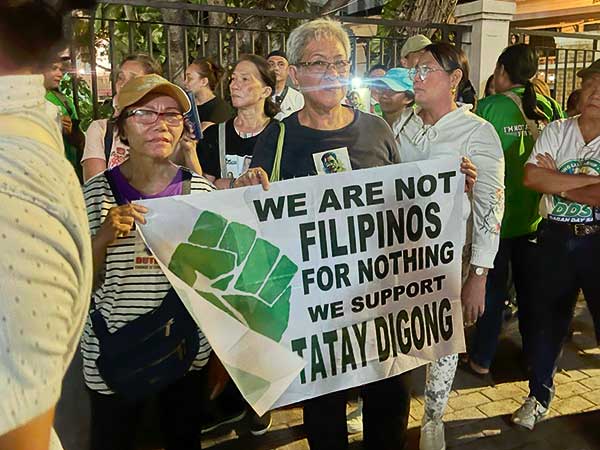
Lastly, and perhaps closest to my propagandist’s heart, there’s that inexplicably vague “I am not a Filipino for nothing” slogan.

Sure, it sounds brave and bold—like it actually says and means something. But does it, really? I’ve been turning the statement around and around in my head and maybe I’m extraordinarily dense and unreceptive but I just don’t get it. In rhetoric, double negatives are often used to suggest or even emphasize the opposite (the technical term is “litotes,” as in “That’s not a bad idea” or “She’s hardly destitute”). 

Rarely do double negatives make good copy for T-shirts and streamers, if you want to rally the masses. Well, there was Winston Churchill’s “We shall never surrender” (arguably a double negative) speech on the occasion of the Battle of Britain in June 1940, but that statement was preceded by a string of powerful positives: “We shall fight in France, we shall fight on the seas and oceans, we shall fight on the beaches, we shall fight on the landing grounds, we shall never surrender.”

Ninoy Aquino—who must be rolling in his grave at being compared to Digong Duterte—famously said “The Filipino is worth dying for,” a slogan ironically made all the more resonant by the fact that it turned out to be self-fulfilling. I doubt that Duterte will carry his emulation to that extreme, but he or his handlers can learn from its clarity and brevity, which contribute to its emotional appeal. “I am not a Filipino for nothing” means, well, nothing. It says nothing about freedom, justice, peace, love, patriotism, godliness, courage, or integrity—none of the grand ideals and ideas that our heroes exemplified. Might it be because these notions were never really associated with a president whom we best remember for his crude expletives and constant exhortations to kill? 

“Sampalin ang ICC!” sounds much more honestly him. It still sounds lame, especially given where he is right now, but it seems more purposeful, and should look good on a green T-shirt.

Qwertyman No. 138: Dutch Entertainment

Qwertyman for Monday, March 24, 2025

AS I’VE mentioned here before, I was a prisoner once—under martial law, for more than seven months, when I was eighteen. I had been arrested without a warrant for unspecified offenses against the State, on the strength of an Arrest, Search, and Seizure Order (ASSO) issued by Defense Secretary Juan Ponce Enrile. ASSOs were literally a catch-all piece of paper, meant to capture anyone whose face the regime didn’t like. I was sleeping at home when military agents barged in, and scooped me up in front of my terrified parents.

Our prison stood on a patch of land where the upscale BGC stands now; when we looked out at night we could see the neon lights of Guadalupe flashing. We had a small library in the back, TV in the mess hall, chess, calisthenics, and rumor-mongering for entertainment. It wasn’t too bad when there were just 40 of us occupying two Army barracks in the early months of martial law, but when we grew to over 200, the harsh realities of prison life set in, and people began escaping through the barbed wire.

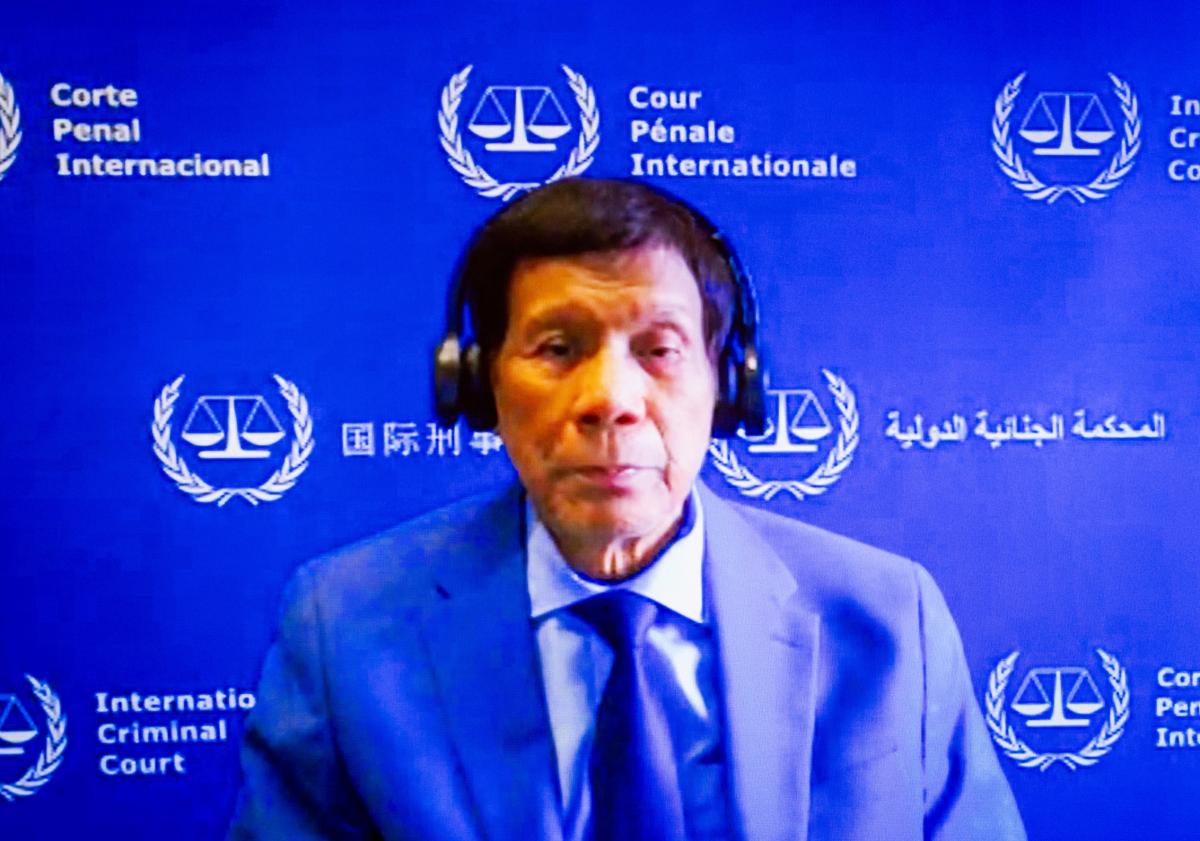
These recollections came back to me last week as I thought about the surprise arrest and deportation of former President Rodrigo Roa Duterte to a holding cell in the Netherlands while awaiting trial by the International Criminal Court.

By any legal reckoning, he’s going to be there for a while—he won’t be arraigned until September—so like it or not he’s going to have to adjust to his new abode over the next few months, like we had to in Bicutan.

His subalterns and supporters can make all the noise they want outside his prison, in the Philippines, and wherever in the world a DDS chapter exists, but RRD’s time ahead in Scheveningen will be largely spent in quiet and solitude.

From what we’ve seen online of his holding cell, Digong’s digs aren’t plush by any standard, but seem fairly adequate and comfortable—just spare enough to suggest to its occupant that he is in some kind of retreat, where he can ponder his worldly actions and contemplate the afterlife. Indeed the room—with its military cot and washbasin—evokes priestly economy, in stark contrast to the sybaritic excesses its previous tenants must have been accustomed to in their prime. In fairness to the incumbent, that lifestyle is something he has never been associated with; part of his popular appeal stems from his image as a man used to sleeping on hard beds and dining on the simplest fare.

There is a large flat-screen TV in the room, through which Digong can follow the news of the world and—given the way that world is going—feel upheld in his conviction that a hard fist and a knock on the head always makes things right. His heroes—Donald Trump, Vladimir Putin, and Xi Jinping (notably the same despots “quoted” by his trolls as expressing their support for him, like character references)—seem to be doing all right, keeping the world safe from the rule of law.

He might learn that the Dutch music industry is undergoing a boom on the strength of songs like “Anxiety” by Doechii and “Guilty” by Teddy Swims. Football, tennis, and golf are the favorite sports of the Dutch, although Digong might also be amused by a Frisian sport called klootschieten, which involves throwing a ball and sometimes drawing blood. Dutch cinema is a small industry, but The Punisher should still be thrilled by local crime classics like “Murder Story” (1989), “Gangsterboys” (2010), and “Accused” (2014).

Should RRD prefer interesting human conversation, I doubt he’s going to get it from the likes of Harry Roque, whose own tribulations must be coming out of Digong’s ears (“I want to go home, and you want to come here?”). If there are any CPP-NDF holdouts left in Utrecht, I’m sure they’ll have  a lot to talk about on a prison visit, going back to the Left’s early flirtation with their “nationalist” ally.

But truth to tell, if I were the former President, I would spend my time in Scheveningen writing my memoirs. I wrote a novel about my government-sponsored Airbnb experience, but given his bluntness, fiction probably won’t be RRD’s best suit.

I suspect Digong is a lot more articulate and maybe even more urbane than he lets on, because no Chief Executive could possibly be that vulgar and that ill-mannered without it being an act (you can imagine him rehearsing those PI’s before the SONA and turning up his collar to look even more roguish). All his life, he has presented himself to be a man of menace, projecting unforgiving brutality, steeping his hands into a cauldron of boiling blood to strike fear into his foes—but couldn’t all that have been just a show in the name of, uhm, good governance? 

The alternative narrative could go thus: In truth and deep at heart, all by his lonesome in his corner of the darkened Palace, he may have been a sensitive and tortured soul whose conscience reared and roared with every fresh report of another tokhang victim, who felt the anguish of every wife and mother like a stab to his own tender heart. He had done what he had to do for the noblest of purposes—the salvation of his suffering people from the stupor of narcotics (about which he knew something himself, but it was only to ease the pain from a motoring accident—all other uses were criminal).

RRD’s memoirs would not only be a spirited defense of his life—an apologia pro vita sua, as they used to be called—but a full, tell-all accounting of everything everyone ever did: henchmen, enemies, beneficiaries, and erstwhile allies alike. If he says he can’t get justice at the Hague, then at least he can dispense some of it from the safety of his albeit involuntary confinement.

Now that would not only be edifying but entertaining, wouldn’t it?

Qwertyman No. 137: ICC Ex Machina

Qwertyman for Monday, March 17, 2025

IN PLAYWRITING and fiction, we call it deus ex machina—literally, the “god out of the machine”—which has come to mean a miraculously happy or fortuitous ending to a long and agonizing drama. 

You’ll find it, for example, when a virginal heroine—beleaguered by dirty old men and rapacious creditors—seems on the brink of yielding her precious virtue, tearfully praying on her knees for deliverance, when a kindly lawyer comes knocking on her door to announce that a distant uncle has passed away, leaving her his fortune. We rejoice with her—despite feeling, at the same time, that divine intervention came a bit too conveniently. This is why I admonish my students to refrain from employing deus ex machina in their stories, because in today’s hard-bitten and cynical world, nobody really believes in it anymore, and readers simply feel deprived of a more rational ending.

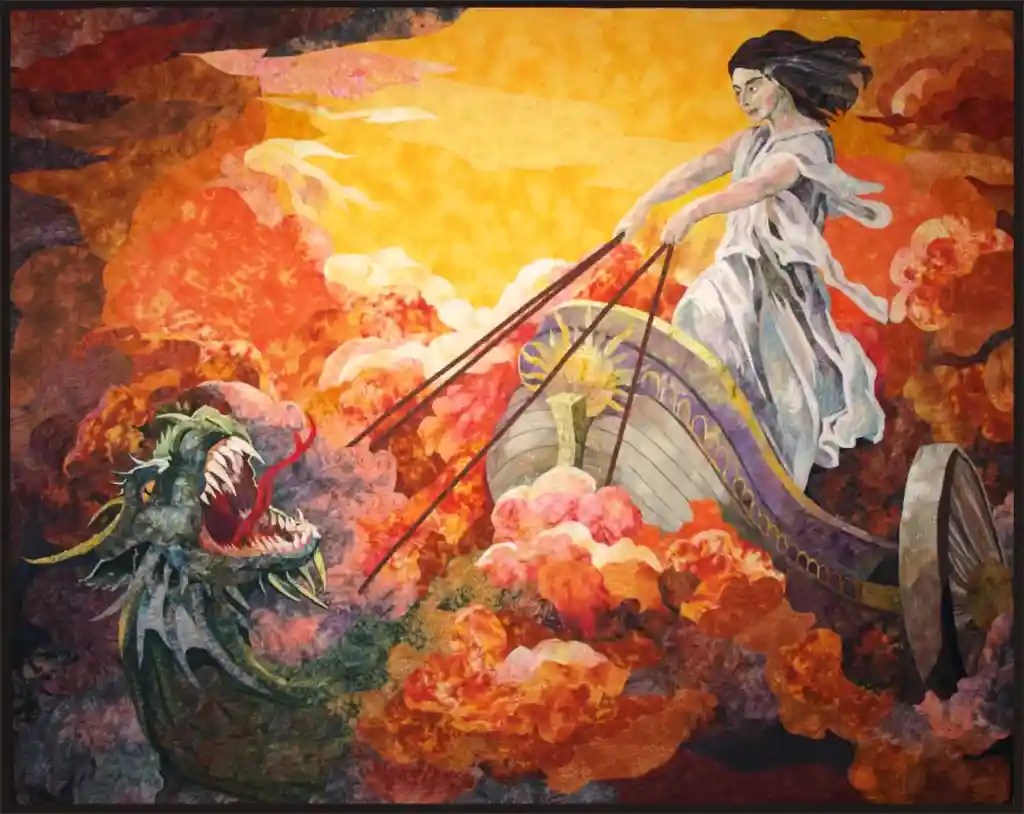
Like many things we know about drama, the idea goes back to the ancient Greeks, whose playwrights used it to great effect, Aeschylus and Euripides among them. Euripides most memorably turned to deus ex machina in Medea, where the title character—having been cheated on by her husband Jason—kills Jason’s mistress and their own two children. Guilty both of murder and infanticide, Medea seems hopeless and bound for damnation—until a machine, actually a crane shaped like a chariot drawn by dragons, emerges from behind the stage. It has been sent by Medea’s grandfather, the sun-god Helios, to pluck Medea away from her husband and from the coils of human justice and deliver her to the safety of Athens.

Was it fair of the gods to save Medea from the punishment awaiting her on earth? It’s arguable, but more than a device to resolve a messy plot, the “god out of the machine” was meant to remind the Athenian audience that a higher order of justice obtained, and that when humanity became too entangled in its own predicaments, then it was time for the gods to take over.

A lot of this swept through my mind last week as the drama of Rodrigo Duterte’s arrest and express delivery to the International Criminal Court at the Hague played out on TV and social media. Had the gods come out of the machine to impose divine justice? It had seemed nearly impossible a few years ago, when Digong was still flaunting his untouchability and taunting the ICC to come and get him. Well, we all know what happened since then—and they did. 

We understand just as well that the Marcos administration performed this operation not out of some abounding sense of justice or because it had suddenly acquired a conscience and realized the evil with which it had “uniteamed” to electoral victory in 2022. “We did what we had to do,” President Marcos Jr. explained on TV, with deadpan truthfulness—referring superficially to the Philippines’ obligation to honor its commitment to Interpol, but subtextually to the irresistible opportunity to cripple someone who had become a political arch-enemy, and providentially gain the support of masses of people harmed and disaffected by Duterte’s butchery.

The outswelling of that support—at least for Digong’s arrest and deportation—was spontaneous and sincere. Not since the Marcoses’ departure at EDSA had I felt such relief and exhilaration—and surely the irony would not have been lost on BBM, who knows what it was like to leave on a jetplane, kicking and dragging, for an uncertain future.

And what I say next may go against the grain of everything I have said and thought about the Marcoses, but no matter what ulterior motives may have come into play in this episode of the Duterte-ICC saga, I feel thankful for the resolve and the dispatch that BBM showed in this instance. Along with his administration’s resistance to Chinese aggression in the West Philippine Sea, this will be certain to count among his most positive achievements. 

The great difference between this drama and Medea, as an example of deus ex machina, is that the intervention of the ICC (with BBM helpfully providing the crane) isn’t going to save Duterte, but rather the people whom his presidency soaked in blood. But as with Medea, the “gods” step in when local justice proves impotent or inadequate (and did anyone really believe that Duterte would be hauled before and convicted in a Philippine court of law, when even the Maguindanao Massacre took a full decade to produce convictions for the principals?).

The question now is what next—not for The Great Punisher, for whom a prolonged trial at a cushy court will not be punishment enough, but for the Marcos administration, which suddenly finds itself with more political capital at its disposal, and yet also put itself at greater risk? Surely it must also realize that it not only has committed itself to tearing down the entire House of Duterte and confronting the many millions of voters they still represent, but that it has also set itself up for higher expectations, on pain of suffering the same ignominious fate?

In the hopeful bit of theater playing in my mind, I imagine BBM parlaying the bonus of goodwill he has earned from this maneuver into a broader if not genuine resolution to distance himself further from his predecessor and create a freer and more just society. There are clear and immediate steps he can take in this direction. The first gesture would be the release of all remaining political prisoners, followed by the abolition of the NTF-ELCAC, which no longer serves any useful purpose (not that it ever did). He can root out and punish the enablers and perpetrators of Oplan Tokhang and eliminate oppression and corruption from the mindset of Philippine law enforcement. And then he can begin reforming Philippine governance, starting with the quality of the people he seeks to bring to power—senators, congressmen, and the like.

But then that would be the ultimate deus ex machina, and we have been shaped by experience into a stubbornly disbelieving lot.

Qwertyman No. 135: Fighting the Truth

Qwertyman for Monday, March 3, 2025

BEAR WITH me as I begin this Monday’s piece with a quotation about last week’s celebration (or non-celebration, from another point of view) of the 1986 EDSA People Power uprising. It really doesn’t say anything we haven’t heard before, but I want you to read it slowly, giving it the full benefit of its sincerity and passion. If you were at EDSA as I and my family were, and no matter how distant a memory those four days in February may seem to be now, these words should still provoke even a flutter of patriotic fervor, and a wistful thought that, perhaps, the EDSA spirit does live on in these troubled times. 

“Martial law, declared by Ferdinand Marcos Sr. in 1972, left a dark legacy; countless lives were lost, freedoms were stripped away, and power was concentrated in the hands of a few. As we remember those who suffered and fought for our liberties, we must remain vigilant, especially now, when the threat of authoritarian rule once again looms over our nation. People Power was more than just a revolution; it was a testament to the collective strength of the Filipino people in demanding truth, justice, and accountability. It is also a reminder that we must remain united against any form of oppression…. Let us honor its legacy by ensuring that history is never distorted, our rights are never trampled upon, and our democracy remains intact for future generations. May the darkest times in our history never happen again.”

Just the kind of resonant exhortation you’d expect from a staunch defender of civil liberties and human rights, right? 

But would your appreciation of these words change just a bit if you knew that they were spoken not by the likes of a Leila de Lima or a Kiko Pangilinan, but by Davao City Mayor Sebastian “Baste” Duterte, whose EDSA Day message this just happened to be?

Truth? Justice? Accountability? “United against any form of oppression?” Where were these noble words when the good mayor’s dad was president, and announcing blatantly on various occasions that ““My order is shoot to kill you. I don’t care about human rights…. Let’s kill another 32 every day. Maybe we can reduce what ails this country…. I will assume full legal responsibility…. My mouth has no due process.”

That “legal responsibility,” of course, has yet to be assumed, full or otherwise. Instead, once he fell out of power, that man (and, last we heard, lawyer) who flaunted his wanton disregard of the law suddenly found religion, and the gumption to say this when his buddy Apollo Quiboloy and his cult followers were raided by the police:

“Our country has never been in a more tragic state as it is today. Rights have been trampled upon and our laws, derided…. We call on the remaining decent and patriotic members of our government not to allow themselves to be used and to be abusive and violent in enforcing illegal orders…. We call on all Filipinos, regardless of political persuasion, to offer prayers for peace and justice, and to spare our people of the unwarranted tension brought about by the reign of fear and terror by people sworn to uphold the law and protect the citizens of this country.”

It makes sense that this statement was published rather than spoken, because I can’t for the life of me imagine how The Great Punisher could say “unwarranted tension brought about by the reign of fear and terror” with a straight face and not burst out laughing—or maybe his listeners would, if they weren’t seized by, well, fear and terror.

Not to be outdone, on a recent sortie to Cebu, embattled Vice President Sara Duterte reportedly declined to answer questions about her impending impeachment trial in the Senate, preferring to leave the matter to her lawyers, but was quoted as saying that she was banking on her “loyalty to truth” to see her through. Ummm, okay…. Now can we please hear the truth, and nothing but the truth, about Mary Grace Piattos?

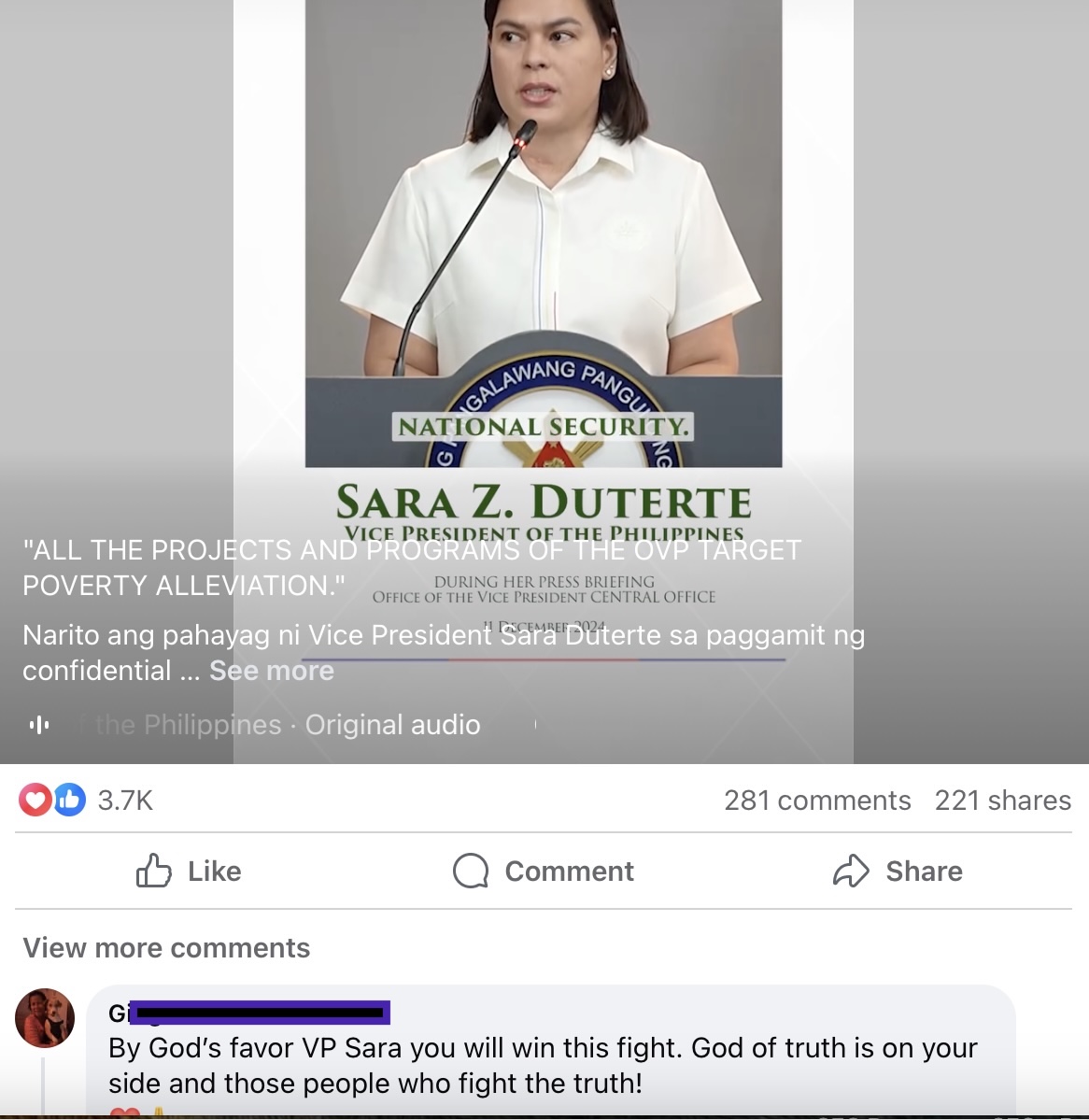
I suppose it’s a sign of how low the value of words like “truth,” “freedom,” and “justice’ have fallen when the very people accused of spitting them into the garbage now spout them like nobody’s business. Perhaps we shouldn’t be surprised that they’re doing this, given the success of Donald Trump at doing the very thing he says he hates, e.g. weaponizing the justice system. There must be pages of advice in the 21st century edition of Playbook for Politicians for just this kind of brazenness, maybe under the Chapter “Reversals of Fortune.” What’s surprising—and scary—is how they continue to be believed by followers such as “Ging C.” whose fervor led her to gush, on PRRD’s FB page, “By God’s favor VP Sara you will win this fight. God of truth is on your side and those people who fight the truth!” (Ooops….there’s a “for” missing there somewhere, but really, does it matter anymore?)

And lest we think only the Dutertes have mastered the art of dissimulation, let me leave you to guess who the character implicated in the following quotes is.

On Independence Day in 2018, someone posted on Facebook that “Freedom is every human being’s birthright. But to claim that right, the time always comes when we are called to fight for and defend that freedom. The Philippines and her people fought long and hard, sacrificed life, limb, treasure and more to achieve our independence 120 years ago. The call for liberty and sovereignty was answered by our heroic ancestors, sacrificing their all at the altar of honor and freedom and country.

“Today we remember, and in remembering, we consecrate that memory of all the courageous and selfless Filipino patriots—our heroes—who gave their lives for that freedom, and to whom we forever owe our status as a free, independent and sovereign nation in the community of nations. Let them long live in our minds, our hearts, in our very souls, the heroes of our great country, our beloved Philippines.”

In a speech before the Kapisanan ng mga Brodkaster sa Pilipinas last November, the guest of honor declared that “Now, more than ever, our democracy depends on an informed and vigilant citizenry…. With the 2025 elections ahead, I am committed to protecting our journalists in championing fearless and credible reporting. Together with KBP and our partners in media, we will stand firm against disinformation, ensuring that every Filipino has access to voices of truth.”

I would love to cry “Amen!” Wouldn’t you?

Qwertyman No. 124: In Sin and Error Pining

Qwertyman for Monday, December 16, 2024

IT WAS at an early Christmas lunch when a friend asked if I thought that Vice President Sara Duterte would be impeached, with all the motions now on the table to that effect. I wasn’t expecting politics to be taken up over the merrymaking, but this is the Philippines where we breathe politics, so I obliged. 

I said that while I certainly believed that the VP was fit to be impeached for all the obvious financial irregularities happening under her watch, I very much doubted that it was going to happen. And why not? Because it was going to come down to the votes in the House and in the Senate, and while President BBM and his allies doubtlessly had the muscle to push the motion through, I just didn’t see why they would. And again why not? You don’t think they can come up with the evidence to find her culpable for the misuse of hundreds of millions of public money in confidential funds? They could, if they want to, I said—but again, why would they? 

Think about it this way, I said. Impeachment is political, so the facts don’t really matter much, except for propaganda purposes—especially with elections coming up in a few months. Don’t get me wrong—there are people who take the process and its reasons seriously, as we all really should, because millions going to non-people like “Mary Grace Piattos,” “Chippy McDonald,” and “Fernando Tempura” in the guise of “intelligence operations” insults our non-artificial intelligence. 

VP Sara’s refusal to explain these strange endowments paints her further into a corner—which, it seems, is exactly where she wants to be. When she says, “I’ll be at peace when I’m impeached,” and when her drumbeaters exclaim that the hearings are turning the Dutertes into “folk heroes,” then you know that she’s not going to get what she wants. 

Why would PBBM let her go? What would be in it for him? He doesn’t need a functioning Vice President—he never had one; this VP can’t point to a single memorable deed beyond publishing an expensive book. Cutting off his “Uniteam” partner and depriving her of her last official job would simply give her free rein to wreak more mayhem with no accountability to the government or the people. 

Keeping her on the official payroll—but fundamentally powerless—would be the smarter thing. It was never in Sara’s nature to do a VP Leni, and turn political Siberia into a veritable factory of good deeds. She’ll stew in the OVP, sans her confidential kitty, until she can’t take it any longer and resigns, which could easily be spun into a form of surrender or an abandonment of her sworn duties.

The other reason, of course, is that while VP Sara is drawing fire, PBBM can enjoy some peace of mind, and make benign speeches at this and that forum with a heartfelt smile. He knows that he has benefited immensely from the odious alternative the Dutertes represent in the eyes of many Filipinos, even those who staunchly opposed his candidacy in 2022. 

The Dutertes have done Marcos Jr. the priceless favor of making him and whatever he does look good by comparison—a difference he has substantively emphasized by rejecting his predecessor’s slavishly pro-China policy and (despite reports of continued EJKs under his regime) withdrawing Digong’s murderous tokhangcampaign. He has had his missteps, like that bizarrely ill-conceived Maharlika Fund, but I have been hearing murmurs of approval from otherwise progressive friends—albeit grudging and cautious—for many of his positions, an unthinkable proposition just a year ago, when the wounds of 2022 were still fresh. 

But with more than half his term yet ahead of him, there’s opportunity aplenty for unraveling and for even graver misdeeds. Even now, while we profess shock and dismay over the P500 million spent by the OVP in confidential and intelligence funds for 2023, the House has given BBM a free pass on the even more staggering P4.57 billion his office disbursed for the same purposes that year. 

And that’s why I think it’s wiser to keep the focus on the Dutertes and to keep the VP where you can see and hear her, flailing around and squealing like a stuck pig. The impeachment drama will play itself out in the New Year with more twists and turns than a telenovela, and then, for some reason, the votes will fall short, and the VP will be censured and chastised before being sent back to the pen. For what it’s worth, I don’t think impeachment is the proper penalty here; criminal prosecution, conviction, and punishment should be, but that’s a whole other game.

* * * * *

Christmas will soon be upon us—my 70th, in my case, a milestone I never expected to reach given the many young deaths that marked my generation, but one I thankfully accept as the ultimate gift and blessing, no matter the turmoil in our world today. I personally have much to cheer about and be grateful for—so why can’t I be merrier?

We associate Christmas with joy and new life, with the Christ child’s coming, but there is nothing to be jolly about where wanton greed and senseless death are concerned. 

Everything today points to a headlong dive into a global cataclysm, a World War III that may not have a clear and time-stamped beginning like the invasion of Poland or the bombing of Pearl Harbor, but a prolonged and widespread series of provocative and catastrophic events occurring all over the planet—Russian incursions into Eastern Europe, Chinese occupation of Southeast Asian waters, Israel’s pyrrhic extermination of its enemies, North Korea’s incessant saber-rattling and nuclear brinkmanship, America’s surrender of the asylum to the lunatics, and the inexorable degradation of the environment—all of which will come to a head. It will be horrific, but a side of me wonders if we need this cataclysm to remind us of our most basic values and virtues as humans, beyond ideology, religion, power, and wealth.

The other week I had a reader, a pro-Israel partisan, writing me to contend that there was no one else to blame for all the dead children in Gaza but their parents who refused to stand up to Hamas. It saddened more than infuriated me to see that this is where all our presumably educated reasoning has come to—a justification for the slaughter of innocents. I wanted to shake the man by the shoulders, across the Internet, to awaken the terrified and hungry child in him.

Our world will become yet darker and more difficult before it comes to its senses, rediscovers the value of truth, beauty, and courage, and pulls back from the brink of self-annihilation. Yes, I remain optimistic about the future of humanity, about a time when reason and justice will prevail, but I am quite sure I will not live to see this “new and glorious morn.”

Qwertyman No. 118: A Flickering Flame

Qwertyman for Monday, November 4, 2024

TOMORROW, NOVEMBER 5 (or Wednesday, November 6, our time), American voters will choose who between Republican Donald J. Trump and Democrat Kamala Harris will lead them from the White House over the next four years.

For more than four million Filipino-Americans, the outcome will bear a direct impact on their daily lives, their choices, their standing in society, their future. For the rest of the world, including those of us here in the Philippines, the result will shape not only how we see America, but also how America sees us in the global scheme of things.

Only the foolish will think that we have no stake in this election, and that America’s position in the world will be the same regardless of who wins. For the people of Ukraine, a Trump victory might as well be his friend Putin’s; for the Taiwanese, the Filipinos, and others dependent on at least the deterrence if not the active deployment of American military power vis-à-vis Chinese expansionism in Asia, Trumpian isolationism can only invite more unbridled aggressiveness from the region’s bullies.

As I’ve often said here before, like many millions of Filipinos, my stake is more personal than that: our daughter lives and works in California, and my sister is also a US citizen, both of them contributing productively to that country’s economic and social well-being. Both are proudly voting and campaigning for the only candidate who offers real hope for the future of America and the world: Kamala Harris. To them, she represents not just the right political but also and even perhaps more importantly the right moral choice.

Of course, I totally agree. Why anyone would vote for a man who even many of his supporters admit is a convicted felon, a habitual liar, a womanizer, a pervert, a racist, a chauvinist, and a would-be dictator is beyond me. But apparently enough Americans will, enough to make all polls point to a dead heat between the two candidates, with the outcome likely to be decided by voters in a handful of so-called “battleground” states.

Among those many millions of Trumpists willing to overlook his not-insubstantial shortcomings are legions of Fil-Ams who—despite having historically voted Democrat as an ethnic minority—now find common cause with Trump’s blatantly racist anti-immigrant rhetoric (it isn’t even about illegal immigration anymore, but about immigrants from “garbage” countries in Asia, Africa, and Latin America) and his supposed “anti-abortion” stance (since diluted for political expediency). Among other single-issue MAGA voters, “the economy” remains their strongest reason for choosing Trump, despite 23 Nobel-prizewinning economists writing that Trump’s tariff-based economic plans will be disastrous for the US.

Eighty-two Nobel laureates, in fact, are on record supporting Harris, but that clearly matters little in an election driven more by primal fear than by truth and reason. As astrophysicist Neil deGrasse Tyson lamented, “How sad it must be—believing that scientists, scholars, historians, economists, and journalists have devoted their entire lives to deceiving you, while a reality TV star with decades of fraud and exhaustively documented lying is your only beacon of truth and honesty.”

My own sense is that many Trump voters won’t be voting for Trump the man, whom his sharper and more hidebound supporters—many of whom, like Sen. Ted Cruz, he has savagely maligned but who have masochistically endured his insults to ensure their own survival—will admit before God to be the lowest of the execrably low. They will be voting for the deep grievances and resentments that Trump has so craftily stoked in them, and against the idea of an “elite” and a “swamp” that Trump and his new acolyte Elon Musk, strangely enough, represent more visibly than most Democrats.

Thus the very real possibility remains that we may wake up Friday morning to the specter of Trump 2.0 and whatever it will bring. Should that happen, we can imagine the global wave of consternation and dismay that will ensue among liberals and progressives everywhere. On the other front will resound the triumphant cheers and chuckles of global despots and their minions.

All this brings me to what I suspect has been my real worry all along—not the US election, about which we can do nothing, but our own political horizon, on which familiar dangers are looming large.

At least one online pundit with an unusual point of view has lauded the recent performances of Vice President Sara Duterte and her father former President Rodrigo Duterte at their Senate hearings as a kind of resurrection—in the very least, an affirmation of their continuing political viability, if not resurgent power. 

The Dutertes mastered their fumbling inquisitors, this commentator crowed, reporting that the gallery even clapped for the senior Duterte at the end of a raucous session at which he virtually confessed to willfully causing the summary execution of suspects without ever being prosecuted. The Dutertes, he seemed to imply, remain above and beyond the law; with their cohorts in office, they are the law, or shall soon be again.

Indeed Philippine politics has become a theater where bravado, bluster, and buffoonery matter. We cannot even tell the actors from the characters any longer. Lies resound louder than the truth, and the audience rewards the best “hugot line” with wild applause.

The upcoming midterm election already promises to showcase the worst of our political predilections, with family dynasties and patently unfit candidates crowding the top of the poll rankings.

So if the Americans choose Trump over Harris, why should we be surprised? Where character, reason, and talent no longer matter, the tyrants rule with fools at their feet to keep the populace amused.

But if Kamala Harris wins, whatever it brings to America, it will mean for me that, however fragile, hope remains for good sense to prevail even in extremely fraught situations such as ours. If only for that flickering flame, I pray she wins.

(Image from newsweek.com)

Qwertyman No.112: Reversals of Fortune

Qwertyman for Monday, September 23, 2024

“ROQUE VS. Roque.” I wish I’d thought up that line, but it was Rappler—yes, that pesky news organization that’s caused many government officials past and present to choke on their soup—that used it for one of their stories on the continuing saga of Atty. Herminio “Harry” Lopez Roque.

In an article posted on September 7, 2020, Sofia Tomacruz reported how Roque had lawyered for the family of Jennifer Laude, the transgender person killed by US Marine Joseph Scott Pemberton in October 2014. On September 3, 2020, Pemberton was ordered to be released by a Philippine court, prompting Roque—still in crusader mode—to recall Laude’s death as “symbolic of the death” of Philippine sovereignty. 

A few days later, however, his current boss, President Rodrigo Duterte, granted Pemberton an absolute pardon, claiming that the convicted murderer had not been treated fairly by Philippine justice (only to add, a few moments later, that as far as drug users were concerned, “Be cruel!”). Spokesman Roque then defended the move as a presidential prerogative—and later rationalized, in his “personal opinion,” that Duterte had made the move to secure American vaccines given the ongoing pandemic. So much for Philippine sovereignty.

It wasn’t the first and certainly not the only time Harry Roque had to eat his own words.

He lawyered for the families of the victims of the 2009 Maguindanao Massacre, where 58 people were killed; eleven years later, as presidential spokesman, he said that “justice had been served” with the conviction of two Ampatuan brothers, despite the acquittal of 56 others. 

But in what has to be the most ironic of these reversals, let’s give a listen to Harry Roque ca. February 2018. Duterte’s nemesis, former Justice Secretary Leila de Lima, had just marked her first year in detention, falsely charged with involvement in the illegal drug trade in what clearly was political vendetta. (The charges would be dismissed and de Lima released—but only after almost seven years.) 

In a news briefing, Roque gloated: “Happy anniversary on your first year of detention. May you spend the rest of your life in jail!” Calling de Lima “the mother of all drug lords,” Roque claimed that “Senator de Lima’s incarceration shows that the criminal justice system in the Philippines is alive, effective and working.” 

Fast forward to September 2024. Asked to explain by a congressional probe how and why his assets in his family business rose from P125,000 in 2014 to P67.7 million just four years later, Roque refused to comply, and was cited in contempt and ordered arrested. On Facebook, he defiantly claimed to be a victim of injustice: “I am not a fugitive because I violated the law. It’s only Congress that considers me a fugitive, and I don’t care. The way I see it, if Congress cited me in contempt, I think Congress is cited in contempt by the people of the Philippines.” 

He had earlier been placed under 24-hour detention in the House, which was investigating him in connection with his ties to a notorious POGO. “I will not wish, even on my fiercest political opponents, to be deprived of their personal liberty and freedom,” he had sonorously spoken of that experience, amplifying his persecution with a reference to a rather more famous political prisoner: “Worse than hunger, said Mahatma Gandhi, is to lose your freedom.”

Let’s forget for a minute that lifetime imprisonment was exactly what Roque had wished on his fierce political opponent, Leila de Lima, who spent 2,454 days in incarceration without even being convicted (even longer than Gandhi, whose total jail time amounted to 2,338 days in colonial South Africa and India). So harrowing must have been his 24 hours in House detention that—faced with the prospect of a few more days in the guest room of an august chamber he once inhabited as a proud member—he declined to yield himself to further scrutiny, and vanished. Given his aversion to discomfort, we can be sure it will only be a matter of time before he resurfaces, perhaps leaner and sexier for the experience.

Indeed, never mind the news, which most people will forget in a week. Worry about scholarship, which, while obscure and often useless, has a way of defining you in perpetuity because of its pre-AI presumption of truthfulness. Harry Roque, I discovered, proved worthy of an academic paper titled “Turn-Taking Strategies of Secretary Harry Roque as a Presidential Spokesperson: A Conversation Analysis” by Janine Satorre Gelaga of Caraga State University, from which I quote:

“Roque had an aggressive and confrontational way of speaking, often responding to criticism or questions from the media with sarcastic comments and eye-rolling…. Roque’s conversation style did not develop understanding, let alone promote public trust…. As Geducos (2021) has put it, “Roque has been at the center of controversy for many remarks that did not sit well with the public.’”

To say the least. How the mighty have fallen, but then again, what can soldiers of fortune expect but, well, reversals of fortune? 

Qwertyman No. 111: Justice Fever

Qwertyman for Monday, September 16, 2024

A DANGEROUS outbreak of justice fever has hit the Philippines these past few weeks, threatening to make that country’s startled citizens believe that their government is intent on doing right by the people, no matter what and come what may.

In quick succession, Bamban ex-mayor Alice Guo, alleged to be a Manchurian candidate, was picked up in Indonesia and flown back to the Philippines; another on the Philippines’ most wanted list, the self-styled “Son of God” Pastor Apollo Quiboloy, emerged from his subterranean kingdom to surrender to the Pharisees, er, authorities; why, even former Palawan governor Joel Reyes, wanted for the murder of an environmental crusader and long out of sight and out of mind, turned himself in; and it should only be a matter of time before ex-Rep. Arnie Teves comes home from his extended Timorese vacation to face murder charges in Negros Oriental. (I don’t think the return of former Iloilo Mayor Jed Mabilog, hounded out of office by the former President on trumped-up charges of drug trafficking, counts in this category.)

What on earth, you might ask, is going on? Is the government running some secret—and wildly successful—“balik-fugitive” campaign? Were there possibly offers and assurances made of kid-gloves treatment, fully furnished jail cells, state-witness options, conjugal visits, and lifetime colonoscopies?

For a while back there, it seemed like the old regime hadn’t completely vanished—you know, the chummy-chummy-with-criminals vibe, which that viral photo with the chinita mayor smiling sweetly and flashing “V” signs between her two captors seemed to suggest. But justice fever is vicious when it takes hold of its victims, and by the time Pastor Apollo Quiboloy was caught in Davao, the afflicted authorities had learned their lesson, and quickly whisked him away in a C-130 to Manila. Why, President Marcos Jr. even fired the chief of the Bureau of Immigration, Norman Tansingco, over the Guo affair. Illegal POGOs were raided, and captives freed.

As if this spate of high-profile catches and prosecutions wasn’t enough, in the Senate and the House of Representatives—once safely Duterte territory—lawmakers were outdoing each other poking holes into Vice President Sara Duterte’s P2-billion budget proposal. Her friend Harry Roque was found in contempt of Congress and served a warrant of arrest for failing or refusing to account for his unexplained wealth. 

Duterte ally Sen. Bong Go also caught the fever, proclaiming in a tweet that he had always been against POGOs, seeing them as a threat to peace and order. “For the record,” he emphasized, “I really hate POGOs.” Justice fever apparently induces amnesia, because the good senator forgot that three years ago, he voted in favor of RA 11591, taxing and effectively legitimizing POGOs in the country.

All this would have been unimaginable then, but here’s something even more incredible: former President Rodrigo Duterte—who routinely ordered his supporters and the police to “shoot” drug suspects without worrying too much about the finer points of the law—seems to have woken up from a kind of coma, suddenly remembering that he was, once upon a time, a lawyer wedded to the idea that people have human rights. 

We know that because Atty. Digong, probably still in a slight daze but overcome with a resurgent sense of right and wrong, filed charges of malicious mischief against Interior Secretary Benhur Abalos, PNP chief General Rommel Marbil, and PNP Region XI chief Brigadier General Nicolas Torre III in the wake of his patron and spiritual adviser’s arrest. 

Not being a lawyer, I had to look up exactly what “malicious mischief” means. Here’s what I found online: “Malicious mischief is a crime of property damage. In order to convict someone of malicious mischief, the prosecutor must prove the damage done to the property was not accidental. A person is guilty of malicious mischief when he or she ‘knowingly or maliciously’ causes physical damage to another person’s property.”

From what I gather, malicious mischief requires a certain, uhm, finesse, a delicacy that appreciates degrees of injury, and even ironic humor. “Mischief” isn’t like the sledgehammer of bloody, first-degree murder; it’s more like a yap rather than a roar, a pinch rather than a punch. You commit malicious mischief by, say, kicking your neighbor’s dog or unpotting his daisies. It’s meant more to annoy and enrage rather than to kill. (Interestingly, under the Revised Penal  Code, “destroying or damaging statues, public monuments or paintings” and “using any poisonous or corrosive substance; or spreading any infection or contagion among cattle; or who cause damage to the property of the National Museum or National Library” also qualify as special cases of malicious mischief.)

I haven’t read the charges in their entirety, so I don’t know exactly what Atty. Digong was complaining about—I’m guessing door locks broken and, okay, egos pricked. But the mere fact of Digong the Terrible sallying forth into a court of law on a matter as grievous as upended flower pots suggests to me—as I wrote about a few weeks ago—that the man has truly undergone the kind of religious conversion that now allows him to believe in, well, judicial justice. He, too, has caught the fever, and now reposes his faith in a judicial system he once decapitated with pronouncements such as this one from April 9, 2018, referencing then Chief Justice Maria Lourdes Sereno: “I’m putting you on notice that I’m your enemy, and you have to be out of the Supreme Court!”

The only problem with this rash of righteousness and conscience is, how long will it last, and what will happen when it wears off and we return to our old jolly, reprobate selves? 

The Dutertes are easy targets, no thanks to their patriarch’s resolve to establish himself as the least presidential president in Philippine history. His successor is reaping the low-hanging fruit of that unpopularity, enjoying, no doubt, the unfolding spectacle. BBM should be warned, however, that like many afflictions, the effects of justice fever can be long-lasting. Once its victims get used to it, their delusions could linger, and they’ll keep expecting and wanting more, and more.

(Photo from dzar1026.ph)