Penman No. 285: A Scavenger’s Finds

Lettsr2 copy.jpg

Penman for Monday, January 8, 2018


LAST WEEK’S piece on my “passion for the past” apparently struck a positive chord with my readers—including a couple of friends who also happen to be professional historians, the eminent professor Bernardita Churchill and my UP neighbor Maris Diokno, who’ll be returning to teaching this semester after her stint with the National Historical Commission. Both messaged me to say that they enjoyed my column (many thanks!) and to invite me to speak to a group of history enthusiasts or to a class about my obsession and my forays into collecting historical memorabilia (I will).

To both friends, and to those who will be listening to me, I once again affirm that I am not a historian or a scholar. A true scholar of history will seek to palpate and to understand the full context of things—not just of objects but of actions, decisions, and ideas; he or she will be guided by some workable theory of human and social behavior, and a disciplined commitment to the truth; and the past could be important less for its own sake than as a window on the present and the future.

I appreciate and respect all these considerations, which is why I know and acknowledge that I can’t live up to them, at least not at the moment. For now, my most honest self-description would be that of a scavenger (“fetishist” also comes to mind), not unlike a dog who drags in interesting objects off the street—sometimes gruesome, sometimes delightful. I rummage through other people’s leavings (as an impoverished grad student in the States, I happily went dumpster diving), finding and retrieving objects of wonder. The material object is my prize; whatever else it leads to—some story, some insight, some unforeseen discovery—is pure bonus.

That’s applied to my vintage pens and books, some of which turned out to have been owned by famous or important persons. But some of my most interesting finds on eBay have involved the most common people and the most ordinary—and therefore the most plaintive and often poignant—revelations.

This is no truer than in the letters I come across on eBay, likely seen by many as the leftovers of estate sales, after all the valuable furniture, silverware, and knick-knacks have been carted away. I’ll admit that reading them feels a little voyeuristic, because there’s nothing more intimate than seeing into someone’s heart and mind, even when it doesn’t involve endearments or estrangements.

1934LetterB.jpg

There were these letters, for example, which I saw last November, written by a teenager named J. R. Oyco (at least that’s what I can make of the signature, but I could be wrong) from Bacolod to Forrest J. Ackermann (1916-2008), whom sci-fi fans will recognize as one of the pioneers of the genre. What’s amazing is that the letters are from 1933-34, when Ackermann himself was no more than 18, so these were two teenagers chatting across the ocean in longhand about what today would be speculative fiction. “Three days ago,” Mr. Oyco writes, “I finished reading the April Astounding Stories and enjoyed the swell stories it had—from H. V. Brown’s cover to the advertisement on the last page…. As I noticed, Astounding was in the market for some years but stopped, and again covered the field just last October. However, from mere weird tales they published on that said issue, the editors, by the present time, have achieved a great if not astounding achievement by their thought-variant narratives. By publishing these kinds of stories, they give authors a chance to show their talents and imaginations and stimulate interesting reactions from the readers themselves.” Apparently Ackermann had responded to an earlier letter because J. R. thanks him for the gift of a magazine.

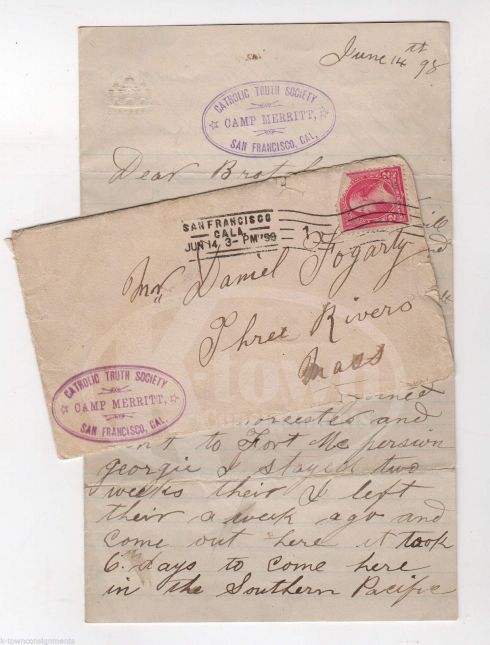
A letter dated June 14, 1898, comes from a soldier named Humphrey Sullivan, who’s in San Francisco on his way to war in the Philippines, to his brother-in-law in Massachusetts. He’s trained in Georgia and has more drills to do before shipping out, but in the meanwhile, he writes, “I don’t know when we will go it will be a long ride I guess the war will be over before I get there. I would like to get the chance of killing a few Spaniards as I come so far…. I am writing this letter where mass is celebrated every morning it is a blessing for the Catholic to have this society [the Catholic Truth Society in Camp Merritt] here. I am in a hurry I will have to go to drill.”
WACNurse1 copy.jpg

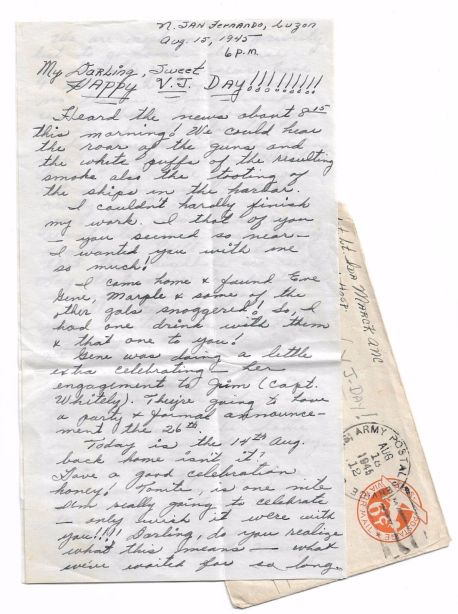
On Aug. 15, 1945, a WAC nurse writes “My Darling, Sweet” from San Fernando, Pampanga: “Happy V. J. Day!… Today is the 14th Aug. back home isn’t it? Have a grand celebration honey! Tonite is one nite I’m really going to celebrate—only wish it were with you!!!! Darling, do you realize what this means—what we’ve waited for so long…. So, Sweetie, “I’ll Be Seeing You” and we’ll have a “White Xmas.”… I’ll give you a run for your money, honey—won’t let you out of my sight—and I’ll see to it that the neighbors are out!”

And so on go the letters and the stories, many of which read better than fiction, written by the Parkers, Sheaffers, and Esterbrooks now lying still and silent in my collection. In many instances, I haven’t even had to buy these documents—it’s enough to read them online and save them for posterity on my computer. (But I’ll need some help soon with two letters written in French, from 1794 and 1798, coming my way.)

These objects affirm, for me, that the past happened, and more than that, that the past will be remembered. It may not matter to me when I’m gone—which, in my darkest musings, could mean that I will no longer have any sense of “me” or of time itself—but it matters to me now, to know that our words and deeds bear consequences, and that we will all leave some trail behind. And so I should write and act with that trail aforethought—so someone, a century hence, will be happy to find a book I wrote, or some note I scribbled, and smile at the memory.

Penman No. 282: Never Enough Patriots

IMG_4055

Penman for Monday, December 18, 2017


(THIS IS the last of three parts of my recent talk on “Celebrating Arguilla” at the Taboan Literary Festival in Bauang, La Union.)

Leonard Casper and Joseph Galdon aver that Manuel Arguilla’s best stories are those in the pastoral tradition, and I would agree that “Midsummer” is in a class all its own, but who knows what else he would have written, given ten or twenty more years? Stories like “Elias” convey less surface beauty than his pastorals, but in some ways are more resonant; his last story, “Rendezvous at Banzai Bridge,” is something of a psychological thriller.

This brings to me my main point, which is to propose that to celebrate Arguilla is to recognize and embrace his complexity and even his seeming contradictions. In a sense, he prefigured the situation of many Filipino writers today who find themselves caught between burning local issues and the seductions of the global. The Third World is the new Nagrebcan, and what lies beyond it the new metropolis.

One thing we have to note of Arguilla’s work is that he wrote in English—indeed, a very refined and educated English—which tells us that while he wrote tirelessly and affectionately about the farmers of Nagrebcan, he wasn’t writing to be read by them. That’s not an accusation—only an observation of the fact that Arguilla was very much a member of his literary milieu, a milieu inflamed by proletarian ideals but one that still conducted its passionate debates in English.

Many years ago, as a graduate student in Milwaukee, I found a copy in an old bookshop of the March 1936 issue of Story Magazine, America’s pre-eminent fiction publication then, featuring Sinai Hamada’s classic love story, “Tanabata’s Wife.” (I later gave that copy to the Hamadas in Baguio.) The author’s notes mentioned that Hamada had been preceded just the month before by another Filipino writer named Manuel Arguilla and a story titled “How My Brother Leon Brought Home a Wife.” Since then I tried to locate that issue, and more than 25 years later, I received it, as a gift from a friend who knew I had been looking for it. The note on the author doesn’t say much, only that “His biography has yet to reach us.” I also just recently acquired, on eBay, a copy of The Prairie Schooner from the Fall of 1935, where can be found a story titled “Midsummer” by Manuel Arguilla. This same journal would also later publish his story “Heat.”

All of these stories—including that of Hamada, who was younger than Arguilla by a year—had already been published in the Philippines. But they still sent them for publication in the US, because it was apparently important for them to do so in their time, just like we seek to be internationally published today not just to find more readers, but to be validated in the global society of letters.

They were young men in their early 20s, brimming with talent and ambition. All they wanted was to write, to be published, and to be read, just like all of you here today. And like many of you, they were outspoken about their beliefs, eccentric and maybe even offensive in certain ways, but totally dedicated to their craft. We lionize them today for good reason, but in truth, as persons and as writers, they were far from perfect, which also means that we can be like them.

Even after his martyr’s death, critical views of Arguilla’s work and legacy have varied widely. Indeed, among his peers, there seems to be a qualified dissatisfaction with his fiction that some of us today would find strange, if not unkind.

As I was preparing for this talk, I was elated to find, in my stash of old literary journals, a copy of the 1952 Literary Apprentice, where five writers—Lyd Arguilla, Ligaya Victorio Fruto, Francisco Arcellana, Edilberto Tiempo, and Alejandrino Hufana—shared their reminiscences of Manuel Arguilla in short personal essays. Lyd sweetly remembers the man and the husband—his bellowing laughter, his flair for fashion, his love of swimming, dancing, jazz, and poker (at least we share something), of Shakespeare, and above all of writing. Ligaya savors the “champaca-laden atmosphere” of the porch at the Arguillas’ house on M.H. del Pilar and the carefree banter of Manila’s prewar literary set, the names and initials of the notables—AEL, AVH, Estrella, Daisy and Bert, SP and Mary, and someone simply referred to by his surname Villa—dropping like cookies along some magical pathway. It all vanishes, of course, in the devastating war that sweeps in from just around the corner—the house, the company, the laughter, the floral fragrance.

Five years Manuel’s junior, Franz recalls Arguilla writing him a letter, urging him to “be true to your real self,” and gifting him with a book with that now famous inscription, “To Francisco Arcellana, May he put more life into his art and less art into his life.” Remarkably, Franz’s memoir ends with a candid admission that “the only thing that pleased me about him was his writing—when he wrote short stories. I didn’t like being lectured to, not even by him…. I shall never be able to forgive him his patriotism. He was no patriot…. He was a writer of short stories. He should have left patriotism alone…. We have many patriots. We don’t have too many writers.”

Ed Tiempo recognizes that “the outstanding gift of Arguilla is his sense of people, his characters,” but adds quickly that “people alone do not make successful fiction.” Ever the traditionalist, Tiempo looks for clearer meaning and coherence in Arguilla’s fiction, but grants that “because we accept the authenticity of the small details, there is something coercive even in (his) unconvincing characters.” Alex Hufana, another son of La Union, does a close reading of “How My Brother Leon Brought Home a Wife” and pronounces it authentic, praising the author for keeping “his hand cool even as they hold hot soil—decorum required of him as an artist.”

Whatever your own estimation of Arguilla may be, you will probably agree with me that at his best, he delivered what I tell my students should be the hallmark of a great story: it should not only be well written, but it should be moving, and it should be memorable.

What Arguilla teaches the young writer is that technical excellence alone is not enough. Too many writers exhibit little more than cleverness and linguistic virtuosity, with hardly any emotional impact or lasting effect. He also reminds us what a vast country we have, much larger, richer, and more complex than Starbucks, Facebook, and the Marvel and DC universe, and that a “real” writer, to use one of his favorite words, is one immersed enough in his or her society to recognize both beauty and brutality in the same place.

Franz Arcellana bemoans Arguilla’s loss to patriotism, but that too tells us something we often forget: that there are things more important than writing or literature, and country is one of them. In a war that tore through and across classes and across beliefs, Arguilla died for his country—not for literature, not for socialism, not for his class; well, maybe for Lydia, which makes him even more of a hero to me. With all due respect to my old teacher Franz, we have writers aplenty; of patriots, especially these days, we can never have enough.

IMG_3828

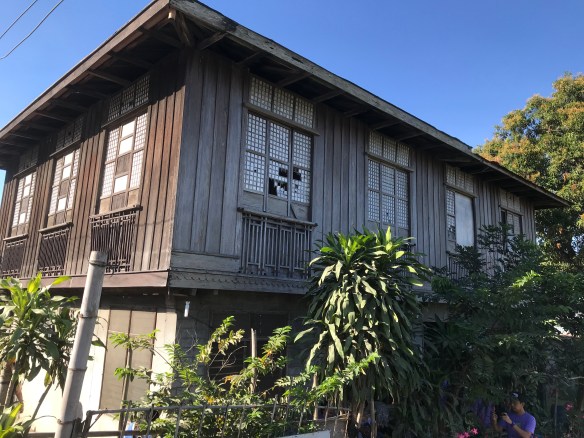
(Photo of Manuel Arguilla’s ancestral home along the National Highway in Bauang, La Union.)

Penman No. 281: The Writer in Progress

IMG_3824

Penman for Monday, December 11, 2017


(THIS IS the second of three parts of my recent talk on “Celebrating Arguilla” at the Taboan Literary Festival in Bauang, La Union.)

“Midsummer” is of course the quintessential mating story, setting the tone for the younger Arguilla’s lyrical odes to rippling muscles and shapely breasts. The man’s strength is contrasted with the girl’s slenderness, and this dichotomy would repeat itself many times over in the stories ahead: in “Heat,” where the Adonis-like Mero captivates Meliang, she of the “long and supple thighs” and whose body exudes “a healthy sweetness.” We see it again in “The Strongest Man”, where the “tall and shapely Onang” enchants Ondong, whose muscles flow under his sweating skin. Mero and Meliang, Onang and Ondong—it’s tempting to think of Arguilla falling into a mannerism, a romantic formula after Amorsolo’s or Botong’s idealized physiques.

But he quickly disabuses us of our idyllic fantasies, because the same terrain in which so much beauty resides, in both the landscape and the bodies of its fecund youth, is shown to be awash with blood and riven by violence. The second story in the collection, right after “Midsummer,” is “Morning in Nagrebcan,” and it begins with a picturesque description of rustic serenity, depicting “the fine, bluish mist, low over the tobacco fields.” But this mood is soon shattered by the brutal killing of a puppy, and the awakening of the children to the harshness of life—indeed, to evil—in what may seem to be a bucolic paradise.

Sometimes the violence is more subtle and only hinted at. “A Son Is Born” is a long and almost anthropological account of family life and birthing rites, ending on the luminously optimistic note of a Christmas birth and a boy named Jesus, but it is shadowed by its very first line: “It was the year the locusts came and ate the young rice in the fields.” Life is difficult, but it goes on.

“How My Brother Leon Brought Home a Wife” appears midway through the book, providing another tranquil respite, returning us to tall and lovely women meeting male approbation.

And then almost abruptly come the city stories, beginning with tales of marital stress and distress. Here I can sense the young writer and husband flexing his muscles and trying out new material and new approaches, experimenting with the kind of breathy, abstracted adoration you might find in Arcellana, acknowledging his broadening universe, with references to Picasso and Vanity Fair popping up in the prose. There’s even an attempt at comedy in “The Maid, the Man, and the Wife.” “The Long Vacation” is a melodramatic paean to loss, in the spirit of Carlos Angeles’ “Landscape II,” but without its magic. In these so-called “marriage” stories, it is the brooding hulk of Elias, in the story of that name, that most comes alive, but this is the one story in that suite that returns to the countryside, as if to make the point that country folk can also lead terribly complicated lives and make terribly complicated decisions.

The last part of the book, which is divided into three, comprises the “socialist” stories, for want of a better description. “The Socialists,” “Epilogue to Revolt,” “Apes and Men,” and “Rice” return us to a rural setting, but this time with an explicitly political agenda, which is to awaken the reader to the inhuman exploitation of the Filipino farmer and worker of the 1930s.

“Caps and Lower Case” is often hailed as a searing indictment of labor exploitation, and indeed it pleads the case of its protagonist—a proofreader who needs the relief of just a small raise—with eloquent anguish, but ultimately it deals him a crushing defeat. “The Socialists” is a scathing satire of armchair socialism. “Epilogue to Revolt” deals with surrender and complicity, “Apes and Men” with industrial unrest, and “Rice” with hunger among the tillers.

These were all worthy subjects, of course, the stories reflecting the afterglow of the recent Sakdalista rebellion and other such uprisings in both country and city. Among writers then, the same tensions would simmer over what would be called “proletarian literature,” its standard held high by such avatars as S. P. Lopez and Arturo Rotor, and inevitably Manuel Arguilla. On the other side of the argument were ranged the likes of Jose Garcia Villa, A. E. Litiatco, and a young Nick Joaquin, who in a 1985 essay would dismiss proletarian literature as little more than that generation’s adoption of the latest American fad. It “failed to sweep the local scene,” Joaquin would chortle, “and the only writer of importance who may have been influenced by it was poor Manuel Arguilla—who got derailed.”

Arguilla’s avowals notwithstanding, however—and at the risk of committing blasphemy in the Vatican—let me opine that it would be a mistake to deify Arguilla as any kind of socialist icon. True, he embraced “proletarian literature,” but his proletarian stories are thoroughly depressing, their desperate protagonists broken and beaten, with the sole exception of “Epilogue to Revolt,” which is one of my favorites because it breaks the mold while remaining absolutely true to character and situation. His realism owes more to Charles Dickens than to Maxim Gorky.

Manuel Arguilla was, to me, very much a writer in progress—a writer still coming to terms with his material and his society, one who had explored the range of his talents and was arriving at a fusion of those extremes. Arguilla’s stories have to be read as a continuum, where country and city were beginning to come together in his artistic and political sensibilities. But then, all too soon, he died, leaving us to wonder if his stories could have taken a brighter and more hopeful turn in the postwar world he never saw.


Penman No. 280: Handfuls of Fragrant Hay

17565288453_db927cdd63_b

Penman for Monday, December 4, 2017


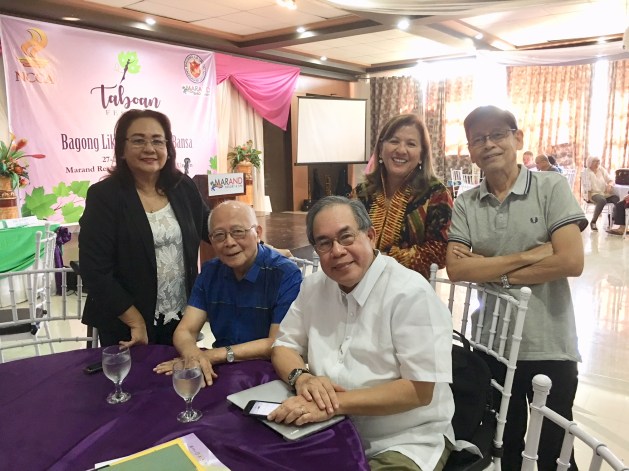
I WAS asked to give a keynote address at this year’s Taboan Literary Festival in Bauang, La Union on the subject of “Celebrating Arguilla”—Manuel Estabilla Arguilla, the writer who was born in Nagrebcan, Bauang, 106 years ago. I’ll share that talk in three installments starting this week.

“Celebrating Arguilla” seems simple enough. After all, who hasn’t read and enjoyed “Midsummer” or “How My Brother Leon Brought Home a Wife,” or pondered the social implications of “Caps and Lower Case,” to mention three of his most familiar stories?

But right there is a huge difference in theme and sensibility between “Midsummer” and “Caps and Lower Case,” which might as well have been written by two different people. How the dreamy romanticism of “Midsummer” could coexist with the gloomy realism of “Caps and Lower Case” might seem a mystery, but those of us who’ve written and read enough will know that, well, it happens, and perhaps it should. You see this spread and stretch in Arcellana, for example, in NVM Gonzalez, in Sionil Jose, even in Nick Joaquin.

I am not a literary scholar or theorist, so I cannot speak about Arguilla the way Fr. Joseph Galdon and E. San Juan do, and I have no special familiarity with him the way near-contemporaries like F. Sionil Jose would. I am a biographer of sorts, but have no access to his life beyond the standard summaries on Wikipedia and a few scattered accounts.

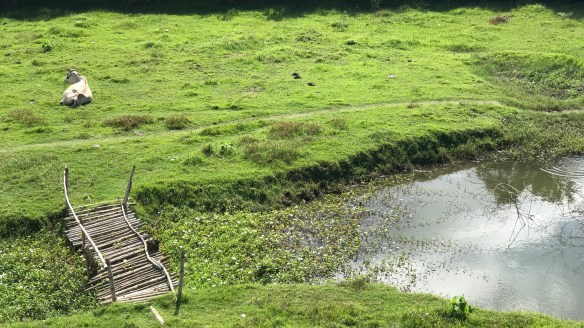
All I have to go on is the fact that I, too, have written stories, was born in a small village far from Manila and close to the sea, and have dealt quite often with the countryside in my fiction, although readers who know me as a city boy have never probably noticed that. I moved to the big city much sooner than Arguilla did, and so I cannot claim the almost ritualistic knowledge of rural life that he displays with gusto in his recollections of Nagrebcan, his evocation of such details as “handfuls of fragrant hay” in that stolidly premodern society where men till the fields and harvest the grain, and the women cook and wash.

IMG_3809

So the best I can do today is to engage Arguilla in a kind of conversation, raising the questions that one writer might have for another. Why do you write what you write, for whom, and for what? And for myself, I might ask, what is this writer doing that I should value? How does he or she reflect on my own work?

Without an autobiographical essay in which Arguilla himself would have explained his writing, I can only speculate on the answers based solely on the evidence of his fiction and of what others have said about his work.

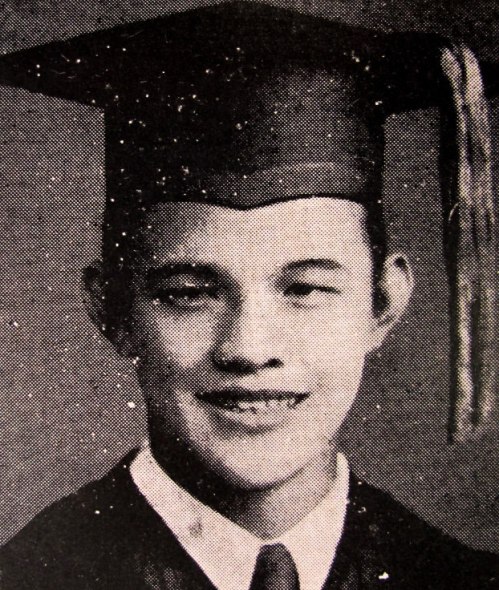
Manuel Arguilla’s first—and to my knowledge, his only solely authored—book, How My Brother Leon Brought Home a Wife, a collection of 19 stories, came out in 1940, on the eve of a war that Arguilla would not survive. He was 29 when the book was published; within four years he was dead at the hands of the Japanese, reportedly beheaded at the Manila Chinese Cemetery in August 1944 along with other guerrilla leaders.

History tells us that 33 can be a good time to die, if you’ve more or less accomplished your mission, as did Jesus Christ, Alexander the Great, Eva Peron, and, just short by a few months, Bruce Lee. Arguably, Arguilla had much more to write, much more to achieve, when his life was abruptly cut short by war.

He had published his first book, with some of his stories appearing in prestigious American literary journals. He had successfully transplanted himself from his provincial roots in La Union to cosmopolitan Manila, earning a degree in Education in 1933 from the University of the Philippines, where he led the UP Writers Club and edited the Literary Apprentice. He taught creative writing at the University of Manila before moving to the Bureau of Welfare and edited its publication well into wartime, when he worked for the guerrillas in intelligence and was captured and executed by the Japanese.

His widow Lydia, herself a fine writer and also a guerrilla, went on to become a painter and to establish the Philippine Art Gallery in Ermita, a seminal promoter of modernist art in the country, and served as a diplomat in Geneva before her death in 1969. In 1957, the book Philippine Tales and Fables was published in Manila by Capitol Publishing, with Manuel posthumously sharing the authorship with Lyd. Two of Lyd’s stories—the first published under her maiden name Lydia Villanueva, before she married Manuel—are featured in Leopoldo Yabes’ landmark anthologies of the Philippine short story.

I have yet to locate his essays, but Manuel Arguilla definitely produced more than the 19 stories in his 1940 collection. One story, the rather whimsical “Rendezvous at Banzai Bridge,” was published in the Philippine Review in April 1943, a year before his death. But it will always be the stories in his book that will define Arguilla for us, and I’ll do a quick review of these for those who may not be too familiar with his work.

IMG_5538

Penman No. 279: That Schoolboy Spirit

IMG_3628

Penman for Monday, November 27, 2017


UNTIL A couple of Saturdays ago, the last basketball shot I saw in a live full-court game was taken by the greatest of them all—Michael Jordan. This was sometime in 1989 or 1990; I was a graduate student in Milwaukee, and my friend Peter enticed me out of Shakespeare class, waving an extra ticket to the Bucks-Bulls game at the downtown arena. MJ was in town—it was literally going to be a once-in-a-lifetime chance to watch an NBA game, with Michael Jordan playing, for free. Screw Macbeth! MJ did not disappoint; with the Bulls trailing by two in the final minute, he sank a three-pointer in the final seconds, and while we were supposed to be Bucks fans, we all jumped in our seats to cheer him, screaming our heads off.

I’ve never been a huge basketball fan, although I very briefly covered the MICAA for a newspaper in the pre-PBA days and followed the NBA back when Kareem Abdul Jabbar was still Lew Alcindor. But I vicariously enjoy sport in all its varieties, from American football and baseball to boxing and badminton, as much from the game itself as from watching the players and the other watchers. There’s something about a surge going through a crowd that senses something magical about to explode on the arena or the court that lights a long-dormant fuse in me and brings me back to my boyhood, when my father took me to the Besa Boxing Arena and the Rizal Coliseum for an afternoon’s throaty mayhem.

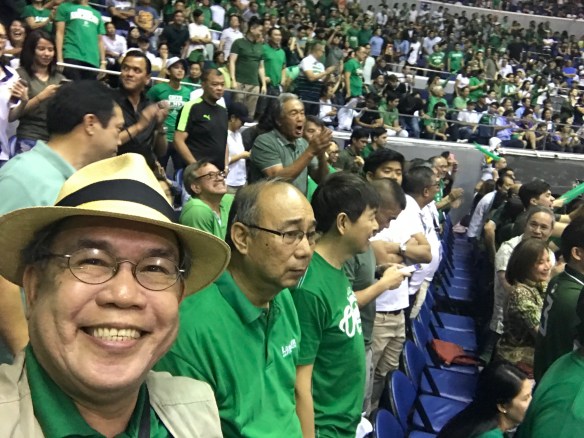
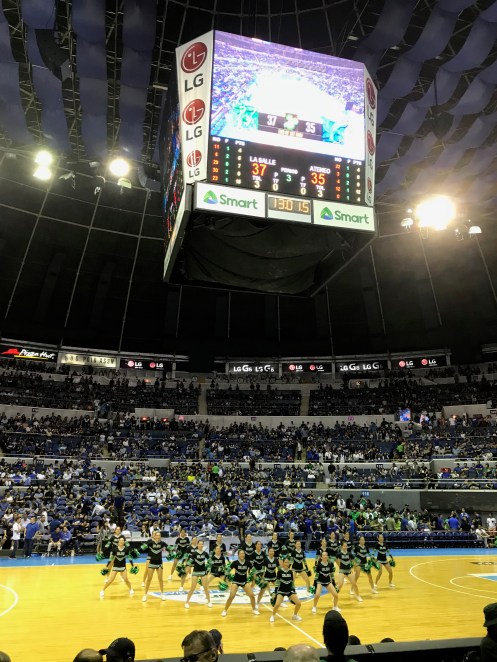
So I could hardly resist when a friend from grade school, who’s so modest I have to call him by his initials JV, invited me and the La Salle Green Hills gang to watch the La Salle-Ateneo game at the Big Dome last November 12. Ever the resourceful fellow (which explains his success in business), JV had managed to secure a certain number of tickets that enabled an impromptu reunion of some guys in our Viber group.

Of course every Pinoy barkada thinks of itself as special, but this one had a genuine claim to fame: our class was accelerated twice, saving us precious time. (And money, for those rarities—destitute La Sallites—like me.) I’ve written about my La Salle sojourn (Prep-Grade 7, 1960-66) elsewhere, the sum of which is, it’s the school I owe my preparation as a writer to, not to mention the supportive friendship of some very fine gentlemen. I went on to the Philippine Science High School, UP, and grad school in America, but I always treasured my schoolboy years in Green Hills and the love of books and language that they left me with.

How much better could it get? One minute I’m watching His Airness drop a game-winning trey, and nearly 30 years later I’m holding a golden ticket to the biggest game of the season so far. (Lest I be accused of treason to UP—which I should be cheering, after all, as a university official—I just haven’t had a chance to attend a live game yet, but was following and rooting for them all the way on the S&A channel, and I promise to come courtside next season.)

IMG_3587

First, we had to dress for the occasion, and while most of my buddies had closets full of green shirts, green socks, and presumably green underwear (JV even wore electric green sneakers), I had to reconnoiter several malls and department stores the week before the game to locate the perfect XXL polo shirt in shamrock green. We assembled four hours before gametime for a long and leisurely lunch in a nearby restaurant—for some of us, our first reunion in over 50 years, a long green-shirted line of seniors who’d last seen each other in khaki shorts, talking maintenance meds over crispy pata and cerveza negra. (Here’s one to us, guys—JV, Billy, Beyey, Dennis, Butch DG, Toffy, Mike, Conrad, and Jun!)

No matter how inured you might be to sports and competition, there’s no way you can escape the peculiar tingle and sizzle of a La Salle-Ateneo game, from the minute the drums unleash their tom-tom thunder from way up in the bleachers to the second the final buzzer sounds and sends half the gallery into hysteria while plunging the other half in utter despair.

It’s a rivalry that they say goes back to 1939, when La Salle beat Ateneo for the NCAA championship for the first time (27-23—sounds more like a halftime score these days). It’s come a long way since, and I don’t know who’s keeping track of the historic score, but every La Salle-Ateneo game feels like the deciding match of a best-of-three finals, going by the sheer electricity around the arena.

The last time I was at the Araneta Coliseum was two years ago to watch a revival concert of the Zombies; well, this was anything but a zombie crowd. Between spotting all the celebrities in the stands, appreciating the, uhm, fine art of cheerleading, and trying to catch up with new cheers and fight songs that I’d never mouthed before, it was sensory overload for a solid hour, an excursion into a culture I’d read about but had never visited.

I won’t bother you with the details of the game itself, which predictably went the cardiac route, with the Archers going down by as much as 12 in the third quarter, only to unload a 10-0 bomb in the closing minutes that led to an extremely satisfying outcome, 79-76, and just like that afternoon in Milwaukee nearly three decades gone, I found myself screaming and shaking like a broken radiator.

On the way out of the coliseum, a foot-wide grin still plastered to my face, I met a couple of blue-shirted colleagues from academia, whose baleful looks I couldn’t (and didn’t really want to) banish with my most effusive greetings.

IMG_3617


Penman No. 278: The Wealth Within Us (2)

Lantern

Penman for Monday, November 20, 2017


THE ARTS are the tangible and creative expressions of our culture, and this is where our strength as Filipinos lie—a strength, however, that we should first recognize, recover, and sustain.

We Filipinos have distinct natural cultural advantages. We are a naturally and irrepressibly expressive people, with strong artistic and creative talents and impulses. We think and speak freely, no matter the cost or the consequences. We reject and resist tyranny; we have no taboos, no sacred cows. We sing of love and death in the same breath, we laugh and weep without shame, we create and light up lanterns even in the most difficult and darkest of Christmases.

That freedom and that courage is our strongest cultural resource, the wellspring of innovation and productivity. This is why we have such great artists, writers, musicians, singers, dancers, filmmakers, designers, and artisans.

This brings me to the economic argument, which is that culture is not just an expenditure, but a valuable resource that, properly managed and supported, can reap substantial material benefits for our people, in the form of what have been called “creative industries.”

In 2009, when the Joint Foreign Chambers of the Philippines initiated a focus group discussion on creative industries in the Philippines, they defined the sector as embracing “a wide array of subsectors including advertising, animation, architecture, broadcast arts, crafts, culinary arts, cultural/heritage activities, design, film, literature, music, new media, performing arts, publishing, and visual arts.”

I won’t go into great detail here, but there are many studies—a recent report commissioned by the British Council, among others—that show how vital these creative industries are. According to that report, and citing UNCTAD figures, “Depending on how they are defined, the Creative Industries are estimated to represent anywhere from 3% to 12% of global GDP.”

I noted in a previous forum that in 2010—the last year for which I have solid figures—copyright-based industries or CBIs contributed more than P660 billion to the economy, according to the Intellectual Property Organization of the Philippines. In GDP terms, the economic contribution of CBIs climbed from less than 5 percent in 2006 to more than 7 percent in 2010. Core CBIs comprising companies in the arts, media, and advertising largely accounted for this surge. A corresponding rise in employment occurred in the sector, from 11 percent of the total number of jobs in 2006 to over 14 percent four years later.

In 2014, the DTI and BOI held a series of Trade and Industry Development Updates to present six industry roadmaps, one of which concerned creative industries. In that particular forum, the DTI’s presenter noted that Singapore and Thailand led ASEAN in creative exports, and while our creative industries have grown, we were a net importer of creative goods as of 2008, with books and movies apparently accounting for the bulk.

This reminds me that in that conference of Asian writers and translators that I attended a couple of weeks ago in Bali, it was reported that Asia is now the world’s biggest producer of books, movies, and games. But that’s an Asia dominated by China, Japan, Korea, and India. The question is, how can we Filipinos and Southeast Asians partake of that boom? First, of course, by strengthening those industries in our countries.

There seems to be a greater awareness on the Philippine government’s part of the economic utility of our artistic talent. In 2012, for example, RA 10557 was passed to promote a “national design policy” highlighting “the use of design as a strategic tool for economic competitiveness and social innovation.”

It’s heartening to note that Chapter 7 of the Philippine Development Plan for 2017-2022 is devoted to “Promoting Philippine Culture and Values,” in which it is acknowledged that “The current governance framework for cultural development has been inadequate in addressing the concerns of the sector.” The plan contains salient proposals for using and promoting cultural values to promote the common good and identifies key legislative measures to achieve full cultural development, including the long-overdue establishment of a full-scale Department of Culture that will not be a mere adjunct of education, sports, or tourism.

But we remain a long way from translating policy into action. As with most things cultural, the first transformation has to take place in the mind—more specifically, in the mindsets of our leaders.

Only now, in preparation for this talk, did I become aware of the ASEAN Socio-Cultural Community and of its noble concerns which include human development, social welfare and protection, social justice, and so on. But only at the very end of its “scorecard” report does it deal with “Building ASEAN Identity” and promoting cultural creativity and industry—talking, for example, about networking among small and medium-sized cultural enterprises of SMCEs around the region.

It’s rather sad in a way to speak of culture as a business, but if that’s what it takes to wake people up to the wealth within them, then by all means, let’s draw on our hearts and imaginations to showcase the best of what we can be, and inspire ourselves in the process toward a stronger sense of nationhood and of regional community.

Penman No. 275: Listening in Bali

IMG_3343

Penman for Monday, October 30, 2017


The first time I saw Bali was 34 years ago. I was a much younger man, then only 29, an eager participant in a writers’ conference organized by F. Sionil Jose, in the company of other Filipinos who included, as far as I can remember, the late Rey Duque, Marjorie Evasco, Charlson Ong, and Fanny Llego. We spent a week in a villa on the steamy banks of Lake Batur, far away from the tourist traps of Denpasar and Ubud, which we would visit only at the very end of our trip.

It was my first time to attend an international gathering of writers, and I was deeply impressed by all the big names I met, aside from Manong Frankie himself—our host, the scholar S. Takdir Alisjabanah, among the pillars of Bahasa Indonesia; the Singaporean poet and professor Edwin Thumboo; the Malaysian poet and lawyer Cecil Rajendra; and the Malaysian-American poet Shirley Geok-lin Lim. I can’t recall a thing I said in the impassioned discussions that took place; that first time, it was all about listening and imbibing the wisdom of the masters in an environment that could not have been more conducive to inspiration.

IMG_3372

The lake was a caldera, which explained the hot springs simmering on its fringes, where we joined the unabashed Balinese in their early-morning ablutions; at night, we argued literature under the spell of the stars and the aptly named Bintang beer, to the faint accompaniment of a gamelan symphony. The one discordant note that I would later write about in a short story was an ill-advised sortie across the lake to a private graveyard, which the locals resented; but even that was a writerly touch, an almost obligatory twist to a near-perfect plot. And rightly so: back home, Ninoy and EDSA had yet to happen, and the country was seething in the darkness.

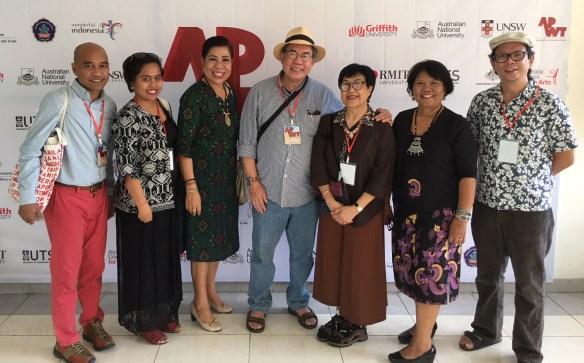
These memories swarmed through my senses last week when I returned to Bali for yet another literary conference, the tenth annual meeting of the Asia Pacific Writers and Translators (APWT), the region’s largest and most active literary network. Hosted by the Ganesha University of Education in the city of Singaraja in the northern part of the island, the conference brought together about a hundred delegates from all over, but mostly from Australia, Singapore, Malaysia, the US, and, of course, the Philippines, which has always figured prominently in this organization (I sit on its Advisory Board). With me were UPICW Director Roland Tolentino, the essayist and playwright Luna Sicat-Cleto, the poet and translator Randy Bustamante, and my wife the art restorer Beng, an avid observer and fully paid member of APWT.

APWTPic

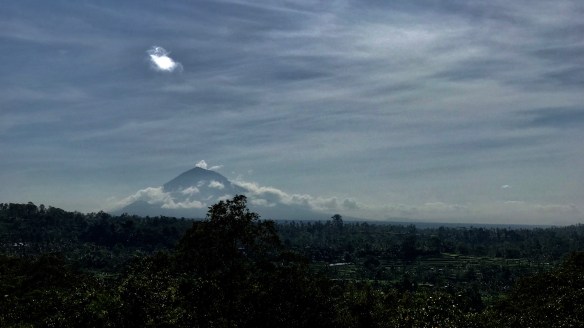
Even the most jaded of writers can’t be faulted for flying into Bali and expecting a bit of paradise, and the island and its people can still deliver on that promise in spades. The manicured rice terraces, the monkeys lining the road, the meticulously patterned garlands, the whiskery banyan trees, the uncountable temples and altars—and let’s not forget the scenically smoldering Mount Agung on the horizon—all suggest transport to another realm of blissful serenity. That illusion, of course, was broken fifteen years ago by catastrophic terror bombings that took more than 200 lives, and in the course of our three-day conference, testimonials by our Balinese friends themselves would reveal certain painful realities behind the festive façade.

“It’s very difficult to be a Balinese woman,” more than one of them said (I’m pooling their voices together, as in a chorus). “People expect you just to be a pretty flower. I have a PhD and I make more than my husband, but I still have to appear subordinate to him and to his wishes, and I have to serve him at home, making his coffee and serving his clothes. When I received a fellowship abroad, people congratulated my husband, instantly assuming that it was his achievement and not mine—and I had to smile and say nothing about it. You know why I write in English? Because my husband can’t read English, so English liberates me, allows me to express my true feelings.”

IMG_3299

Another intriguing panel I attended took up “Nostalgia and the Asian City,” and the discussion dwelt on how cities like Hong Kong and Singapore had changed in the literary imagination. But, from the floor, I had to interject the Philippine experience and note how nostalgia in many other places like ours referred to a longing for an unspoiled rural Eden that no longer exists, an unrecoverable if not fact an imaginary past. Over lunch, I pursued the point: nostalgia is being used as a powerful political tool, such as in defense of a mythical “better time under martial law” to support a restoration of that regime.

I was assigned to a panel devoted to protest literature, and found myself grouped with three Australians who spoke on their respective struggles as immigrant, aborigine, and bohemian writers. I chose to speak about our history of protest literature and what a deadly business it was. So, our moderator asked in the end, what were we personally doing to upend the status quo? The status quo for me, I said, was darkness and despair, and it was winning out even in literature, so that there’s nothing easier to write these days than another sad and dismal story. Therefore, I would strive to write happy stories—stories with a believably, hard-won, happy ending—as my form of resistance. We have to fight for joy as much as justice; we have to keep fighting for happiness, hope, and beauty in this age of Trump and tokhang—what else were we persisting for?

As I said those words—which I had not expected to say, but had long been coming around to saying—I felt all of my 63 years, hoping perhaps that some young soul in that audience was truly listening.


Penman No. 274: Acronyms for Authors

ALBWW.png

Penman for Monday, October 23, 2017


AS YOU read this, I’ll be in Bali, Indonesia, attending this year’s Asia Pacific Writers and Translators (APWT) conference, about which you’ll hear more next week. But today I’m going to throw in a few more terms aside from APWT into our literary alphabet soup, so you’ll know a bit more about what our writers are doing.

APWT, of course, is the region’s primary and most active network of writers and translators. While many of its members are also teachers, APWT is refreshingly non-academic, meaning you can actually understand what people are saying at its conferences, which are devoted to practical issues and questions of craft. You can find out more about the organization here (apwt.org) and maybe even think of signing up so you can attend next year’s meeting in Brisbane.

If you’re just starting out as a writer and feel like you’re still a long way away from APWT, perhaps you should try out for the next ALBWW, which is the Amelia Lapeña Bonifacio Writers Workshop. Now on its second year, the ALBWW was initiated by the University of the Philippines Institute of Creative Writing (UPICW) to help and encourage young, beginning writers.

UP, of course, had been supporting novices since the workshop itself began in 1965, but since its main summer workshop shifted toward mid-career writers in the 2000s, beginners have had to choose from a roster of workshops offered by other schools. The ALBBWW—named after the country’s foremost exponent of children’s theater—is UP’s way of saying “We haven’t forgotten you.”

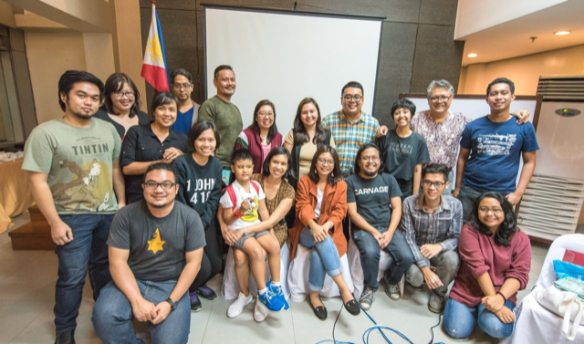
Devoted to young adult writing, this year’s ALBWW was held from October 6 to 9 at the Oracle Hotel on Katipunan Avenue, and brought in 12 of the country’s youngest and brightest writers. They included Ivan Khenard Acero, Angeliza T. Arceño, Gabriel Carlos T. Cribe, Sigrid Gayangos, Ivan Emil Labayne, Kid Orit, Steno Padilla, Rayjinar Salcedo, Rai Aldrin B. Salvador, Krizelle R. Talladen, Carlos Valdes, and Sofia Zemana. They came from as far north as Isabela and Baguio to as far south as Butuan and Zamboanga, with backgrounds as diverse as Math, public relations, illustration, and book design, aside of course from literature and creative writing. Veteran writers Dean Alfar, Eugene Evasco, Mina Esguerra, Vim Nadera, and Christine Bellen walked the fellows through discussions of their works and of aspects of the craft.

A highlight of the ALBWW was a group visit with Ma’am Amel at her home, which also happens to be the headquarters of Teatrong Mulat, her pioneering children’s theater group which performed excerpts of their puppet plays for the visitors. The fellows were also treated to a tour of the Ateneo campus and the Rizal Library.

IMG_3130.jpeg

Another important ICW event last month was the third iteration of the IBF or Interdisciplinary Book Forum, an activity co-sponsored by the UCW and the UP Press. I conceived of the IBF a couple of years ago when I was still ICW Director, thinking how interesting it would be if a new book—in any field, not just literature—were to be read and discussed by a panel of experts from a broad range of disciplines. How would a book on colonial architecture be read by, say, a sociologist, a historian, and a civil engineer? How would a novel on OFWs be received by a labor economist, a diplomat, and a psychologist?

We began this new IBF series last year with discussions around books on tattooing in the northern highlands on new speculative fiction written by Filipinos. For our third book, we chose Dr. Ma. Mercedes Planta’s Traditional Medicine in the Colonial Philippines: 16th to the 19th Century—a book recommended by UP Press Director Neil Garcia not because it was intrinsically interesting but because it also connected us to what its author, a historian, calls “our usable past.” Valuable insights into that past and our appreciation of it were contributed by the archeologist Dr. Victor Paz, the historian Dr. Ma. Luisa Camagay, and the physician Dr. Salvador Caoili. You can find the videos of this and other ICW events at http://panitikan.com.ph/media/.

Last, there’s KSA—Kutura, Sining, Atbp.—a cultural talk show that I host on TVUP along with Drs. Neil Garcia and Cecilia de la Paz. TVUP (tvup.ph) was started last year as UP’s Internet TV station, creating and broadcasting new programs—on significant and important topics, but presented in a popular and accessible manner (one of my favorites titles is “Hairy Balls and Donuts: The Fascinating World of Geometry” by Dr. Joey Balmaceda, a mathematician). On our show—which is bilingual, by the way—we’ve done episodes on film, theater, creative writing, and visual arts, among others, and are looking forward to taping further episodes on architecture, music, and dance, once we get the right mix of guests together.

There’s a few more acronyms for authors I can think of—we’ll soon be looking for our next NSWW fellows (that’s the National Summer Writers Workshop), the big mid-career gig that we’re hoping to be able to move to other UP campuses around the country, possibly in the Visayas next after two years in Los Baños—but you get the idea. In this life of letters, we try to make every word count.

Penman No. 273: A Privileged Friendship

IMG_7575

Penman for Monday, October 16, 2017


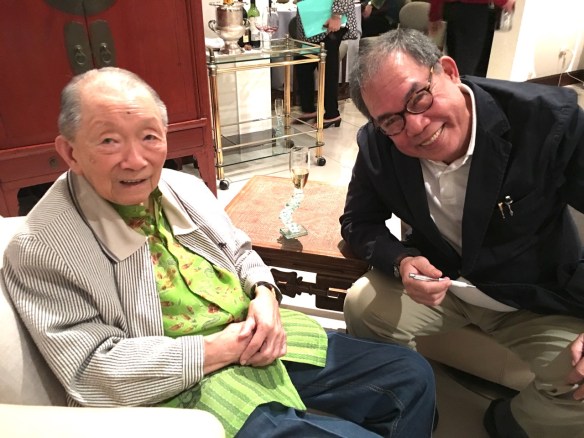
THE LAST time I saw Wash SyCip was from a far distance. It was his 95th birthday on June 30, 2016, and a long line of well-wishers—businessmen, politicians, and other celebrities—had queued up at the ballroom of the Shangri-La Makati to greet him and have their pictures taken with the icon. I thought for a second about falling in line, just to say hello, but then decided against it, already having spent more time with Wash than most people except his closest associates. He looked more frail than I had ever seen him, even as he kept up a cordial countenance seated in his chair on a raised dais, and I felt content to remember the sprightlier octogenarian I had first met a decade earlier.

Of course I knew who Washington SyCip was well before then; my wife Beng worked as an artist in the communications department of SGV in the 1980s, but I had never met the man himself—not until an opportunity arose to bid for and to write his biography in early 2006, when he was turning 85. I felt very fortunate to have been chosen for the job—and that’s what it was to me then, a job, albeit one involving an illustrious subject. I had no inkling that I was about to enter into a privileged friendship, something that would extend well beyond the writing of a book.

I had already done books for and about other personages in politics and business, and would do many more after Wash. But none of them—meaning no disrespect to or disregard for my other clients—would come close to the biography I would write for Wash, and it had everything to do with the uniqueness of the man, who lived not only an extraordinarily long life but also one far more colorful than you would credit an accountant for.

For months, we met Saturday mornings in his seventh-floor SGV office, and chatted for a couple of hours about phases of his life, proceeding chronologically from his childhood to the key decision to open his own accounting firm, a moment that I would later decide to open the book with. (Wash: Only a Bookkeeper was published in 2009 by the SGV Foundation and the Asian Institute of Management, and won the National Book Award for Nonfiction in 2010.) Immediately I felt at ease with his polite formality; no artificial chumminess there or dramatic flourish, just a quiet consistency of well-remembered detail, everything from trying to learn the foxtrot for a graduation dance and breaking Japanese codes in Calcutta to carrying a cold, dressed duck under his arm on the New York subway to bring to a lady friend.

Most readers, I’m sure, were looking for the grand contours, the big business decisions—and there’s all that in the book—but I tried to keep things homely, and was glad that Wash was game for it. He liked to play “Lara’s Theme” from Dr. Zhivago on his iPod—but not being a techie, often forgot to recharge it.

When he learned that I collected pens, he sent a bunch of them over to my house; I opened the box and saw that he had gifted me with some very nice ballpoints, which I thanked him for. When a perceptive associate gently reminded him that I collected not ball pens but fountain pens, he sent another box of the correct writing instruments—CEOs like him typically received scores of these as gifts and stored them away in drawers—with an apologetic note, even more graciously acknowledged by the ecstatic recipient. And every Christmas we would receive a box filled with some lovely piece of décor handcrafted by a microenterprise he supported in Cebu.

He had a soft spot for Filipino talent of all kinds. He once hosted a party at his home for President Cory Aquino, some ambassadors, and similarly lofty people. After dinner, he sprung a surprise on them. “Just get into your cars and follow me!” he announced with a twinkle in his eye. He led the convoy to a dimly downscale stretch of Boni Avenue, down into the happy maw of Club Mwah, the gay musical revue. Cory had a blast, and I had fun watching Wash garlanded by that feathery parade.

Sometimes I dropped by his office or chatted with him in the corner of a soirée to hear him share his views on current goings-on, both of us probably thinking that they would be useful inputs to the centennial update of his biography, but really just to catch up. It was these unscripted asides, his inviting trust, that I felt most privileged by. I suppose biographers come in through some special door, and with Wash, that door always seemed open.

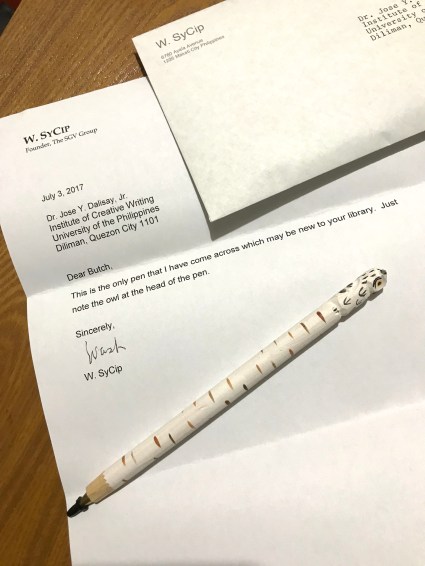
Last July I received an envelope from Wash, and even without opening it I could feel that it contained a pen inside. “Dear Butch,” said the accompanying note, “This is the only pen that I have come across which may be new to your library. Just note the owl at the head of the pen. Sincerely, Wash.” It was a ballpoint, but I didn’t mind—owls (and turtles) were his trademark avatars.

IMG_3207

His generosity was well known, but it was never the showy or sentimental kind. He believed above all in the capability of the poor to learn and to lift themselves up with a little help. Despite the American citizenship he had to accept in a time of war, he thought and acted as a true global Filipino.

When he passed away last week on a plane above the Pacific—bridging the two shores he knew best, and still on the job at 96—I was requested to draft an obituary, and I replied, choking, that it was going to be my honor. It was the first—and, almost certainly, the only—time I would shed a tear for someone I wrote about.

Penman No. 272: A Poet of Nature

Junyee

Penman for Monday, October 9, 2017


IT’S NATIONAL Artist season again, with the deadline for nominations for the next group of NAs falling last September 30. It’s a triennial exercise that raises some very fundamental questions about how the arts figure in our national life and consciousness, and what we value in art.

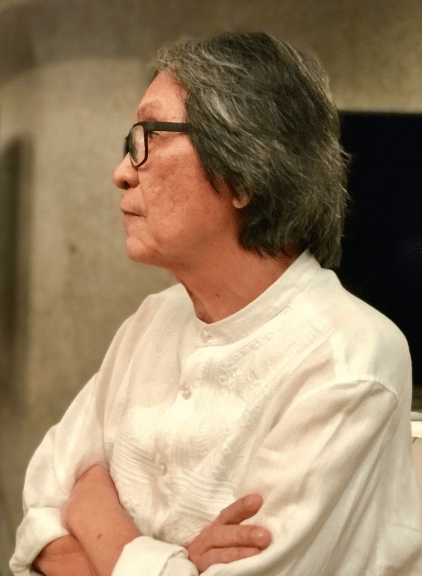
There’ll surely be an impressive roster of nominees to review, each name with its own merits to recommend it. But among all those presumptive candidates, the one I’ll be rooting for is a lanky, genial, youthful-looking septuagenarian who goes simply by the name “Junyee,” short for the Luis E. Yee, Jr. that only his family and closest friends probably know.

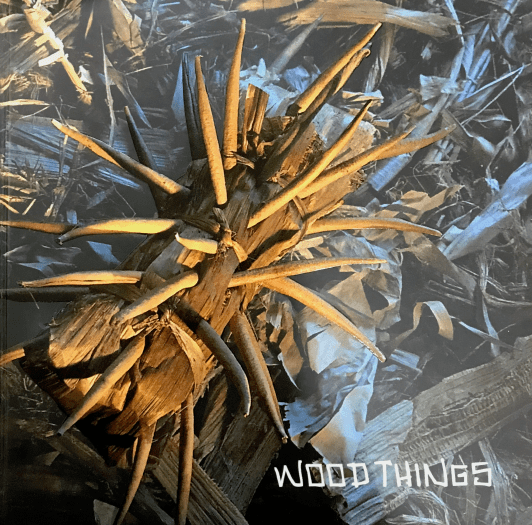
I’ve known Junyee and his work for some time now, but I was even more impressed by its breadth and quality as I listened to him address a large crowd that had gathered for the launch of his artistic biography Wood Things at the CCP lobby last Tuesday.

Like many artists, Junyee has a certain shyness about him that prevents more aggressive self-advertisement, so let me sing his praises for him in the hope that he finally gets the recognition due his lifetime of labors.

If you’ve never met him but read the book (written with grace and deep insight by the equally gifted artist Jose “Bogie” Tence Ruiz), the first thing that will strike you will be the life itself, the engrossing narrative of how a boy born in the hinterlands of northern Mindanao at the height of the Japanese Occupation nurtured a native talent that would, much later in life, see his works celebrated in France, Cuba, Israel, Japan, and Australia, among other cultural capitals.

The boy drew his first inspirations from the bales of scrap paper his father imported to use as wrappers in their general store, bundles that contained American and local comics depicting worlds far removed from Agusan del Norte. Later moving to Cebu, he found a job with a funeral parlor, first as a janitor and a clerk, then as a beautician for corpses, and later as an embalmer, all the while ogling the art supplies in the local department store, never yielding his dream.

In 1964, he received a scholarship to study Fine Arts at the University of the Philippines, and apprenticed with the renowned sculptor and later National Artist Napoleon “Billy” Abueva. The opportunity opened Junyee’s eyes to a whole new world of modernism, and eventually he broke out on his own, even as the prevailing forces of the 1970s—the psychotropic seductions of Carlos Castañeda on the one hand and the First Quarter Storm on the other—pulled him in different directions. While Junyee held progressive sentiments, Tence Ruiz notes that “He was inherently a maverick individualist who, while recognizing the need for collective actions to affect change, saw how formulaic and uncreative propaganda could get.”

WoodThings.png

And that’s key to the kind of visionary and yet also political art Junyee would produce over the next four decades—an art that manifests an abiding love of life, and of nature as the bringer of that life. In his preface to the book, artist Hugo Yonzon III writes that “The dominant and recurring theme of his installation is nature or, more precisely, the respect for it. There is none of the theatrics of LED lights or the electronic sounds that characterize such art especially in the Western world. A twig, a pod, a tree bark, local hemp, and then some. Period.”

“Installation” is a word that would inextricably be attached to Junyee’s art, as he explored and promoted the genre well before the term itself became fashionable, always and again drawing on nature for his materials and inspiration, from the seminal Balag of 1970 to the installations now dotting the campuses of Diliman and Los Baños, in which latter place he has found his literal and spiritual home, amid the trees and rocks that he never sees just as objects but as bearers of messages, like the 10,000 tombstone-like stumps of wood he laid out on the CCP grounds in 2007 to bemoan illegal logging and the catastrophic flooding it induced.

Junyee is a master sculptor and painter, and a wordsmith as well—his sensitive lyrics add a more personal touch to the book—but he is, ultimately, a poet of nature, who can make wood and stone speak and sing in joy, sorrow, and just the sheer excitement of living.

Lotsu.jpg

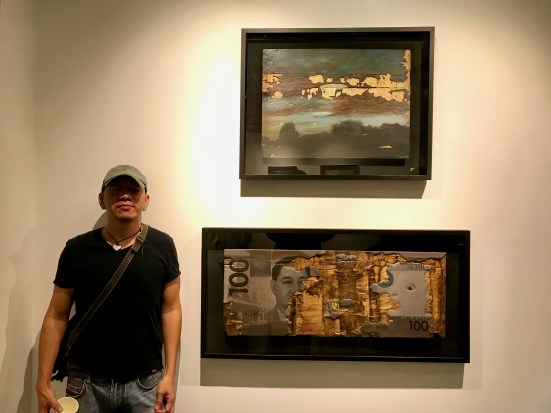
Speaking of artists, let me draw your attention to a younger painter in mid-career by the name of Lotsu Manes, whose seventh one-man exhibit titled “Handumanay” (after the Visayan word for keepsake or memorial) is now running at the Eskinita Gallery on the 2nd floor of Makati Cinema Square until October 23.

We’d known Lotsu since he was a small boy running on the beach of our hometown in Alcantara, Romblon, and took notice when he won the Grand Prize in the Shell Art Competition of 1996. “Handumanay” shows him maturing well beyond the meticulous craftsmanship that distinguished his earlier work to a more conceptual understanding of time and memory, and of the preciousness of what remains in his termite-ravaged portraits and landscapes.

At the opening, I was also glad to speak with curator and sculptor Renato “Ato” Habulan, who has been mentoring younger artists like Lotsu toward a less technical and more philosophical appreciation of their own work and vision.

Seeing Lotsu in his prime, chatting with Ato Habulan, and applauding Junyee at his book launch all left me warmly reassured that—even and especially in these terror-stricken times—art, like music as the poet Congreve put it, “hath charms to soothe the savage breast, to soften rocks, or bend the knotted oak.”