Penman No. 284: A Passion for the Past

IMG_3975.jpeg

Penman for Monday, January 1, 2018


DESPITE THE fact that I write biographies and institutional histories, I’m not a historian and have never claimed to be one. But some days I wish I were. Back in 1981, when I was re-entering UP after dropping out for ten years as a freshman, I chose between History and English as my professed major, and settled on English only because it offered the faster path to follow, to make up for lost time. But if truth be told, in more leisurely circumstances, I would have preferred to study History, and thereby learn Spanish and even some Latin.

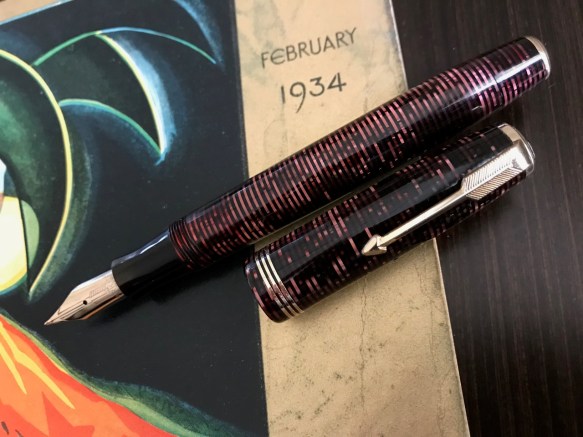
That’s because I’m fascinated by the past—by what happened, and by “what if”; I suppose that becoming a writer of fiction satisfies some of that curiosity (one always has to imagine and construct a past that never really happened but could have, for one’s characters). I’ve indulged that curiosity by collecting vintage fountain pens, surmising the words of love, pain, loss, and hope they would have inked for their long-vanished owners.

But more recently I’ve been edging into a new area of interest—old books and manuscripts. I’ve had the odd book from the 1800s and some beautifully handwritten documents from Spanish times, but my passion took a more serious turn with the acquisition, on eBay and elsewhere, of some rather more precious pieces. I often bring these specimens—like my December 1922 Philippine Collegian—to my classes, so my students can appreciate the material reality of the past and understand that the world, time, and society didn’t begin with the Internet and Facebook.

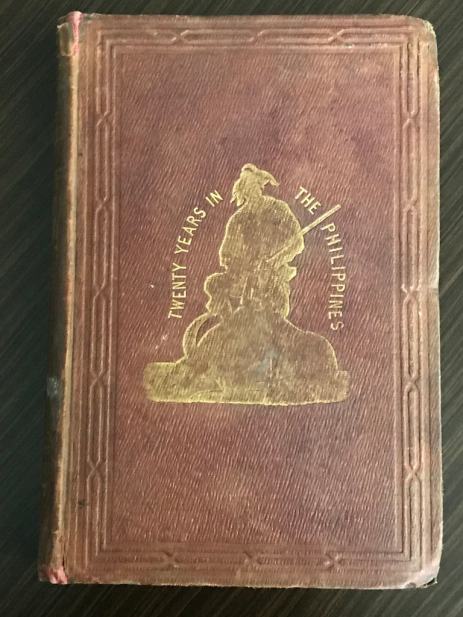
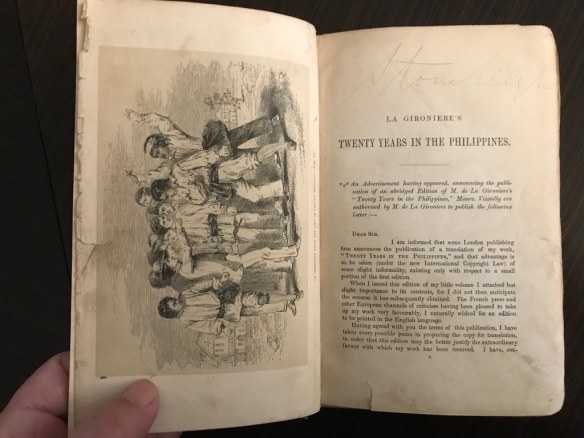
About a year ago, I picked up a first English edition of a book I’ve enjoyed (in paperback) since the 1970s—Paul P. de la Gironiere’s Twenty Years in the Philippines, later expanded into Adventures of a Frenchman in the Philippines. Gironiere was an adventurer who came to the Philippines from France in the early 1800s and established a large estate in Jalajala, on the shore of Laguna de Bay. He wrote about his exploits, and the original French came out in an English edition in 1853. I found a copy of that book on eBay, from the UK.
38985878042_bf134a46f3_b.jpg

38985877652_490a1afe80_b.jpg

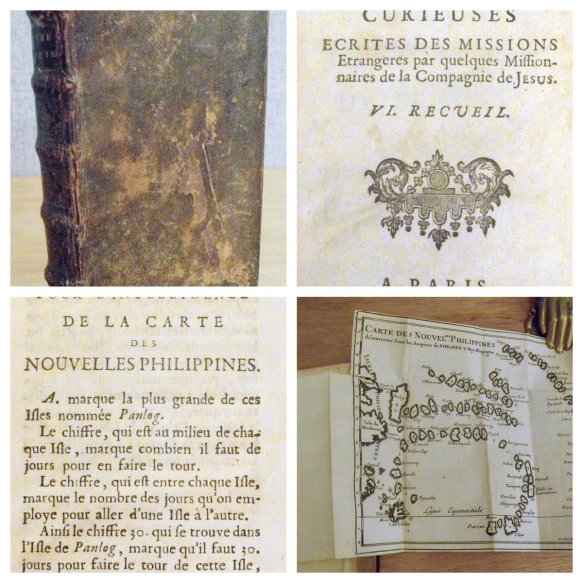
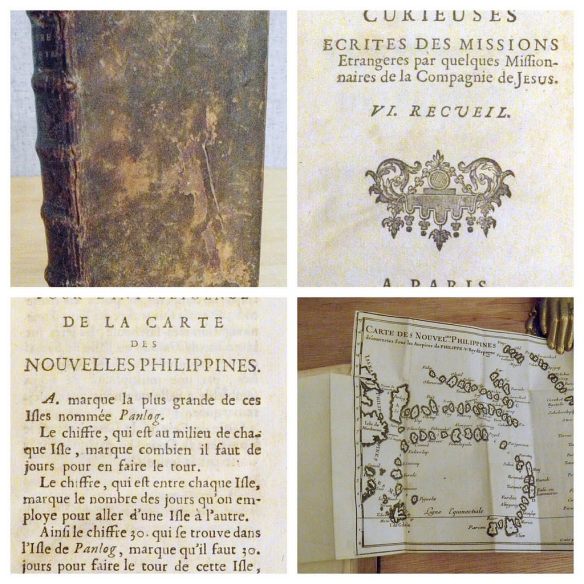
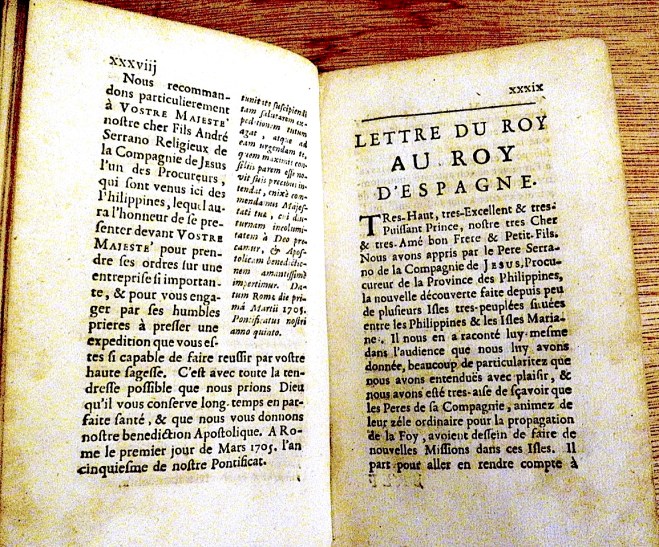
Now, 1853 is pretty old, but that would soon be surpassed by another irresistible find: a book of letters written by the Jesuit missionaries in the Philippines, published in France in 1706. The Jesuits arrived here in 1581, so the book—part of a century-long series called the Lettres Edifiantes, covering their missions around the world—is full of stories. I may not be an Atenean and my French is very poor, but I can discern marvelous adventures and great historical importance in this volume, which I found in California.
27498055959_fffba7d055_b.jpg

IMG_4230.jpg

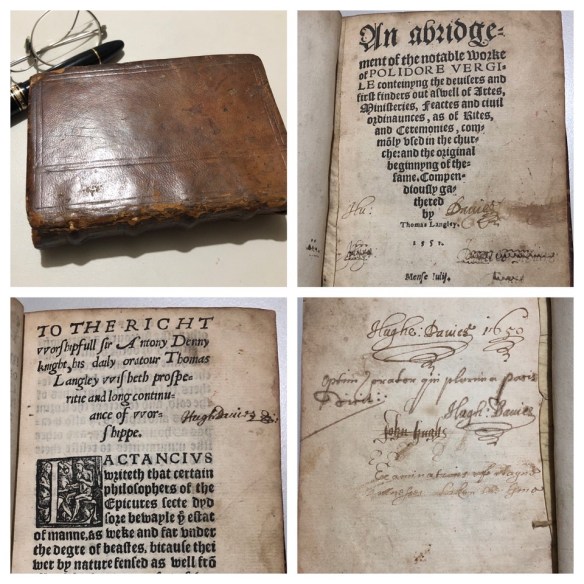
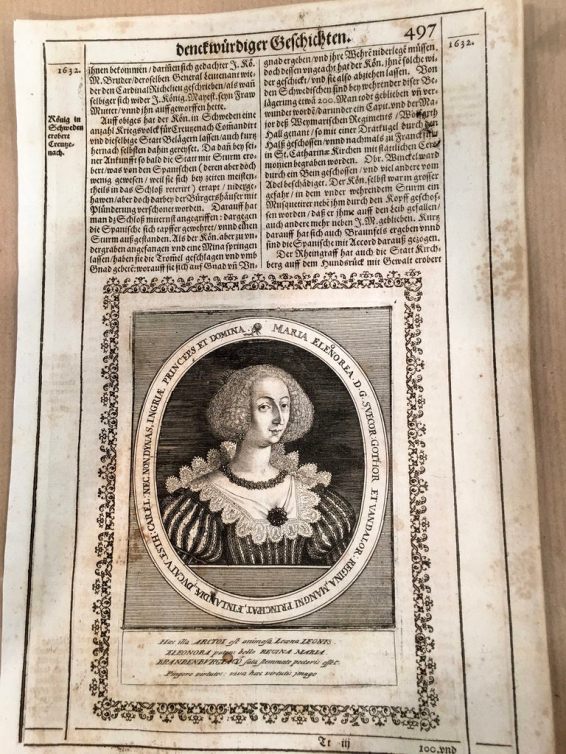
Before this, I actually had something older: a page of a German book from 1632, which I picked up at the Frankfurt Book Fair last year. But nothing could top the elation of a discovery I made just this Christmas Eve. I was idly browsing olx.ph; not finding any interesting pens, I searched for “antiques,” and stumbled on what was clearly a very old book in English from 1551, printed in Gothic blackletter. I made what I thought was a fair offer, and the seller texted back quickly to accept it; he’d been trying to sell it for a year with no takers, so my offer seemed timely, given the season. He said he was in Cubao; I said that in that case, I’d just drive over to pick it up. I saw the ad around 6:00 pm and by 7:00 the book was in my hands.
IMG_4127.jpeg

It’s nothing outstanding on its own—an abridgment by the churchman Thomas Langley of an earlier book, De inventoribus rerum, by Polidore Vergil, an Italian scholar, a kind of history of institutions like the Catholic Church (Vergil’s book got him in trouble with the church, which put it on its index of banned books). But I’m amazed by the fact that it’s survived quite handsomely for its 466 years—the pages are crisp, the leather binding firm—and charmed by the marginal notes of one of its owners, a Hugh Davies from 1650, written in extremely fine point with a quill, using sepia ink. When this book came out, Shakespeare (1564-1616) hadn’t even been born yet; the sacking of Manila was still 20 years away.

And how ever did it travel from London to Cubao across five centuries? My seller told me that his mother was a caregiver in Paris, whose clients gifted her with all manner of odds and ends—old books, Russian banknotes, silver spoons—and so the Pinoy diaspora once again works amazing wonders, bringing the flotsam and jetsam of history to our distant shores.

As I’ve often noted, the most wonderful thing about the past is that it’s over, especially when you think about all the terrible wars, the hardships, and the filth people had to endure just to get where we are today. But in a more romantic mood I can imagine myself strolling down the Escolta in the mid-30s in a white linen suit and straw hat, stepping into the Crystal Arcade or Heacock’s to scoop up the newest Parker Duofolds and Vacumatics. If you visit my office in UP, the magazine you’ll find on my visitor’s table won’t be from last month, but from February 1934. This will soon be joined by another magazine—indeed, the very first publication to use “magazine” in its title—the London-based Gentleman’s Magazine, issue of November 1773, and by a copy of the Illustrated London News, showing Taal Volcano, from February 4, 1860.

The past (or should I say eBay?) is truly inexhaustible; I only wish I could say the same for my finances. Happy New Year!

29865499124_9395dcd754_b.jpg


Penman No. 283: (Happy (Digital) Anniversary

ebay2

Penman for Monday, December 25, 2017


IT USED to be, in simpler times, that we marked and celebrated only the most meaningful of anniversaries—birthdays, weddings, the passing of loved ones, and maybe the day when we became a lawyer, a professor, or a boss. In my case, things got even simpler because Beng and I decided to get married on my 20th birthday (44 years ago in a few weeks). It’s a decision I’ve regretted since—not the marriage, but the twinning of these events, because it would have been nice to have two separate days and two separate excuses to celebrate.

But in this era, when relationships don’t seem to last much longer than cellphone batteries and when people can instantly “unfriend” each other for the most peevish of reasons, anniversaries have become precious things, with millennials having to invent such clumsy portmanteaus as “monthsaries” or “mensversaries” to find relief in the completion of another month’s tetchy togetherness.

And then there’s the turn of the consumer year that merchandisers won’t let you forget; if it’s September, then it’s not only the start of Yuletide in the Philippines, but also the inevitable announcement of the new iPhone X, Y, or Z (accompanied by a deep intake of breath as the awesome new gadget is unveiled, followed by the gnashing of teeth once the price is mentioned).

And yes, of course, I have the new X, which I was intrigued by but surely didn’t need—people my age could have lived happily ever after with the iPhone 4s, if truth be told—but I felt like rewarding myself for having stuck with the iPhone for ten years since the first one came out. That’s what anniversaries usually do—compel you to repeat a lunatic act. (Those of us now screaming about the X’s price tag will do well to remember that the first one, with all of 16 gigs of memory, cost a princely 45K in September 2007, plus another 5K to hack for use with local telcos. And before anyone subpoenas my SALN as a UP prof, I got my X at a steep discount through my telco, by hocking my soul for two more years.)

The decade-defining X reminded me of two more anniversaries that fell this year, of the kind that makes sense only in the context of our new digital reality, where a few years might as well be a lifetime in terms of changes in the way we think and work.

Last December 17, I marked my 20th year on eBay, which means I’ve been a digital consumer for longer than some of my students have been alive. EBay began as Auction Web in 2005, but it was in September 1997 when it opened shop as eBay, so it turns out that I signed up just a few months after its official launch. My first eBay purchase was a 1950s Pelikan 140 fountain pen from Germany, which stayed with me until I foolishly sold it a couple of years ago; my most recent one this month, again from Germany, was a 1950s Montblanc 234 ½ fountain pen—how odd is that? (But perhaps no odder than another recent acquisition—a book of letters of the Jesuits in the Philippines to the King of Spain, in a French edition published in 1706.)

DPb-BQ_UEAAmCOg

Between those two purchases lies a long green trail of about 1,000 other eager buys (my 100%-positive feedback score stands at 869)—mostly pens, watches, and books, but also computers, phones, spare parts for everything, and things you can’t get from any store (like original Apple shirts, the blue ones Apple Store employees wear). Like the cliché goes, one man’s junk is another man’s treasure, and I’ve very often been that other man, crazy and willing enough to take your grandfather’s Parker 51 or that weird-looking Hamilton Piping Rock (yes, that’s what it’s called) off your hands.

Friends scared of doing business online often ask if I’ve ever been scammed or burned on eBay. In those hundreds of transactions, maybe two or three times, I either never received what I bought, or got something else; but since eBay has an ironclad guarantee, I got refunded in the end. Presuming you take the right precautions—examine advertisements down to the minutest detail; read feedbacks (although they’re not infallible); know your product; review its price history, etc.—eBay’s safe and easily the world’s largest bazaar open to Filipinos. My only word of caution: it can get addictive, especially since it’s cashless; expect your PayPal/credit card bill to soon read “eBay eBay eBay…”

My other anniversary thankfully came free: last March, I marked my tenth year on Twitter. Ironically, I’m not much of a social-media guy, and that Twitter account (@penmanila), which I must’ve opened in 2007 on a whim, lay dormant for most of that decade until two years ago, when—uhm—a certain candidate in a certain election got me so worked up that I quickly found my meek and gentle self embroiled in a full-scale Twitter war with a vandal army. (“Something wicked this way comes,” I tweeted, quoting Macbeth; it didn’t stay that lofty or that literate for long.)

Wicked

I’m now up to 760 tweets, and counting—still nowhere near the many thousands that my younger readers have unleashed upon the universe, but old guys think more slowly and our fingers take more time to travel across the keyboard. That’s actually good for social media and its trigger-happy culture, and I can only wish I were that pokey and that deliberate on eBay.

Still, happy anniversary, and Merry Christmas, all!

Penman No. 282: Never Enough Patriots

IMG_4055

Penman for Monday, December 18, 2017


(THIS IS the last of three parts of my recent talk on “Celebrating Arguilla” at the Taboan Literary Festival in Bauang, La Union.)

Leonard Casper and Joseph Galdon aver that Manuel Arguilla’s best stories are those in the pastoral tradition, and I would agree that “Midsummer” is in a class all its own, but who knows what else he would have written, given ten or twenty more years? Stories like “Elias” convey less surface beauty than his pastorals, but in some ways are more resonant; his last story, “Rendezvous at Banzai Bridge,” is something of a psychological thriller.

This brings to me my main point, which is to propose that to celebrate Arguilla is to recognize and embrace his complexity and even his seeming contradictions. In a sense, he prefigured the situation of many Filipino writers today who find themselves caught between burning local issues and the seductions of the global. The Third World is the new Nagrebcan, and what lies beyond it the new metropolis.

One thing we have to note of Arguilla’s work is that he wrote in English—indeed, a very refined and educated English—which tells us that while he wrote tirelessly and affectionately about the farmers of Nagrebcan, he wasn’t writing to be read by them. That’s not an accusation—only an observation of the fact that Arguilla was very much a member of his literary milieu, a milieu inflamed by proletarian ideals but one that still conducted its passionate debates in English.

Many years ago, as a graduate student in Milwaukee, I found a copy in an old bookshop of the March 1936 issue of Story Magazine, America’s pre-eminent fiction publication then, featuring Sinai Hamada’s classic love story, “Tanabata’s Wife.” (I later gave that copy to the Hamadas in Baguio.) The author’s notes mentioned that Hamada had been preceded just the month before by another Filipino writer named Manuel Arguilla and a story titled “How My Brother Leon Brought Home a Wife.” Since then I tried to locate that issue, and more than 25 years later, I received it, as a gift from a friend who knew I had been looking for it. The note on the author doesn’t say much, only that “His biography has yet to reach us.” I also just recently acquired, on eBay, a copy of The Prairie Schooner from the Fall of 1935, where can be found a story titled “Midsummer” by Manuel Arguilla. This same journal would also later publish his story “Heat.”

All of these stories—including that of Hamada, who was younger than Arguilla by a year—had already been published in the Philippines. But they still sent them for publication in the US, because it was apparently important for them to do so in their time, just like we seek to be internationally published today not just to find more readers, but to be validated in the global society of letters.

They were young men in their early 20s, brimming with talent and ambition. All they wanted was to write, to be published, and to be read, just like all of you here today. And like many of you, they were outspoken about their beliefs, eccentric and maybe even offensive in certain ways, but totally dedicated to their craft. We lionize them today for good reason, but in truth, as persons and as writers, they were far from perfect, which also means that we can be like them.

Even after his martyr’s death, critical views of Arguilla’s work and legacy have varied widely. Indeed, among his peers, there seems to be a qualified dissatisfaction with his fiction that some of us today would find strange, if not unkind.

As I was preparing for this talk, I was elated to find, in my stash of old literary journals, a copy of the 1952 Literary Apprentice, where five writers—Lyd Arguilla, Ligaya Victorio Fruto, Francisco Arcellana, Edilberto Tiempo, and Alejandrino Hufana—shared their reminiscences of Manuel Arguilla in short personal essays. Lyd sweetly remembers the man and the husband—his bellowing laughter, his flair for fashion, his love of swimming, dancing, jazz, and poker (at least we share something), of Shakespeare, and above all of writing. Ligaya savors the “champaca-laden atmosphere” of the porch at the Arguillas’ house on M.H. del Pilar and the carefree banter of Manila’s prewar literary set, the names and initials of the notables—AEL, AVH, Estrella, Daisy and Bert, SP and Mary, and someone simply referred to by his surname Villa—dropping like cookies along some magical pathway. It all vanishes, of course, in the devastating war that sweeps in from just around the corner—the house, the company, the laughter, the floral fragrance.

Five years Manuel’s junior, Franz recalls Arguilla writing him a letter, urging him to “be true to your real self,” and gifting him with a book with that now famous inscription, “To Francisco Arcellana, May he put more life into his art and less art into his life.” Remarkably, Franz’s memoir ends with a candid admission that “the only thing that pleased me about him was his writing—when he wrote short stories. I didn’t like being lectured to, not even by him…. I shall never be able to forgive him his patriotism. He was no patriot…. He was a writer of short stories. He should have left patriotism alone…. We have many patriots. We don’t have too many writers.”

Ed Tiempo recognizes that “the outstanding gift of Arguilla is his sense of people, his characters,” but adds quickly that “people alone do not make successful fiction.” Ever the traditionalist, Tiempo looks for clearer meaning and coherence in Arguilla’s fiction, but grants that “because we accept the authenticity of the small details, there is something coercive even in (his) unconvincing characters.” Alex Hufana, another son of La Union, does a close reading of “How My Brother Leon Brought Home a Wife” and pronounces it authentic, praising the author for keeping “his hand cool even as they hold hot soil—decorum required of him as an artist.”

Whatever your own estimation of Arguilla may be, you will probably agree with me that at his best, he delivered what I tell my students should be the hallmark of a great story: it should not only be well written, but it should be moving, and it should be memorable.

What Arguilla teaches the young writer is that technical excellence alone is not enough. Too many writers exhibit little more than cleverness and linguistic virtuosity, with hardly any emotional impact or lasting effect. He also reminds us what a vast country we have, much larger, richer, and more complex than Starbucks, Facebook, and the Marvel and DC universe, and that a “real” writer, to use one of his favorite words, is one immersed enough in his or her society to recognize both beauty and brutality in the same place.

Franz Arcellana bemoans Arguilla’s loss to patriotism, but that too tells us something we often forget: that there are things more important than writing or literature, and country is one of them. In a war that tore through and across classes and across beliefs, Arguilla died for his country—not for literature, not for socialism, not for his class; well, maybe for Lydia, which makes him even more of a hero to me. With all due respect to my old teacher Franz, we have writers aplenty; of patriots, especially these days, we can never have enough.

IMG_3828

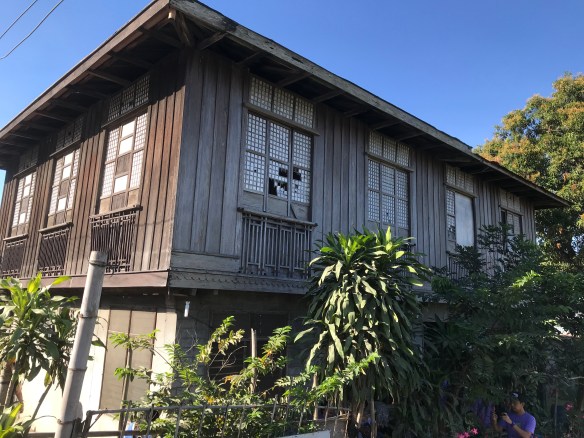
(Photo of Manuel Arguilla’s ancestral home along the National Highway in Bauang, La Union.)

Penman No. 281: The Writer in Progress

IMG_3824

Penman for Monday, December 11, 2017


(THIS IS the second of three parts of my recent talk on “Celebrating Arguilla” at the Taboan Literary Festival in Bauang, La Union.)

“Midsummer” is of course the quintessential mating story, setting the tone for the younger Arguilla’s lyrical odes to rippling muscles and shapely breasts. The man’s strength is contrasted with the girl’s slenderness, and this dichotomy would repeat itself many times over in the stories ahead: in “Heat,” where the Adonis-like Mero captivates Meliang, she of the “long and supple thighs” and whose body exudes “a healthy sweetness.” We see it again in “The Strongest Man”, where the “tall and shapely Onang” enchants Ondong, whose muscles flow under his sweating skin. Mero and Meliang, Onang and Ondong—it’s tempting to think of Arguilla falling into a mannerism, a romantic formula after Amorsolo’s or Botong’s idealized physiques.

But he quickly disabuses us of our idyllic fantasies, because the same terrain in which so much beauty resides, in both the landscape and the bodies of its fecund youth, is shown to be awash with blood and riven by violence. The second story in the collection, right after “Midsummer,” is “Morning in Nagrebcan,” and it begins with a picturesque description of rustic serenity, depicting “the fine, bluish mist, low over the tobacco fields.” But this mood is soon shattered by the brutal killing of a puppy, and the awakening of the children to the harshness of life—indeed, to evil—in what may seem to be a bucolic paradise.

Sometimes the violence is more subtle and only hinted at. “A Son Is Born” is a long and almost anthropological account of family life and birthing rites, ending on the luminously optimistic note of a Christmas birth and a boy named Jesus, but it is shadowed by its very first line: “It was the year the locusts came and ate the young rice in the fields.” Life is difficult, but it goes on.

“How My Brother Leon Brought Home a Wife” appears midway through the book, providing another tranquil respite, returning us to tall and lovely women meeting male approbation.

And then almost abruptly come the city stories, beginning with tales of marital stress and distress. Here I can sense the young writer and husband flexing his muscles and trying out new material and new approaches, experimenting with the kind of breathy, abstracted adoration you might find in Arcellana, acknowledging his broadening universe, with references to Picasso and Vanity Fair popping up in the prose. There’s even an attempt at comedy in “The Maid, the Man, and the Wife.” “The Long Vacation” is a melodramatic paean to loss, in the spirit of Carlos Angeles’ “Landscape II,” but without its magic. In these so-called “marriage” stories, it is the brooding hulk of Elias, in the story of that name, that most comes alive, but this is the one story in that suite that returns to the countryside, as if to make the point that country folk can also lead terribly complicated lives and make terribly complicated decisions.

The last part of the book, which is divided into three, comprises the “socialist” stories, for want of a better description. “The Socialists,” “Epilogue to Revolt,” “Apes and Men,” and “Rice” return us to a rural setting, but this time with an explicitly political agenda, which is to awaken the reader to the inhuman exploitation of the Filipino farmer and worker of the 1930s.

“Caps and Lower Case” is often hailed as a searing indictment of labor exploitation, and indeed it pleads the case of its protagonist—a proofreader who needs the relief of just a small raise—with eloquent anguish, but ultimately it deals him a crushing defeat. “The Socialists” is a scathing satire of armchair socialism. “Epilogue to Revolt” deals with surrender and complicity, “Apes and Men” with industrial unrest, and “Rice” with hunger among the tillers.

These were all worthy subjects, of course, the stories reflecting the afterglow of the recent Sakdalista rebellion and other such uprisings in both country and city. Among writers then, the same tensions would simmer over what would be called “proletarian literature,” its standard held high by such avatars as S. P. Lopez and Arturo Rotor, and inevitably Manuel Arguilla. On the other side of the argument were ranged the likes of Jose Garcia Villa, A. E. Litiatco, and a young Nick Joaquin, who in a 1985 essay would dismiss proletarian literature as little more than that generation’s adoption of the latest American fad. It “failed to sweep the local scene,” Joaquin would chortle, “and the only writer of importance who may have been influenced by it was poor Manuel Arguilla—who got derailed.”

Arguilla’s avowals notwithstanding, however—and at the risk of committing blasphemy in the Vatican—let me opine that it would be a mistake to deify Arguilla as any kind of socialist icon. True, he embraced “proletarian literature,” but his proletarian stories are thoroughly depressing, their desperate protagonists broken and beaten, with the sole exception of “Epilogue to Revolt,” which is one of my favorites because it breaks the mold while remaining absolutely true to character and situation. His realism owes more to Charles Dickens than to Maxim Gorky.

Manuel Arguilla was, to me, very much a writer in progress—a writer still coming to terms with his material and his society, one who had explored the range of his talents and was arriving at a fusion of those extremes. Arguilla’s stories have to be read as a continuum, where country and city were beginning to come together in his artistic and political sensibilities. But then, all too soon, he died, leaving us to wonder if his stories could have taken a brighter and more hopeful turn in the postwar world he never saw.


Penman No. 280: Handfuls of Fragrant Hay

17565288453_db927cdd63_b

Penman for Monday, December 4, 2017


I WAS asked to give a keynote address at this year’s Taboan Literary Festival in Bauang, La Union on the subject of “Celebrating Arguilla”—Manuel Estabilla Arguilla, the writer who was born in Nagrebcan, Bauang, 106 years ago. I’ll share that talk in three installments starting this week.

“Celebrating Arguilla” seems simple enough. After all, who hasn’t read and enjoyed “Midsummer” or “How My Brother Leon Brought Home a Wife,” or pondered the social implications of “Caps and Lower Case,” to mention three of his most familiar stories?

But right there is a huge difference in theme and sensibility between “Midsummer” and “Caps and Lower Case,” which might as well have been written by two different people. How the dreamy romanticism of “Midsummer” could coexist with the gloomy realism of “Caps and Lower Case” might seem a mystery, but those of us who’ve written and read enough will know that, well, it happens, and perhaps it should. You see this spread and stretch in Arcellana, for example, in NVM Gonzalez, in Sionil Jose, even in Nick Joaquin.

I am not a literary scholar or theorist, so I cannot speak about Arguilla the way Fr. Joseph Galdon and E. San Juan do, and I have no special familiarity with him the way near-contemporaries like F. Sionil Jose would. I am a biographer of sorts, but have no access to his life beyond the standard summaries on Wikipedia and a few scattered accounts.

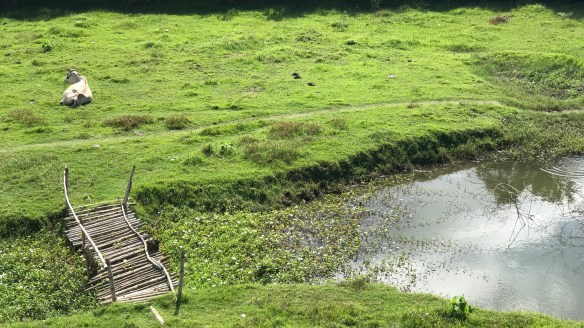
All I have to go on is the fact that I, too, have written stories, was born in a small village far from Manila and close to the sea, and have dealt quite often with the countryside in my fiction, although readers who know me as a city boy have never probably noticed that. I moved to the big city much sooner than Arguilla did, and so I cannot claim the almost ritualistic knowledge of rural life that he displays with gusto in his recollections of Nagrebcan, his evocation of such details as “handfuls of fragrant hay” in that stolidly premodern society where men till the fields and harvest the grain, and the women cook and wash.

IMG_3809

So the best I can do today is to engage Arguilla in a kind of conversation, raising the questions that one writer might have for another. Why do you write what you write, for whom, and for what? And for myself, I might ask, what is this writer doing that I should value? How does he or she reflect on my own work?

Without an autobiographical essay in which Arguilla himself would have explained his writing, I can only speculate on the answers based solely on the evidence of his fiction and of what others have said about his work.

Manuel Arguilla’s first—and to my knowledge, his only solely authored—book, How My Brother Leon Brought Home a Wife, a collection of 19 stories, came out in 1940, on the eve of a war that Arguilla would not survive. He was 29 when the book was published; within four years he was dead at the hands of the Japanese, reportedly beheaded at the Manila Chinese Cemetery in August 1944 along with other guerrilla leaders.

History tells us that 33 can be a good time to die, if you’ve more or less accomplished your mission, as did Jesus Christ, Alexander the Great, Eva Peron, and, just short by a few months, Bruce Lee. Arguably, Arguilla had much more to write, much more to achieve, when his life was abruptly cut short by war.

He had published his first book, with some of his stories appearing in prestigious American literary journals. He had successfully transplanted himself from his provincial roots in La Union to cosmopolitan Manila, earning a degree in Education in 1933 from the University of the Philippines, where he led the UP Writers Club and edited the Literary Apprentice. He taught creative writing at the University of Manila before moving to the Bureau of Welfare and edited its publication well into wartime, when he worked for the guerrillas in intelligence and was captured and executed by the Japanese.

His widow Lydia, herself a fine writer and also a guerrilla, went on to become a painter and to establish the Philippine Art Gallery in Ermita, a seminal promoter of modernist art in the country, and served as a diplomat in Geneva before her death in 1969. In 1957, the book Philippine Tales and Fables was published in Manila by Capitol Publishing, with Manuel posthumously sharing the authorship with Lyd. Two of Lyd’s stories—the first published under her maiden name Lydia Villanueva, before she married Manuel—are featured in Leopoldo Yabes’ landmark anthologies of the Philippine short story.

I have yet to locate his essays, but Manuel Arguilla definitely produced more than the 19 stories in his 1940 collection. One story, the rather whimsical “Rendezvous at Banzai Bridge,” was published in the Philippine Review in April 1943, a year before his death. But it will always be the stories in his book that will define Arguilla for us, and I’ll do a quick review of these for those who may not be too familiar with his work.

IMG_5538

Penman No. 279: That Schoolboy Spirit

IMG_3628

Penman for Monday, November 27, 2017


UNTIL A couple of Saturdays ago, the last basketball shot I saw in a live full-court game was taken by the greatest of them all—Michael Jordan. This was sometime in 1989 or 1990; I was a graduate student in Milwaukee, and my friend Peter enticed me out of Shakespeare class, waving an extra ticket to the Bucks-Bulls game at the downtown arena. MJ was in town—it was literally going to be a once-in-a-lifetime chance to watch an NBA game, with Michael Jordan playing, for free. Screw Macbeth! MJ did not disappoint; with the Bulls trailing by two in the final minute, he sank a three-pointer in the final seconds, and while we were supposed to be Bucks fans, we all jumped in our seats to cheer him, screaming our heads off.

I’ve never been a huge basketball fan, although I very briefly covered the MICAA for a newspaper in the pre-PBA days and followed the NBA back when Kareem Abdul Jabbar was still Lew Alcindor. But I vicariously enjoy sport in all its varieties, from American football and baseball to boxing and badminton, as much from the game itself as from watching the players and the other watchers. There’s something about a surge going through a crowd that senses something magical about to explode on the arena or the court that lights a long-dormant fuse in me and brings me back to my boyhood, when my father took me to the Besa Boxing Arena and the Rizal Coliseum for an afternoon’s throaty mayhem.

So I could hardly resist when a friend from grade school, who’s so modest I have to call him by his initials JV, invited me and the La Salle Green Hills gang to watch the La Salle-Ateneo game at the Big Dome last November 12. Ever the resourceful fellow (which explains his success in business), JV had managed to secure a certain number of tickets that enabled an impromptu reunion of some guys in our Viber group.

Of course every Pinoy barkada thinks of itself as special, but this one had a genuine claim to fame: our class was accelerated twice, saving us precious time. (And money, for those rarities—destitute La Sallites—like me.) I’ve written about my La Salle sojourn (Prep-Grade 7, 1960-66) elsewhere, the sum of which is, it’s the school I owe my preparation as a writer to, not to mention the supportive friendship of some very fine gentlemen. I went on to the Philippine Science High School, UP, and grad school in America, but I always treasured my schoolboy years in Green Hills and the love of books and language that they left me with.

How much better could it get? One minute I’m watching His Airness drop a game-winning trey, and nearly 30 years later I’m holding a golden ticket to the biggest game of the season so far. (Lest I be accused of treason to UP—which I should be cheering, after all, as a university official—I just haven’t had a chance to attend a live game yet, but was following and rooting for them all the way on the S&A channel, and I promise to come courtside next season.)

IMG_3587

First, we had to dress for the occasion, and while most of my buddies had closets full of green shirts, green socks, and presumably green underwear (JV even wore electric green sneakers), I had to reconnoiter several malls and department stores the week before the game to locate the perfect XXL polo shirt in shamrock green. We assembled four hours before gametime for a long and leisurely lunch in a nearby restaurant—for some of us, our first reunion in over 50 years, a long green-shirted line of seniors who’d last seen each other in khaki shorts, talking maintenance meds over crispy pata and cerveza negra. (Here’s one to us, guys—JV, Billy, Beyey, Dennis, Butch DG, Toffy, Mike, Conrad, and Jun!)

No matter how inured you might be to sports and competition, there’s no way you can escape the peculiar tingle and sizzle of a La Salle-Ateneo game, from the minute the drums unleash their tom-tom thunder from way up in the bleachers to the second the final buzzer sounds and sends half the gallery into hysteria while plunging the other half in utter despair.

It’s a rivalry that they say goes back to 1939, when La Salle beat Ateneo for the NCAA championship for the first time (27-23—sounds more like a halftime score these days). It’s come a long way since, and I don’t know who’s keeping track of the historic score, but every La Salle-Ateneo game feels like the deciding match of a best-of-three finals, going by the sheer electricity around the arena.

The last time I was at the Araneta Coliseum was two years ago to watch a revival concert of the Zombies; well, this was anything but a zombie crowd. Between spotting all the celebrities in the stands, appreciating the, uhm, fine art of cheerleading, and trying to catch up with new cheers and fight songs that I’d never mouthed before, it was sensory overload for a solid hour, an excursion into a culture I’d read about but had never visited.

I won’t bother you with the details of the game itself, which predictably went the cardiac route, with the Archers going down by as much as 12 in the third quarter, only to unload a 10-0 bomb in the closing minutes that led to an extremely satisfying outcome, 79-76, and just like that afternoon in Milwaukee nearly three decades gone, I found myself screaming and shaking like a broken radiator.

On the way out of the coliseum, a foot-wide grin still plastered to my face, I met a couple of blue-shirted colleagues from academia, whose baleful looks I couldn’t (and didn’t really want to) banish with my most effusive greetings.

IMG_3617


Penman No. 278: The Wealth Within Us (2)

Lantern

Penman for Monday, November 20, 2017


THE ARTS are the tangible and creative expressions of our culture, and this is where our strength as Filipinos lie—a strength, however, that we should first recognize, recover, and sustain.

We Filipinos have distinct natural cultural advantages. We are a naturally and irrepressibly expressive people, with strong artistic and creative talents and impulses. We think and speak freely, no matter the cost or the consequences. We reject and resist tyranny; we have no taboos, no sacred cows. We sing of love and death in the same breath, we laugh and weep without shame, we create and light up lanterns even in the most difficult and darkest of Christmases.

That freedom and that courage is our strongest cultural resource, the wellspring of innovation and productivity. This is why we have such great artists, writers, musicians, singers, dancers, filmmakers, designers, and artisans.

This brings me to the economic argument, which is that culture is not just an expenditure, but a valuable resource that, properly managed and supported, can reap substantial material benefits for our people, in the form of what have been called “creative industries.”

In 2009, when the Joint Foreign Chambers of the Philippines initiated a focus group discussion on creative industries in the Philippines, they defined the sector as embracing “a wide array of subsectors including advertising, animation, architecture, broadcast arts, crafts, culinary arts, cultural/heritage activities, design, film, literature, music, new media, performing arts, publishing, and visual arts.”

I won’t go into great detail here, but there are many studies—a recent report commissioned by the British Council, among others—that show how vital these creative industries are. According to that report, and citing UNCTAD figures, “Depending on how they are defined, the Creative Industries are estimated to represent anywhere from 3% to 12% of global GDP.”

I noted in a previous forum that in 2010—the last year for which I have solid figures—copyright-based industries or CBIs contributed more than P660 billion to the economy, according to the Intellectual Property Organization of the Philippines. In GDP terms, the economic contribution of CBIs climbed from less than 5 percent in 2006 to more than 7 percent in 2010. Core CBIs comprising companies in the arts, media, and advertising largely accounted for this surge. A corresponding rise in employment occurred in the sector, from 11 percent of the total number of jobs in 2006 to over 14 percent four years later.

In 2014, the DTI and BOI held a series of Trade and Industry Development Updates to present six industry roadmaps, one of which concerned creative industries. In that particular forum, the DTI’s presenter noted that Singapore and Thailand led ASEAN in creative exports, and while our creative industries have grown, we were a net importer of creative goods as of 2008, with books and movies apparently accounting for the bulk.

This reminds me that in that conference of Asian writers and translators that I attended a couple of weeks ago in Bali, it was reported that Asia is now the world’s biggest producer of books, movies, and games. But that’s an Asia dominated by China, Japan, Korea, and India. The question is, how can we Filipinos and Southeast Asians partake of that boom? First, of course, by strengthening those industries in our countries.

There seems to be a greater awareness on the Philippine government’s part of the economic utility of our artistic talent. In 2012, for example, RA 10557 was passed to promote a “national design policy” highlighting “the use of design as a strategic tool for economic competitiveness and social innovation.”

It’s heartening to note that Chapter 7 of the Philippine Development Plan for 2017-2022 is devoted to “Promoting Philippine Culture and Values,” in which it is acknowledged that “The current governance framework for cultural development has been inadequate in addressing the concerns of the sector.” The plan contains salient proposals for using and promoting cultural values to promote the common good and identifies key legislative measures to achieve full cultural development, including the long-overdue establishment of a full-scale Department of Culture that will not be a mere adjunct of education, sports, or tourism.

But we remain a long way from translating policy into action. As with most things cultural, the first transformation has to take place in the mind—more specifically, in the mindsets of our leaders.

Only now, in preparation for this talk, did I become aware of the ASEAN Socio-Cultural Community and of its noble concerns which include human development, social welfare and protection, social justice, and so on. But only at the very end of its “scorecard” report does it deal with “Building ASEAN Identity” and promoting cultural creativity and industry—talking, for example, about networking among small and medium-sized cultural enterprises of SMCEs around the region.

It’s rather sad in a way to speak of culture as a business, but if that’s what it takes to wake people up to the wealth within them, then by all means, let’s draw on our hearts and imaginations to showcase the best of what we can be, and inspire ourselves in the process toward a stronger sense of nationhood and of regional community.

Penman No. 277: The Wealth Within Us (1)

35092804316_00f878c388_k

Penman for Monday, November 13, 2017


THIS ASEAN week and next, I’m sharing excerpts from a short paper I presented at a conference on ASEAN Leadership Amid a New World Order that took place last November 8 at the Shangri-La Makati, under the auspices of the Stratbase ADR Institute and the Asia Society. Ours was a panel on ASEAN cultural cooperation, and I spoke as a writer and academic engaged in regional networking.

As a creative writer and professor of literature, I’ve had many opportunities over these past 25 years to meet and mingle with my Southeast Asian counterparts in various conferences.

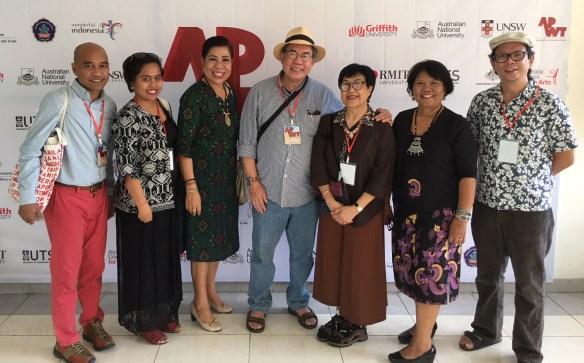
Until recently, there weren’t too many of these regional networks for writers and artists to get together, but today, some formal networks are in place. In my field, for example, the Asia Pacific Writers and Translators or APWT—which held its tenth annual conference just two weeks ago in Bali—has been very active in making connections between writers, translators, teachers, scholars, and publishers around the region. APWT goes well beyond Southeast Asia to include China, Japan, Korea, India, and even the United States and the UK, and very recently its major sponsor has been Australia, which is seeking to expand its Asian footprint.

I’m sure that similar associations exist in the other arts—in theater, music, and dance, for example. But let me use these writers’ gatherings as an illustration of the challenges and opportunities we Filipinos face on the cultural front.

Cultural cooperation presumes an awareness of each other’s culture. The problem is, there’s very little of that kind of connection, people to people, around the region, or at least between us and the rest of the region. Chalk it down to the fact that we have been separated from the rest of Southeast Asia by geography, by history, by language, and by religion. Scholars, writers, and artists—and let’s add OFWs—should of course have a deeper understanding of regional cultures, but that’s their job.

And even so, at nearly every regional conference I’ve attended, I’m acutely reminded of how out of the loop we Pinoys are—out of the Sinic loop up north, out of the Indic loop out west, out of the Malay loop down south, and out of the Commonwealth loop to which many of those countries belong. Having cast our lot with America and English, we find little in common with most everybody else, beyond the color of our skin and our shared legacy of colonialism.

Ironically, cultural commonalities and exchanges of a kind do happen around the region, and even around Asia—largely as a result of globalization, the Internet, satellite TV, and their impact on youth and pop culture. Witness the spread of K-Pop, anime, rap, telenovelas, and anything from Hollywood, especially the Marvel and DC universe.

But while these influences have arguably injected new vitality into traditional cultures and media, they have also, to a significant extent, contributed to the homogenization of those cultures, and to the forgetting or even obliteration of traditional knowledge, leaving our youth in a cultural limbo, divorced and alienated from the common experience of their own people.

Consider this: young urban Filipinos don’t consider agriculture as a career option, don’t like to eat fish unless it’s imported salmon, have no idea where or what Quiapo is, see Mindanao as another country, and know more about Japanese manga and Star Wars than they do about our heroes. Their world-view is shaped by Facebook and Netflix and spread by Twitter and Instagram, and not by direct immersion in their societies, much less by the societies around them. Indeed the fashionable thing today is to propose that the very idea of “nation” is a thing of the past, even as the rabidly resurgent nationalisms of some of our neighbors reveal that to be a precarious fantasy.

Clearly this indicates a failure of education, but as we all know, subjects related to culture and history have increasingly been relegated to the back rows of our curricular priorities in favor of science, technology, and mathematics. As a graduate myself of the Philippine Science High School and an abortive engineer and economist, I have no quarrel with pushing those competencies in the name of competitiveness and national development.

But there are also powerful arguments to be made for supporting cultural programs and endeavors instead of diminishing them. I will focus on two: what I will call the moral argument, and the economic argument.

The moral argument is that culture is an essential element of national growth and development, as it helps define our national identity and our national interests. Without culture, we have nothing to stand on except our territory. Cultural cooperation begins at home, first of all with an awareness of what culture is and how it can not only explain but enhance human life.

Culture is a dynamic description of our commonalities and differences, without understanding which we will be moving forward blindly, guided only by the political and economic interests of our elites.

Politics and economics may dominate the news and people’s consciousness, but many of our problems are cultural in nature—indeed, our politics and economics are significantly shaped by culture, from the ascendancy of Rodrigo Duterte to the conflict in Marawi.

The problem is that we often see culture as little more than entertainment, a musical interlude between presumably more important matters. Even overseas, Filipinos think of culture as the obligatory pancit and tinikling on June 12—not the underlying reason why there are hundreds of Filipino organizations in Southern California alone but few major statewide Fil-Am political leaders. (More next week)


Penman No. 276: A Storyteller Returns

Cover

Penman for Monday, November 6, 2017


I EDIT a lot of books and manuscripts in the course of my work as a professional writer, mostly for institutions like banks, NGOs, government agencies, airlines, and even accounting firms. These people need help with their corporate communications, and I’m glad to lend a hand.

But now and then I get asked to edit a book of a more personal nature—a memoir, an autobiography, a travelogue, or a collection of essays—and when that happens I have to think twice about taking the job on, because these personal projects require a certain compatibility—almost an intimacy—between the writer and the editor. While institutional work is largely impersonal—the very reason I prefer it—editing someone’s life-work demands close familiarity with and sensitivity to the author’s character and concerns. That can be difficult, which is why I’ve declined many such invitations, unwilling to engage in so taxing a process.

There’s been one person, however, for whom I’ve edited four books—each one of them formidably full-length and chockful of detail. I have to admit—and she will agree—that the job has involved careful line-by-line editing and restyling. That’s easy to explain: she’s a terrific storyteller, but English wasn’t her first language—she also speaks Arabic, Greek, French, Dari, at least one other language—so she does need an editor, and she found me.

That happened 15 years ago through the intervention of a mutual friend, Jimmy Laya. He had a good friend in the United States, he said, whose husband had just passed away and who wanted to write a book about her life with him, a life that had taken them around the world and to the Philippines, where they had spent many good years. It seemed interesting enough, so I said yes.

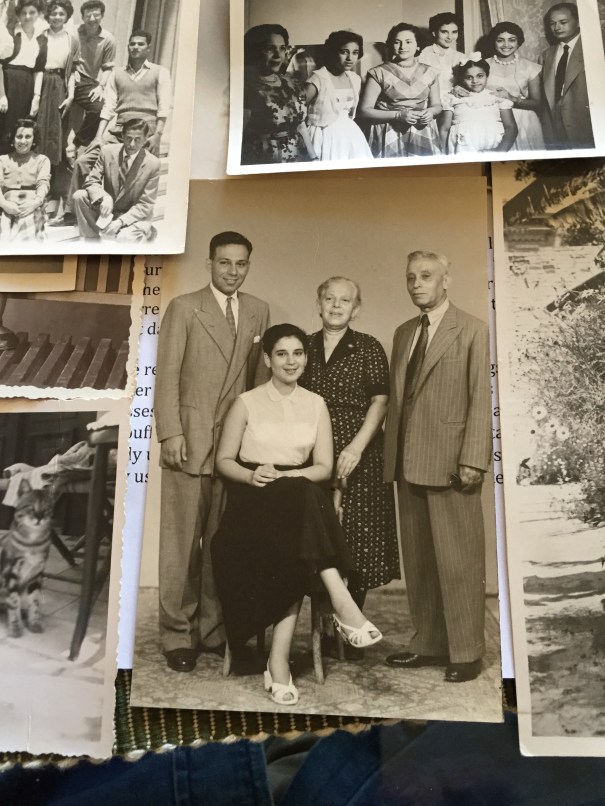
And so began what became a unique friendship for me and my wife Beng with Mrs. Julie Hill, an Alexandrian Greek born and raised in Egypt but who moved to the US for her master’s degree in chemistry, then spent the next many decades traveling the globe with her husband Arthur, an official of the Ford Foundation. Later, Julie herself would become a telecommunications executive—and, after Arthur’s passing, an inveterate traveler trekking the Mongolian desert, the Afghan hills, the Russian steppes, the valleys of Papua New Guinea, and the Norwegian fjords.

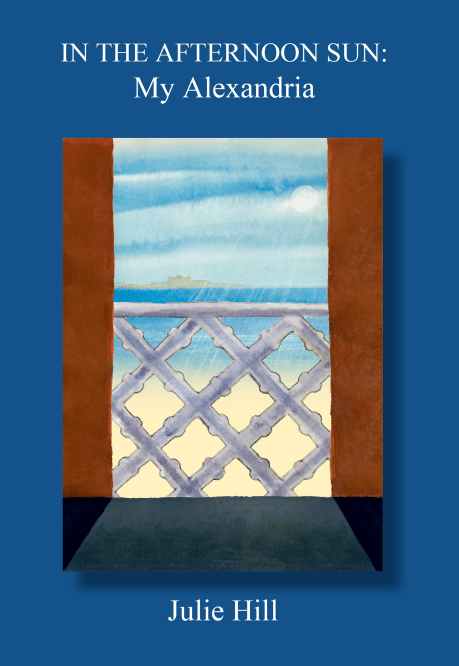
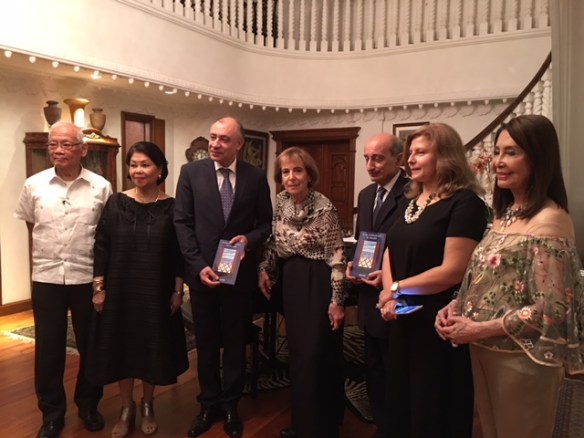
Out of that life and those travels came four books, all of which I would edit: A Promise to Keep: From Athens to Afghanistan (2003), The Silk Road Revisited: Markets, Merchants and Minarets (2006), and Privileged Witness: Journeys of Rediscovery (2014). Her newest, In the Afternoon Sun: My Alexandria (2017), was launched just last week in Makati, again through the kind auspices of Jimmy Laya and the Society for Cultural Enrichment, which Jimmy serves as vice-chair, and which published Julie’s book.

IMG_4712

Despite her aches and pains—as any octogenarian globetrotter is bound to suffer—Julie flew in from Southern California to be with old friends like the Cesar Viratas and the Francis Estradas and to give thanks to Angola Consul Helen Ong, who graciously hosted the launch, and to Ambassadors Ahmed Abdelaziz Ezzat and Kaimenakis Nikolaos of Egypt and Greece, respectively. Of course she also gave special thanks to her cover artist, June Dalisay, and to her editor—who, sadly, had to fly to Thailand at the last minute on a mission for his university.

It may seem that My Alexandria—Julie’s haunting memoirs of her childhood years in that vanished cosmopolis—would have very little to do with us Filipinos (A Promise to Keep has some very sharp vignettes of expatriate life here under the Marcoses), and Julie herself had expressed serious doubt about its worth as a book, but I had urged her strongly to press on with it, convinced that its evocation of a place and time where cultures and religions could get along so well was what our fractured world today needed to see.

IMG_6711

Of all her books, it was frankly the hardest to work on, as I challenged her to go into sometimes painful detail; our relationship had long gone past editor and client, well past discussing fees, and I wanted this book to be the crowning glory of her authorial career. Here and there, as any editor would, I worked on tenses, participles, and modifiers; but what rewards the dutiful editor is a natural writer who sees what’s worth seeing, and Julie Hill has been just that, as this passage from an earlier book chronicling her journey over the Silk Road (taken when she was in her seventies!) reveals—simple in language, but bright and articulate with emotion. (You can find all her books on Amazon.)

Night had fallen; it was a bright full moon. The sky bristled with stars; but it remained bluish gray, unlike the black velvet firmament of Rajasthan or the Sulu Archipelago. Constellations tipped at an unfamiliar angle. A shooting star! It had been years since I viewed one, and it was a good omen for the trip.

 At dawn I stepped outside my ger. It was a soft morning with the sun rising behind high clouds. Seized by the clarity and the silence, I stood and listened. Not a breath of wind, not a sound from the gravel paths of our encampment, no machine whirring, no horse snorting, no voice coming from the nearby gers, no bird calling. I felt that I was in one of the emptiest places on earth.

 Freed of distraction I held my breath and listened to my own heartbeat; I sensed nothing. There was no wind to move the clouds or dust or bushes. No sound, no movement, no scent, no warmth yet in the sun, no cold remaining in the air. The only sensation was through the eyes: the desert, the mountains, and the hills. This was the Gobi. I wondered if it was possible to be happier.

 Welcome back, Julie, and from here, happy trails!


Penman No. 275: Listening in Bali

IMG_3343

Penman for Monday, October 30, 2017


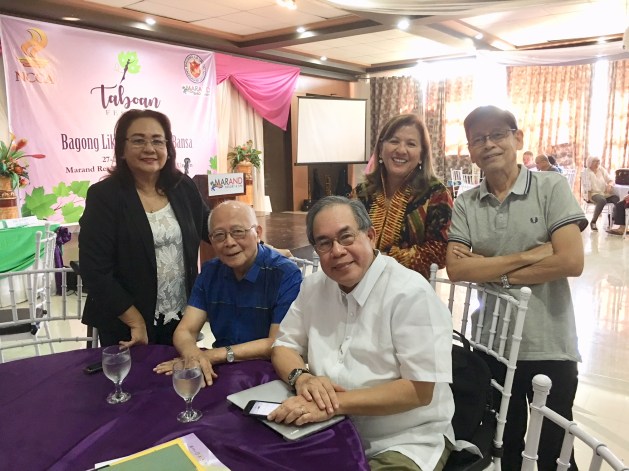
The first time I saw Bali was 34 years ago. I was a much younger man, then only 29, an eager participant in a writers’ conference organized by F. Sionil Jose, in the company of other Filipinos who included, as far as I can remember, the late Rey Duque, Marjorie Evasco, Charlson Ong, and Fanny Llego. We spent a week in a villa on the steamy banks of Lake Batur, far away from the tourist traps of Denpasar and Ubud, which we would visit only at the very end of our trip.

It was my first time to attend an international gathering of writers, and I was deeply impressed by all the big names I met, aside from Manong Frankie himself—our host, the scholar S. Takdir Alisjabanah, among the pillars of Bahasa Indonesia; the Singaporean poet and professor Edwin Thumboo; the Malaysian poet and lawyer Cecil Rajendra; and the Malaysian-American poet Shirley Geok-lin Lim. I can’t recall a thing I said in the impassioned discussions that took place; that first time, it was all about listening and imbibing the wisdom of the masters in an environment that could not have been more conducive to inspiration.

IMG_3372

The lake was a caldera, which explained the hot springs simmering on its fringes, where we joined the unabashed Balinese in their early-morning ablutions; at night, we argued literature under the spell of the stars and the aptly named Bintang beer, to the faint accompaniment of a gamelan symphony. The one discordant note that I would later write about in a short story was an ill-advised sortie across the lake to a private graveyard, which the locals resented; but even that was a writerly touch, an almost obligatory twist to a near-perfect plot. And rightly so: back home, Ninoy and EDSA had yet to happen, and the country was seething in the darkness.

These memories swarmed through my senses last week when I returned to Bali for yet another literary conference, the tenth annual meeting of the Asia Pacific Writers and Translators (APWT), the region’s largest and most active literary network. Hosted by the Ganesha University of Education in the city of Singaraja in the northern part of the island, the conference brought together about a hundred delegates from all over, but mostly from Australia, Singapore, Malaysia, the US, and, of course, the Philippines, which has always figured prominently in this organization (I sit on its Advisory Board). With me were UPICW Director Roland Tolentino, the essayist and playwright Luna Sicat-Cleto, the poet and translator Randy Bustamante, and my wife the art restorer Beng, an avid observer and fully paid member of APWT.

APWTPic

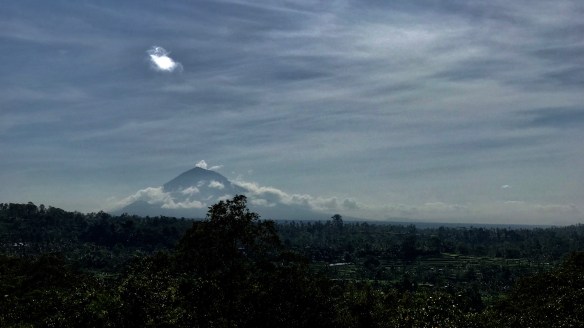
Even the most jaded of writers can’t be faulted for flying into Bali and expecting a bit of paradise, and the island and its people can still deliver on that promise in spades. The manicured rice terraces, the monkeys lining the road, the meticulously patterned garlands, the whiskery banyan trees, the uncountable temples and altars—and let’s not forget the scenically smoldering Mount Agung on the horizon—all suggest transport to another realm of blissful serenity. That illusion, of course, was broken fifteen years ago by catastrophic terror bombings that took more than 200 lives, and in the course of our three-day conference, testimonials by our Balinese friends themselves would reveal certain painful realities behind the festive façade.

“It’s very difficult to be a Balinese woman,” more than one of them said (I’m pooling their voices together, as in a chorus). “People expect you just to be a pretty flower. I have a PhD and I make more than my husband, but I still have to appear subordinate to him and to his wishes, and I have to serve him at home, making his coffee and serving his clothes. When I received a fellowship abroad, people congratulated my husband, instantly assuming that it was his achievement and not mine—and I had to smile and say nothing about it. You know why I write in English? Because my husband can’t read English, so English liberates me, allows me to express my true feelings.”

IMG_3299

Another intriguing panel I attended took up “Nostalgia and the Asian City,” and the discussion dwelt on how cities like Hong Kong and Singapore had changed in the literary imagination. But, from the floor, I had to interject the Philippine experience and note how nostalgia in many other places like ours referred to a longing for an unspoiled rural Eden that no longer exists, an unrecoverable if not fact an imaginary past. Over lunch, I pursued the point: nostalgia is being used as a powerful political tool, such as in defense of a mythical “better time under martial law” to support a restoration of that regime.

I was assigned to a panel devoted to protest literature, and found myself grouped with three Australians who spoke on their respective struggles as immigrant, aborigine, and bohemian writers. I chose to speak about our history of protest literature and what a deadly business it was. So, our moderator asked in the end, what were we personally doing to upend the status quo? The status quo for me, I said, was darkness and despair, and it was winning out even in literature, so that there’s nothing easier to write these days than another sad and dismal story. Therefore, I would strive to write happy stories—stories with a believably, hard-won, happy ending—as my form of resistance. We have to fight for joy as much as justice; we have to keep fighting for happiness, hope, and beauty in this age of Trump and tokhang—what else were we persisting for?

As I said those words—which I had not expected to say, but had long been coming around to saying—I felt all of my 63 years, hoping perhaps that some young soul in that audience was truly listening.