Penman No. 198: Mind-blowers and Eye-openers

IMG_8289.jpg

Penman for Monday, May 2, 2016


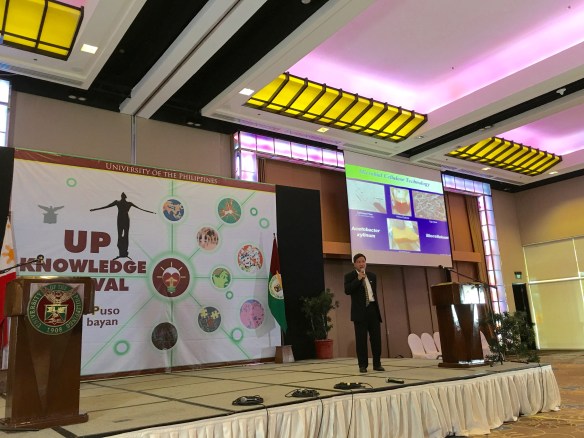
THE FIRST-EVER Knowledge Festival held by the University of the Philippines in Tagaytay City a couple of weekends ago proved true to its promise and offered mind-blowing, eye-opening discoveries galore, shoring up not only UP’s reputation as the country’s leading university but also that of the Filipino genius as a whole.

Part academic conference and part science fair, the festival brought together over 200 of UP’s top scientists and artists from the university’s many campuses all over the country to showcase the best and most promising products of their ongoing research. The festival also featured talks by experts on key academic and research issues (I excerpted my own keynote here last week), and presented the university’s expansion plans and the latest publications of the UP Press. A roundtable with members of the media had UP President Alfredo E. Pascual exchanging views with some of the country’s top journalists on future directions in Philippine higher education.

But it was the exhibits themselves that formed the living heart of the festival. Most were focused on science and technology, but UP’s most advanced endeavors in the arts, education, and mass communications were on display as well. What unified them was the element of interdisciplinarity, of crossing traditional academic turfs and boundaries to arrive at better solutions to age-old problems, or better products for the 21st century. Most of the projects were being financed by the university’s Emerging Interdisciplinary Research fund (EIDR), an ambitious program which has funneled many hundreds of millions of pesos into projects cutting across disciplines and with a positive impact on the government’s Key Result Areas (KRAs).

(I know—I get fidgety myself whenever I step on the road to Acronymia, but like I said in the open forum after my talk, artists—especially those in public life—have to learn to speak bureaucratese and to do the math if they want to engage outside their comfort zones, which is also key to getting grants.)

The exhibits were organized into six clusters: (1) agri/aquaculture, food, and nutrition; (2) health and wellness; (3) disaster risk management and climate change; (4) energy, environment and ecotourism; (5) technology, new materials and other products; and (6) progressive teaching and learning.

As a frustrated scientist (I entered UP as an Industrial Engineering major fresh out of Philippine Science High), I’m always fascinated by what goes on in S&T, and touring the science booths gave me an overview of the research and development in the field within UP. Among the dozens of projects on show, I lingered longest on a few: an analysis of the use of Twitter to keep track of typhoon events; the development of the Philippine Scientific Earth Observation Microsatellite (better known as Diwata-1, which is now in orbit) for disaster risk reduction; an ecosystem assessment of Laguna de Bay, a study aimed at finding ways to revive a dying lake; and a study on the use of microbes from shipworms (tamilok) as potential sources of enzymes for biofuel production. (I’ve had tamilok wriggling down my gullet on a dare during trips to Palawan, where they’re a delicacy, and I’d happily give them up to biofuels.)

In the health and wellness cluster were a flurry of projects ranging from a dengue detection kit to the development of best-practice guidelines for the better management of prevalent community diseases and the use of social media for promoting healthcare. In agriculture, a product called BioN promised to replace 30-50% of chemical fertilizers while increasing yields by 11%, keeping plants “healthy and green even in drought and in the presence of pests.”

Although it was a tucked away in a corner of the learning cluster, what especially caught my eye was a little black box called VISSER—short for “Versatile Instrumentation System for Science Education and Research,” a highly portable science kit which can do over 120 experiments in biology, chemistry, physics, engineering and environmental science. As it turned out, VISSER had been developed by a team headed by a fraternity brother of mine, physicist Dr. Giovanni Tapang, originally with some support from the University of Maryland. The argument for VISSER is compelling: more than a third of the country’s 13,000 high schools—catering to about 7 million students—have no labs, and of those that do, only 2,800 have access to digital tools. The VISSER kit isn’t cheap at over P40,000 per unit—about the price of a laptop—but its potentials are huge, with a total market value estimated at almost P60 billion. It isn’t just good science, but good business as well for technopreneurs.

And speaking of technopreneurship, few Pinoys can be more inspiring than Dr. Gonzalo “Al” Serafica, a much sought-after consultant on technology commercialization who also spoke in Tagaytay on how he developed new uses for microbial cellulose—known to most of us as the lowly nata de coco—for the global medical market as brain patches and artificial skin. A chemical engineer and also a PSHS alumnus like Dr. Tapang, Al Serafica holds 10 US and 20 international patents and co-founded Xylos Corporation in 1996, proving that crossing over from the lab to the boardroom isn’t only possible but, in many cases, necessary.

On the whole, the Knowledge Festival offered ample proof that with the right support and incentives, Filipino scientists, artists, and researchers can be right up there with their international counterparts, but we have a lot of catching up to do. As a UP study notes, we spend about half of what our ASEAN neighbors spend on education, and even less on R&D. But just showing ourselves what’s possible is a good start, and UP will soon be touring key exhibits not just around the UP system but to other universities as well.

And UP itself will keep growing, as I was mighty impressed to see in the display that featured ongoing and upcoming expansion projects: the UP Clark Green City that will include, among others, a new College of the Natural Environment and College of Designed Environments; the soon-to-open UP Bonifacio Global City that will host classes in law, engineering, business, architecture, labor and industrial relations, urban and regional planning, statistics, and distance education; the UP Professional Schools-South Road Properties in Cebu; the Philippine Genome Center in Diliman; the new UP Diliman Sports Complex rising out of the rubble of the old track oval; and an upcoming UP Cavite incubator campus.

If we can shoot satellites up into the cosmos and turn a coconut dessert into brain implants, you’d have to believe that the sky’s the limit for the Filipino genius—as long as we don’t get sidetracked by personality politics and medieval mindsets.

timpeake-20160427-diwata-1-deployment-001_FD3086695C6E4EA699A3E0129B0153AD.jpg

[Diwata-1 photo courtesy of ESA/Tim Peake]

Penman No. 193: Knowledge as Capital

2171790476_7c4dfcd25a

Penman for Monday, March 28, 2016


THE UNIVERSITY of the Philippines (UP) campus in Cebu City hosted the second presidential debate a couple of Sundays ago, and with education on the debate agenda, the setting couldn’t have been more appropriate. UP—so far, our only “national university” so designated—may be more than a hundred years old, but it continues to grow, particularly in places like the Visayas, Mindanao, and Central Luzon, where the demand for quality higher education is as great as ever.

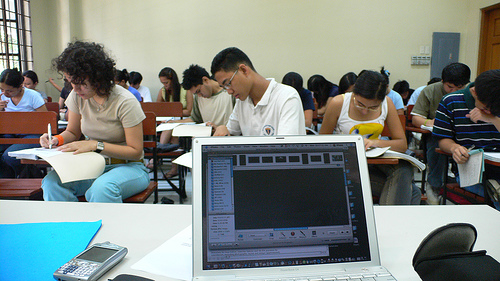
Not too many people may have been aware of it, but in preparation for the debate—and indeed for the next national administration—UP President Alfredo E. Pascual commissioned a study by the university’s think tank, the Center for Integrative Development Studies (CIDS), to look into where we are in the regional scheme of things and how we can expect to catch up and compete with our more advanced neighbors.

Copies of the paper—titled “Knowledge-Based Development and Governance: Challenges and Recommendations to the 2016 Presidential Candidates”—were provided by UP to the staffs of the presidential candidates in advance of the Cebu debate. But knowing most politicians’ propensity to go for the sound bite and dwell on the personal, I tend to doubt if more than one or two of the candidates or their staffs found the time and the focus to read it.

It would be a pity if that indeed were the case, not only because of all the work that UP put into the paper (CIDS was backstopped by the offices of the President and the Vice President for Academic Affairs), but because of all the opportunities for development that we will likely miss, again, if our political leaders don’t heed what our top academic minds are saying.

The full text of the paper can be found here: http://www.up.edu.ph/wp-content/uploads/2016/03/20160315-UP-Knowledge-Paper-Final.pdf. For the benefit of our readers (and maybe the odd politician who will read this), I’ll unpack the technical jargon and get to the core of what the paper says and proposes.

It opens with an indisputable premise: Education is indispensable for economic development. More education means less poverty and income inequality, because it drives innovation and productivity, and helps people adjust to new challenges and opportunities.

But of course we already knew that. In a society like ours, we all look to education as the way out and the way forward, which is why our people slave for years overseas to put their kids through college. So sacred is education to the Filipino family that every candidate for public office, especially the Presidency, feels duty-bound to extol its virtues.

To be fair to the present administration, it’s put its money where its mouth is, for the most part. The study notes that “Since Benigno S. Aquino III assumed the presidency, government expenditure on public education has enjoyed annual increases. Out of the education sector‘s PHP364.9 billion budget for 2015, PHP43.3 billion was given to state universities and colleges—a 13.8 percent increase over the 2014 allotment…. Over PHP3 billion was made available for scholarships under SUCs and more than PHP2 billion for scholarships administered by the Commission on Higher Education. A total of PHP316 million (roughly 0.09 percent) was earmarked to fund research.”

That sounds good, but sadly it’s still not enough. The rest of our ASEAN neighbors spend an average of 5 to 6 percent of their GDP on education, but we try to make do with 3 percent. That’s why even our best universities lag behind their global and regional counterparts. The study notes that “In 2014, the University of the Philippines ranked only 8th out of the top 10 universities in ASEAN. In 2010, the Philippines ranked 89th in the global Knowledge Economy Index, far behind Singapore, which placed 19th.”

With all the new phones, computers, and call centers we see around us, we might be led to believe that the Philippines has become a high-tech haven, but that just isn’t so. (“We may be No. 1 in voice operations,” I once heard President Pascual say in relation to BPOs, “but were just around No. 9 in non-voice, which is where there’s more value-added. We need not just call center agents, but software engineers!”)

In its summary, the study observes that “Our level of technology remains low in quality and scale, and concentrated in low-productivity sectors. To catch up and move ahead faster, we need to raise our scientific and technological skills, which only better and more focused education can achieve.

“This calls for massive government investments in high-level knowledge capital—the so-called ‘suprastructure’ of economic growth. This human capital will create a knowledge-based economy driven not just by brawn but brains, tapping into one of our richest but least developed resources.”

In other words, and to put it plainly, we need more brainpower—more nerds, if you will—of the kind who can innovate, produce, do trailblazing research, and network with their global peers. That kind of knowledge can reap sizeable benefits for our economy, as it’s done for Singapore, China, Korea, and a host of other countries who’ve invested in their “suprastructure.”

But PhDs don’t come easy and don’t come cheap. UP argues that our government should have a plan to produce them systematically. The object of our educational system shouldn’t just be producing hordes of college graduates who can’t find good jobs, but graduates in fields and with skills that the economy actually needs. The best of them should be sent abroad for advanced degrees, and then brought home with sufficient incentives and an environment conducive to research. The UP paper goes even farther and recommends that in areas where we lack expertise, world-class professors and researchers should be enticed to teach here and work with their local counterparts, in the same way that Singapore was able to considerably shorten its learning curve.

While much of this will occur in science and technology, the paper wisely notes that “Because values are important in setting the right path to growth, the promotion of science and engineering should be closely integrated with the social sciences, the arts, and the humanities to ensure the holistic development of the Filipino.”

To spread the work and its benefits, the UP paper envisions a hubs-and-spokes model of development anchored on regional centers of excellence in certain fields—possibly even other national universities beyond UP.

There’s a lot more to be found in the study that was UP’s gift to the candidates—and thereby to the nation—but whether any practical good comes out of it will depend on the political leaders who govern our fortunes, and, ultimately, on us who vote them into office.

(Kindly note that as a “think paper” subject to further discussion, the study mentioned here does not necessarily reflect the position of the UP academic community as a whole, but rather of the researchers and offices involved.)


Penman No. 172: Going Against the Grain

IMG_8272

Penman for Monday, October 26, 2015

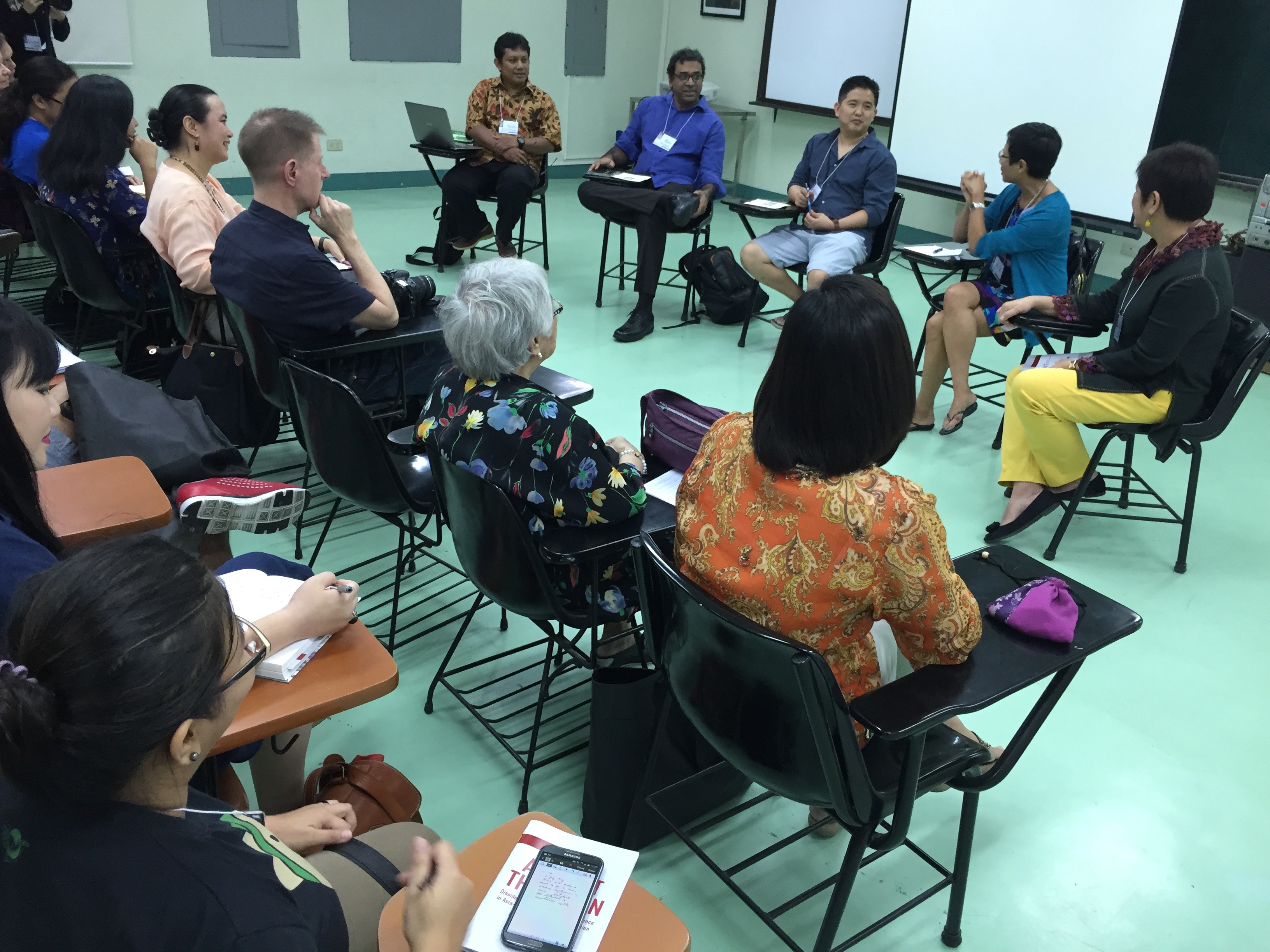
I WAS asked to give the first keynote last week at the annual meeting of the Asia Pacific Writers & Translators at the University of the Philippines, on the conference theme of “against the grain,” and here’s part of what I said:

The Filipino writer is among the freest in the world as far as self-expression is concerned; but the Philippines is also one of the deadliest countries for journalists in the world—according to the New York-based Committee to Protect Journalists, it ranked second only to Iraq in 2013.

Creative writing won’t pay you much, but you can say whatever you want and reasonably expect to stay alive and ambulant. Nobody in this country ever got killed or imprisoned in recent times because of a novel or a story. Neither has a Filipino despot been deposed because of a play or a poem. Journalism, on the other hand, can be a dangerous enterprise, especially if you live and work far away from the glare of the metropolis.

…. We have one of the region’s richest concentrations of writers, and very likely the region’s most strongly developed systems for the development of new writers; but these writers have precious few readers.

We have never lacked for writers, and likely never will. The Filipino writing community is very much alive, producing new work not only in English but in Filipino and in many regional languages.

Within the region, we can claim to have the oldest, the longest-running, and possibly the most comprehensive writing programs—not just writers’ workshops which go back 50 years, but also degree programs from the BA to the PhD in several major universities. The Palanca Awards, which are handed out every year to the best work in many categories and several languages, have been running now for 65 straight years.

New young writers will find it easier to break out and get noticed by their peers and seniors here than in many other places, because, while Filipinos respect their elders, and everyone above 40 is a “Sir” or a “Ma’am,” we do not have the kind of master-apprentice, or senior-junior relationship that exists elsewhere. You do not need a senior’s validation or sponsorship to advance; indeed you might move forward much faster by slaying a literary father or two.

But for all the literary talent we think we have, it can be argued that creative writers really don’t matter much in Philippine politics today—certainly not as much they used to—because, to be hyperbolic about it, no one reads, no one buys books, and no one understands nor cares what we’re doing.

It’s a sad fact that in a country of 100 million people, with a literacy rate of about 97%, a first printing for a new novel or book of stories will likely run to no more 1,000 copies—which will take about a year to sell, and earn the author a maximum of about P50,000 (about US$1,000) for a few years’ work—good enough for a new iPhone. There’s no such thing as a professional novelist or playwright in the Philippines, which makes it easier for writers of any worth to be sidetracked or co-opted by the government or by industry.

It’s ironic that Philippine literature’s political edge should be blunted not by timidity nor by censorship but by sheer market forces. The simplest reason many Filipinos don’t buy books has to be poverty, with the price of an average paperback being higher than the minimum daily wage.

But perhaps we writers ourselves are also to blame, for distancing ourselves from the mainstream of popular discourse. Politics is nothing if not the domain of the popular, and the very fact that many of us write in English is already the most distancing of these mechanisms. The question of language has always been a heavily political issue in multilingual Philippines, where some regionalists still resent the choice of Tagalog as the basis of the new national language Filipino in 1935, and where English is reacquiring its prominence not only as the lingua franca and the language of the elite but as our economic ticket to the burgeoning global call-center industry.

Political change in the Philippines has historically been led by the middle and upper classes, from the Revolution against Spain of 1896 to the anti-Marcos struggle of the 1970s and the 1980s to the Edsa uprisings of 1986 and 2001. Therefore, one might argue that English is, in fact, the language of reform and revolt in the Philippines in modern times.

But it is this same English-literate middle class—our potential readership—that is the strongest bastion of neocolonialism in the Philippines, blindly infatuated with Hollywood, hip-hop, and Harry Potter, keen on trading the local for the global, opportunistic in its outlook and largely unmindful of the social volcano on the slopes of which it has built its bungalows. As I often remind my fellow Filipino writers, our rivals on the bookshelves are not each other, but J. K. Rowling, Stephenie Meyer, E. L. James, Paulo Coelho, and Tom Clancy.

When I return to the two main points I raised—that we are free to speak and to write, but only in politically inconsequential forms; and that we have writers aplenty, but very few readers—I have little choice but to conclude that the main culprit is our self-marginalization through English, and the academicized, Western-oriented mindset the language encourages.

The interesting upside of this unfortunate situation is that—largely untethered from the considerations of commerce and politics—our writers have been free to write their hearts and minds out, producing poetry and fiction of a high quality that, in a double irony, might yet break through to the global market.

The triple irony would be that it sometimes takes the international spotlight for local readers to take notice of native genius. It sounds like wishful thinking, but by being here today, and connecting our literature to yours, we might do enough together to push our literatures to the forefront of our peoples’ consciousness.

But let’s face it: the margins are familiar if not comfortable territory to many of us, not only here but wherever we live and write, as they give us a clearer view of the center. Going against the grain is very much in the grain of how and why we work. And if you didn’t think so, you wouldn’t be here today.

Penman No. 163: The Gentler Path

IMG_7998

Penman for Monday, August 24, 2015

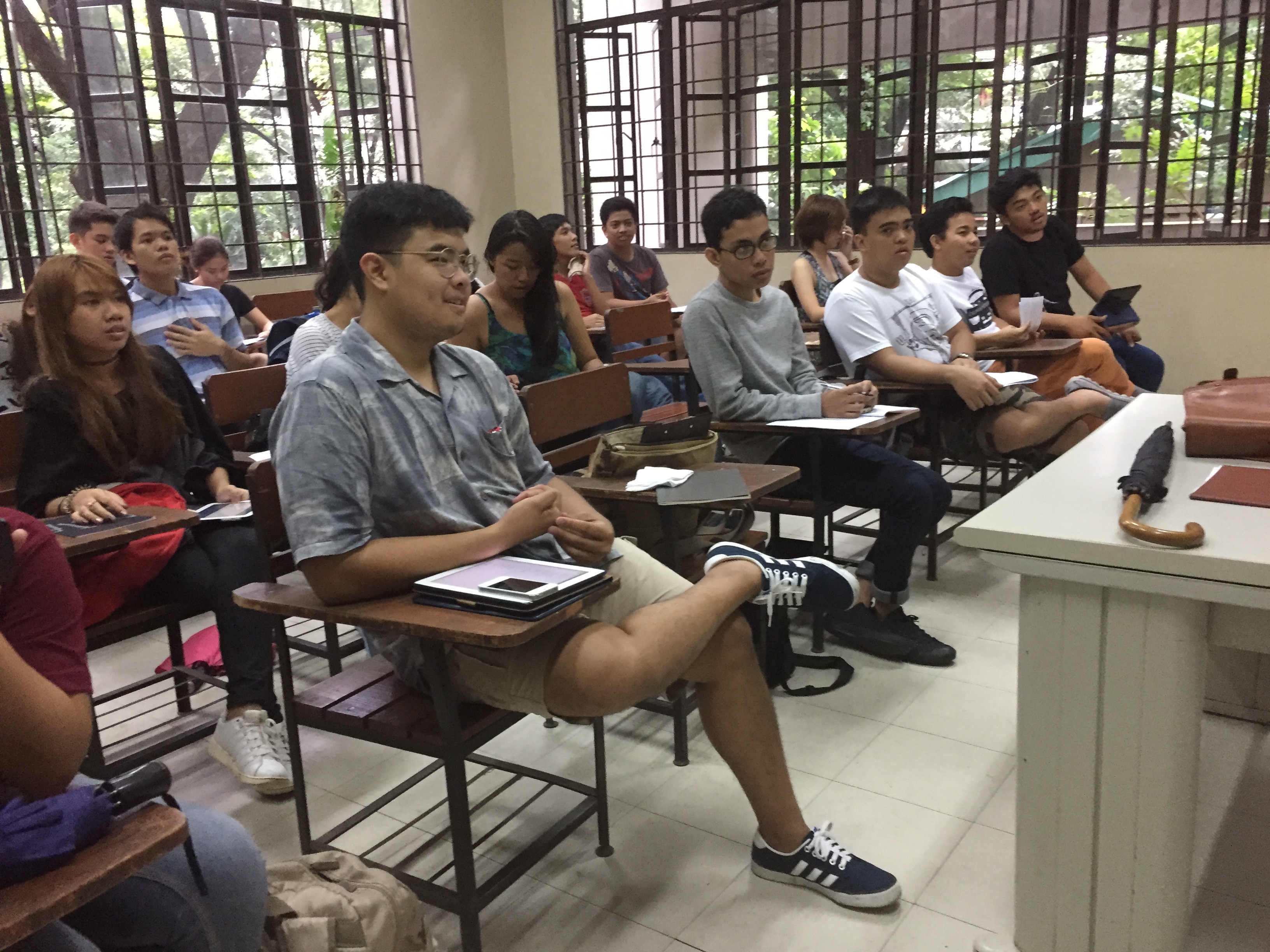
FOR THE first time in something like 20 years, I’m teaching two undergraduate classes this semester. I usually teach one graduate and one undergrad class, but thanks to what I’m taking as a glitch in the registration process, my graduate fiction writing class—which is usually oversubscribed—had zero enrollees this term, forcing its cancellation and my reassignment to a course usually reserved for young instructors, English 11 or “Literature and Society.”

I should make it clear that I’ve always insisted on teaching at least one undergrad class every semester, and have done so unfailingly since I returned from my own graduate studies abroad in 1991. The benefits go both ways—young students get to learn from more experienced professors, and senior profs get to know how young people think. With four years of active teaching left before retirement (it’s hard to believe, but I’m getting there), these encounters with some of the country’s brightest young minds will only become more precious, and as with every class I take on, I can only hope that, many years from now, my former students will remember something useful that they picked up from me.

I haven’t taught English 11 in ages, so it was with some trepidation that I entered the classroom on our first day a couple of weeks ago, under UP’s new academic calendar. Students don’t realize this, but professors can be just as full of anxiety at the start of the semester as they are. As I scan the roomful of faces, I’m already wondering who will likely give me problems and who will make it worth the effort of preparing for every day’s lesson as if I myself were taking an exam. Thankfully, most of these mutual apprehensions soon retreat as I reassure my students that I know what I’m talking about—and that I won’t scream at them if they don’t—and as I begin to understand what exactly I’m working with, which is always a welcome challenge.

This semester, I was glad to discover that my English 11 class of about 30 students was composed of mainly science and engineering majors. You’d think that teaching the humanities to them would pose problems, but I see it as a unique opportunity to lead smart people on an adventure they might have missed out on otherwise. Of course, UP’s General Education program makes sure that our graduates acquire a balanced outlook on life, so my students didn’t really have any choice, but I see my job as making them see Literature as much less an imposed subject than a welcome relief from everything else—in other words, fun. When you disguise labor as discovery, and emphasize incentives over penalties, the students—and you yourself—can feel more relaxed.

English 11 is what used to be English 3 in my time—an introduction to literature—and while some teachers see this as a chance to pile on the heavy stuff like The Brothers Karamazov (and I can understand why), I prefer to take the gentler path to literary enlightenment, and begin with things the students know or can apprehend. That way you can lead them to stranger and more intriguing discoveries about the way language works to convey human experience.

Last week, for example, one of the first poems we took up in class was “Southbound on the Freeway,” a poem published in 1963 by the American poet May Swenson. We could’ve done something like T. S. Eliot’s “The Wasteland,” but unless you train lay people to look at poetry a certain way—to see it as a puzzle or a riddle to be solved, for example—it’s often very hard for them to get a handle on what some poets do on a high and abstracted level of language and idea, much like the way Picasso’s departure into Cubism (think of his women-figures with their eyes looking this way and their noses pointing that way) can be better appreciated if you first consider what goes into a traditional portrait like the Mona Lisa.

“Southbound on the Freeway” reads like a rather simple and even funny poem, in which alien visitors on a spaceship look down at the Earth, and see creatures “made of metal and glass…. They have four eyes. / The two in the back are red. / Sometimes you can see a 5-eyed / one, his red eye turning / on the top of his head.” It doesn’t take much for the student to see that the aliens, hovering above a freeway, have concluded that the cars themselves are Earthlings, and even that some cars—like the “5-eyed” police car—are more special than others.

In literature, this is a familiar device we call “defamiliarization,” by which poets and other artists take something we see everyday and present it to us in fresh and unexpected ways, revealing facets and insights we never really thought about before. The Swenson poem seems like all it does is show us how perspective can change our perception of things, but it goes beyond that eye-trick and asks a very intriguing question at the end: “Those soft shapes, / shadowy inside / the hard bodies—are they / their guts or their brains?”

At this point, I ask the class, what’s this poem really about? Is it just about aliens and humans, or about cars on the road? Inevitably, someone spits out the magic word: technology! So what is it about technology that’s so important, I press on, and what does it have to do with our lives? Why, everything, the class exclaims in a chorus—we’d die without our cell phones and iPads!

We go into a brief and engaging discussion about what exactly technology means, and whether it has benefited human society—or not. We talk about mechanization, automation, better and easier ways of doing things, products that were invented to improve human life, and inventions that did the opposite. We talk about armaments, and about Eli Whitney’s cotton gin and how it actually helped to encourage more slavery in the American South. I tell them that at some point, later in the semester, I’ll talk to them some more about the legend of Dr. Faust and how it led to the stereotype of the mad scientist, all the way to Dr. Strangelove, Lex Luthor, and Doc Ock. I can see that the class is listening, and I’m happy.

I ask them what the real question is that the Swenson poem is posing, and they get it. It’s been a good day in school for Literature and Society.

Penman No. 151: A Workshop in Biography


IMG_7561

Penman for Monday, June 1, 2015

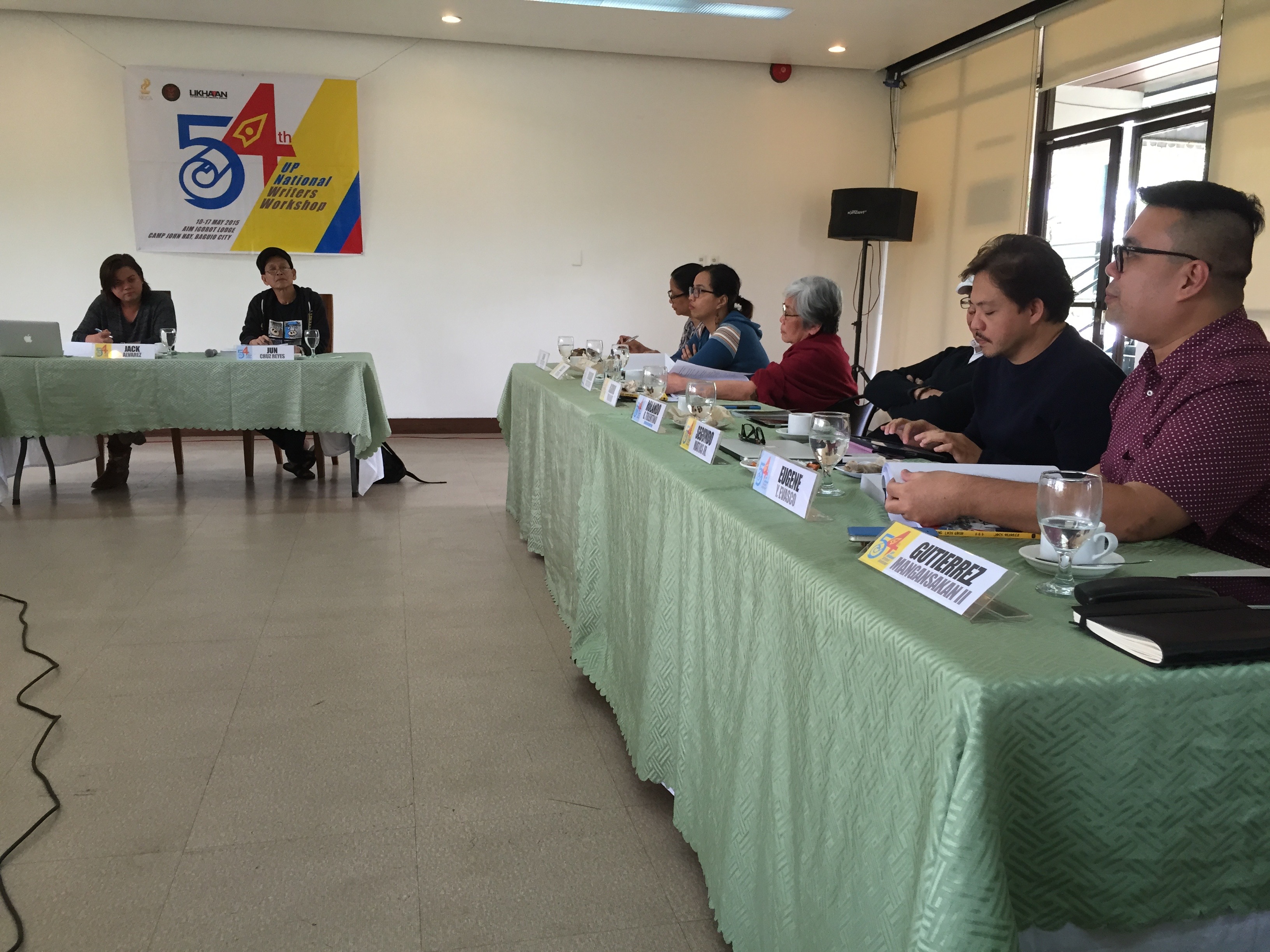
BECAUSE OF my trip to Canada, I was able to attend only one day of this year’s UP National Writers Workshop, which took place from May 10 to 17 in Baguio. I immediately went to work that morning leading a discussion of a biographical project submitted by one of the twelve fellows.

It was a topic I was keenly interested in, because of my own work in biographical writing. (Two of my biographies—A Man Called Tet: The Story of Enrique T. Garcia, Jr. and Edgardo J. Angara: In the Grand Manner—were published and launched recently by Anvil Publishing and the University of the Philippines Press, respectively.) I’m at work on a few more, and if it becomes my lot to be known primarily for my accounts of other people’s lives than for my own fiction, then I can’t complain, having assumed a rather unique responsibility and occupation, among a few others in our writing community.

As a grade-schooler, I devoured biographies in the library, finding that the lives of successful or significant people—whether here or in faraway lands—inspired me to try harder and do more in my own difficult existence. I especially enjoyed the life stories of scientists, explorers, soldiers, artists, and heroes. Of course, these elementary editions were highly simplified, and very likely glossed over the human imperfections—sometimes gross—that these characters possessed, which more mature biographies would reveal if not revel in. No matter; at that time, the overarching greatness of their deeds lent a luminous aura to these characters’ profiles, and I have to believe that I emerged all the richer for reading those books.

The idealization of a life was one issue we discussed at the workshop. There are many kinds of biographies, and I took the occasion to go over a simple classification of these kinds.

On one extreme would be hagiography—literally, writing about saints, and therefore the sunny sanctification of the subject as though everything that he or she did were beyond reproach. On the dark end would be the hostile or malicious biography, written for no other reason than to malign its subject as indelibly as possible, even at the expense of the truth. To its left would be the critical biography—a sober, perhaps scholarly, and more even-handed study of a life, sparing nothing and no one (least of all the subject) in pursuit of the presumptive truth, although these works could also carry their own agenda.

Farther on would come the kind of work that I and some others do on commission, for which I’ve coined the term “sympathetic biography,” a largely positive presentation of a subject’s life—without skirting, however, the major controversies and issues publicly known to involve the subject. Is it the whole truth and nothing but the truth? Realistically, I would expect not, and not because I think my subjects deliberately lie to me, but because it’s in human nature to present the best side of oneself. (I think Dolphy set the bar for searing candor and self-awareness in his autobiography, Hindi Ko Ito Narating Mag-Isa; I can’t imagine politicians or business figures being so open about their private lives.)

A sympathetic biography may be a half-filled glass to many, but it puts something on the table to be seen and seen through. I expect—I would hope—that whatever I write about my subject will be interrogated by more knowledgeable critics and scholars. This is why I urge my clients to be as forthright as possible and to deal with whatever issues they may have been embroiled in, because we live in a highly skeptical environment where questions never cease, especially online.

But to get back to the workshop, we were glad to succeed in our continuing quest for the discovery and encouragement of bright new writing talent across the archipelago. The UP Writers Workshop is different from most others in that it engages mid-career writers—people of proven ability with at least one published book, or major stage or film production to their name. We deal with them less as students than as younger brothers and sisters in the profession.

The critics of writing programs and workshops who think that all they produce are clones and sound-alikes of those teaching these courses should take a look at our roster of fellows and their work. These young writers sound nothing like us, and even after the workshop, they’ll continue working with their own material in their own styles, because we instructors do our best to recognize and preserve the originality of their voices.

The best help we can give them is to provide a response—whether it be a gut reaction or a learned reading that draws on a certain context—from our side of the generational divide, although they get responses as well from their peers, which might just be more useful and valuable to them, coming from people who share their vibe.

This year, we welcomed the following: Jack A. Alvarez (Creative Nonfiction); Armida Mabitad Azada (Poetry); Kristoffer Brugada (Nobela); Resty Cena (Nobela);

Gutierrez M. Mangansakan II (Creative Nonfiction); Isidro T. Marinay (Biography);

Segundo D. Matias Jr. (Kuwentong Pambata); Rhoderick V. Nuncio (Nobela); Will P. Ortiz (Nobela); Benedict Bautista Parfan (Poetry); Charlie Samuya Veric (Poetry); and Eliza Victoria (Fiction). Watch these names, because if you haven’t read or heard about them already, you will soon.

What many don’t realize is what a precious resource we have in these programs and workshops here in our part of the world. Our friends from the region have begun to notice what a liberal and nourishing environment we have for young writers. There’s still patronage and paternalism in the system to be sure—this is Asia, after all—but it’s much less pronounced and potentially stifling than elsewhere. Our tradition is for the younger ones to tell their elders “Up yours!”—until they start putting on the poundage and the gray hairs themselves.

Speaking of writing programs, it was with great alarm and dismay that I received news of the planned closure of one of Asia’s most unique and successful graduate writing programs—the low-residency Master of Fine Arts (MFA) program at the City University of Hong Kong.

The low-residency formula allows students from Hong Kong and around the region to enroll for an MFA and work online with mentors from all over the world, flying in to HK just once or twice a year for intensive workshops and face-to-face interaction. Some Filipinos have gone through the program, and I’ve had the privilege to lecture and to read at a couple of sessions over the years.

The City University administration says that the program costs too much to maintain, but ironically the program turned the corner this year financially, so it can’t be just the money. We wonder if someone up there sees creative writing as a threat to socialism with Chinese characteristics. City U ‘s mandarins should know that Hong Kong’s and China’s prestige and goodwill derive from programs like this—and not from building lighthouses and airstrips in the South China Sea.

Penman No. 146: A Life in the Grand Manner

SEJA2013UPPenman for Monday, April 27, 2015

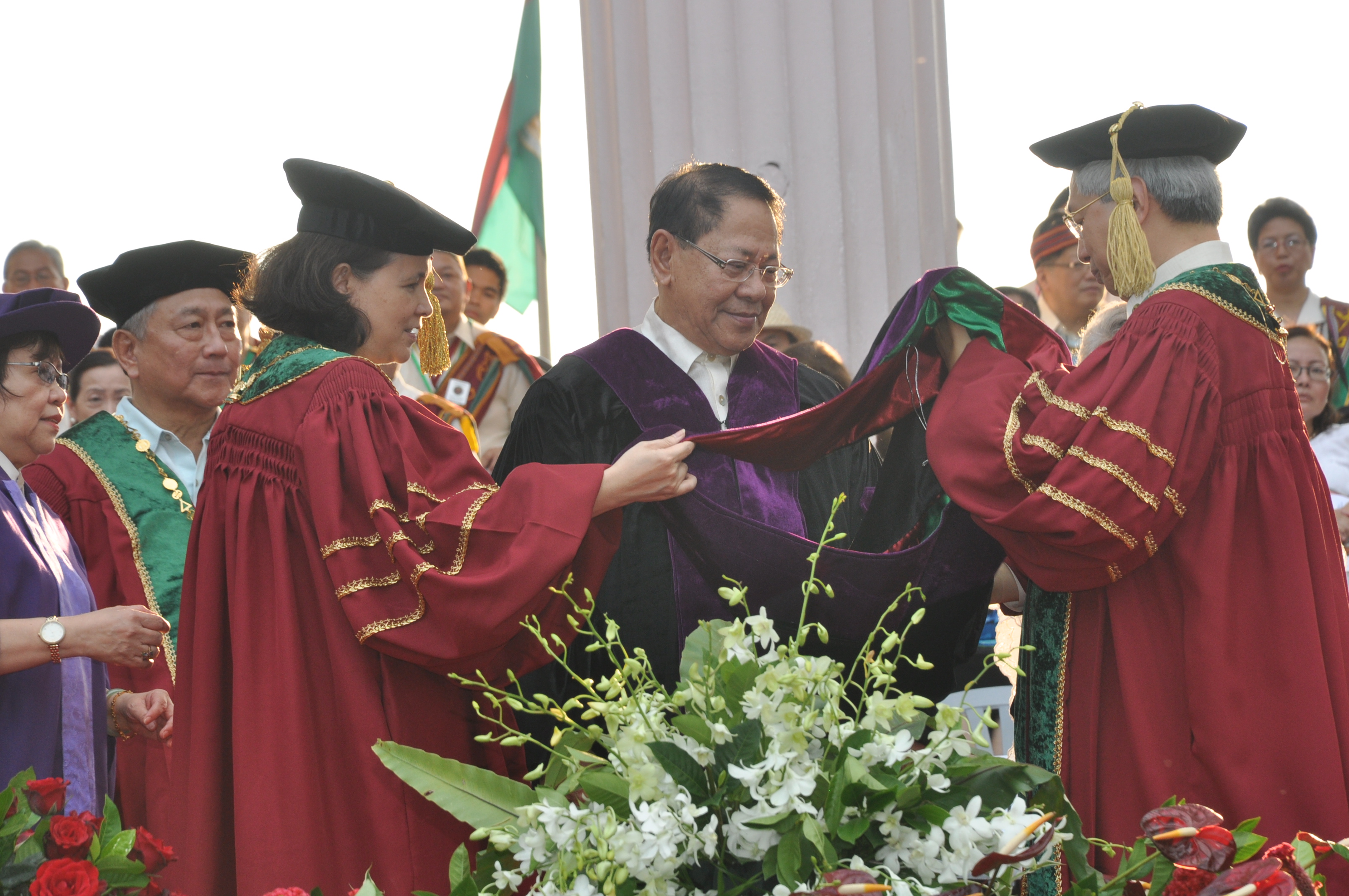
I’VE BEEN privileged to work with some of the most accomplished and interesting personalities in Philippine politics and business on their biographies—the accounting pioneer Washington SyCip, the brilliantly rebellious Lava brothers, the Marcos-era tycoon Rudy Cuenca, and the political maverick Tet Garcia, among others. This Wednesday, April 29, another biography I wrote—Edgardo J. Angara: In the Grand Manner, published by the University of the Philippines Press—will be launched at the Manila Polo Club, from 3 to 6 pm, and it’s focused on a man who will be remembered for many things in many ways, whose impact on our political, economic, and social life has been far greater than the headlines alone would suggest.

The man now known by many as SEJA (for Senator Edgardo J. Angara) courted consternation and even disdain from many people, including some old friends, when he stood by the embattled Erap Estrada into the last days of the latter’s doomed Presidency. He also confounded many of his own followers when, after leading the opposition, he signed up with Gloria Macapagal Arroyo’s senatorial ticket in 2007. The biography addresses those issues, and more—the Apeco issue in his home province of Aurora, for example, involving the conversion of land claimed to have been the ancestral domain of the Dumagats into an economic zone.

It also sheds light on some little-known but key moments in our political history, such as the peace agreement that Angara was able to negotiate, when he was Agriculture Secretary, with communist rebels in Negros. “That agreement continues to hold,” Ed told me. “It’s the longest-lasting agreement the Philippine government has achieved with insurgents.” The biography also narrates how Angara, still as Agriculture Secretary, was just about to conclude a rehabilitation plan for Camp Abubakar, in close consultation with the MILF leadership. “It would have been a historic breakthrough,” said Angara, “but it was opposed by the military, and ultimately dropped by President Estrada.”

My favorite portions of the biography have to do with his days as UP President, when he threw that famously independent and historically dissident institution into a tizzy by coming in from the cold and applying corporate governance to the academe.

Rumored to have been President Marcos’ choice for the UP job—something Angara strongly denies, attributing his selection to the support of the late Onofre D. Corpuz—Angara stepped into Quezon Hall from out of the blue, “the blue” being ACCRA, the law firm he had set up with some of the brightest young lawyers of his time. Angara would recall that “OD asked me to meet with him in the coffeeshop of the Mandarin. He brought up the UP presidency with me, and I told him that while it was certainly a great honor to be considered for such a lofty academic position, I simply wasn’t prepared for it. My only teaching experience was as a lecturer for two semesters, right after I had returned from Michigan. The School of Business Administration was looking for someone to teach corporation law, and I drove my Beetle from Makati to Diliman to teach my classes.”

His election by UP’s Board of Regents was no cakewalk: Angara faced a formidable and distinguished array of fellow candidates, including Secretary of Justice Vicente Abad Santos, Acting Budget Minister Manuel S. Alba, UPLB Chancellor Emil Q. Javier, Director of the United Nations Fund for Population Activities Rafael M. Salas, incumbent University President Emanuel Soriano, Economic Planning Minister Gerardo P. Sicat, Assemblyman Arturo M. Tolentino, and Assemblyman Ronaldo B. Zamora, among others. It was even rumored that First Lady Imelda Marcos herself was interested in the position.

In the end, the BOR elected the 46-year-old lawyer, and he lost no time wielding the broom—reorganizing and trimming down UP’s tangled and bloated bureaucracy, revamping its academic programs, and securing fiscal autonomy for the university. Some of these measures inevitably made him enemies, but also unlikely allies, such as the staunchly leftist professors Francisco Nemenzo and Roger Posadas.

Known to his colleagues as an irrepressible jokester, University Secretary Mart Gregorio probably wasn’t joking when he recalled a moment when he entered the campus with Angara, who observed a virtual menagerie of farm animals along University Avenue. “He asked me, ‘Why are there so many animals at the university entrance?’ I told him, ‘Ah, Mr. President, that’s the College of Veterinary Medicine. In other universities abroad, you might be welcomed by a beautiful arch or statue. Here we have cows, chickens, and goats.’ And then he asked, ‘What’s that other college there?’ I said, ‘That’s the College of Fisheries, sir.’ He said, ‘Fisheries—but we don’t even have an aquarium here!’ And right there, he said, ‘I think that should be transferred to UP Visayas.’ And it was. ‘Vet Med should be transferred to UP Los Baños.’ And it also was.”

I’m biased, of course, being a UP professor and former university administrator myself, but that’s the kind of anecdote that made this book a pleasure to write. It was also the realization that I was talking to the man responsible for many landmark bills that made a key difference in my own life, among many other millions of Filipinos—the Senior Citizens Act, PhilHealth, the Generics Act, and the creation of the Commission on Higher Education and the National Commission for Culture and the Arts, aside from laws on Agricultural and Fisheries Modernization, the Free High School Act, the creation of TESDA and of a host of financial and educational reforms.

He has been a strong supporter of culture and the arts, and lately has been an avid Hispanist, but Ed’s emergence as a cultural champion came as a surprise to many people—even to Ed himself, who acknowledges that “I don’t even sing or dance, much to the frustration of my wife. I don’t do any artistic work.”

From Con-Con delegate, corporate lawyer, and UP President to senator, Senate President, Agriculture and Executive Secretary, SEJA’s life has certainly been one of the most storied hereabouts. “I will be the first to say that it has been a far from perfect life, fraught with challenge and accident,” he says in his foreword, “but in my 80th year I can only still feel privileged to have lived it the way I did. The title of this book may sound rather immodest—it draws on Justice Holmes’ admonition for the law to be taught and therefore practiced in the grand manner—but I would like to believe that in the end, this is the only standard we can be measured by, as we seek to reshape society itself and our nation’s future.”

See you, I hope, at the book launch.

Penman No. 138: On Wall and Paper

IMG_7127Penman for Monday, March 2, 2015


OF ALLl the forms of art, nothing catches the public eye quite like a mural—a painting on a wall. It isn’t just that murals tend to be massively larger than your usual living room portrait or still life. They very often seek to capture and represent the spirit and experience of a community, voicing the concerns and celebrating the values of that community. Starting with cave paintings, murals are also the oldest human art form, but they’ve survived surprisingly well into the 21st century, creatively adapting—often literally—to their physical and social environment. (For some of the world’s best contemporary murals, see here: http://www.cartridgesave.co.uk/news/the-50-most-stunning-wall-murals-from-around-the-world/)

In the Philippines, muralists like the late National Artist Carlos “Botong” Francisco have defined the content, style, and temper of the form, much like Diego de Rivera and Jose Clemente Orozco did in Mexico. Informed by history and politics, their work also incorporates ethnic and religious elements, presented in a sweeping visual montage.

Given our colorful history and the need to inflame our people with greater patriotic fervor, you’d think we should have more murals adorning our many walls—think of the kilometer-long mural that snakes through downtown Hanoi, for example—but sadly, we don’t. Good murals take time, resources, and of course artistic talent and vision to make, not to mention the large blank spaces that are the muralist’s work- and play-ground.

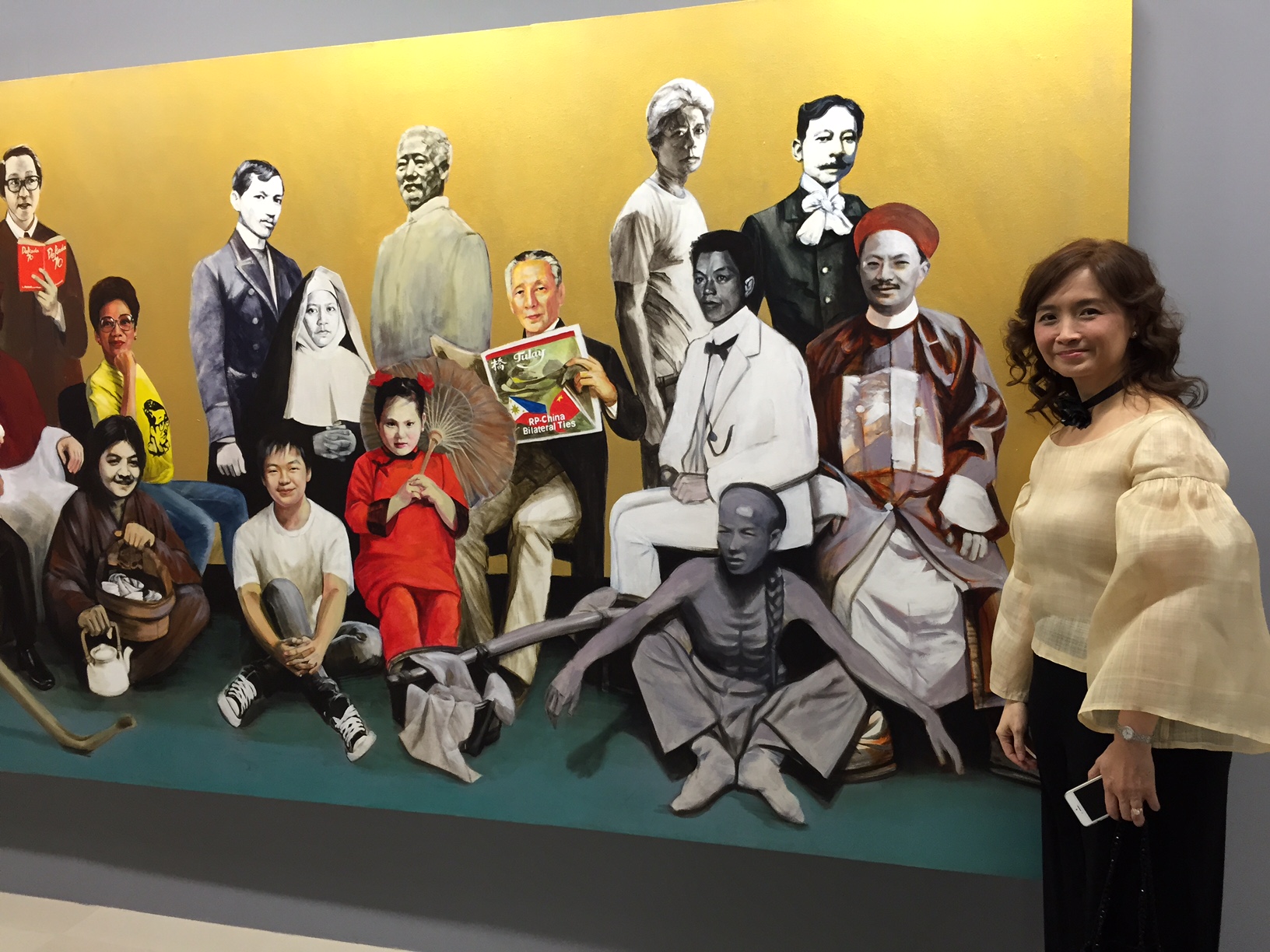
Thankfully, the University of the Philippines—in cooperation with the UP Alumni Association and the Araneta Center Complex—has taken a major step to redressing that shortage, by commissioning 28 of the university’s top alumni artists to produce murals depicting various periods and aspects of Philippine history.

This distinguished roster includes Adonai Artificio, Armand Bacaltos, Adi Baen-Santos, Grandier Bella, Benjie Cabangis, Ben Cabrera, Angel Cacnio, Romeo Carlos, Cris Cruz, Denes Dasco, Gig de Pio, Simkin de Pio, Vincent de Pio, Neil Doloricon, Norman Dreo, Amado Hidalgo, Abdul Asia Mari Imao, Ben Infante, Gigi Javier-Alfonso, Aileen Lanuza, Romeo Mananquil, Norlie Meimban, Julius Samson, Jonahmar Salvosa, Randy Solon, Michael Velasco, Jun Yee, and Janice Young. The resulting exhibit, titled “” or Philippine History in Art—opened at the Araneta Center’s Gateway Gallery last February 18.

The murals—all of a uniform 6’ x 12’ size—cover the full range of Philippine history from pre-Hispanic times to the present, under the guidance of historian Dr. Luisa Camagay and project director and artist Dr. Gigi Javier Alfonso. To UP President Alfredo Pascual, the project is UP’s way of helping to promote a keener historical consciousness among Filipinos, especially the young. The Araneta Center in Cubao, which is marking its 60th anniversary, graciously agreed to host the exhibit in its new 5th-floor gallery.

Coming from a science background, a senior UP official whom I was touring the exhibit with asked me for my critique of the murals on show. I told her that while I was of course pleased with the project as a whole, with its intentions and execution, I personally preferred those works that went a step beyond the literal in their treatment of history, and that dwelt less on the big and obvious historical figures and more on pedestrian realities. I do understand that murals can’t be too abstract, lest they fail to connect with their intended mass audience; in any case, the murals did what they were meant to do, which is to provoke more thought and talk among their viewers.

FullSizeRender

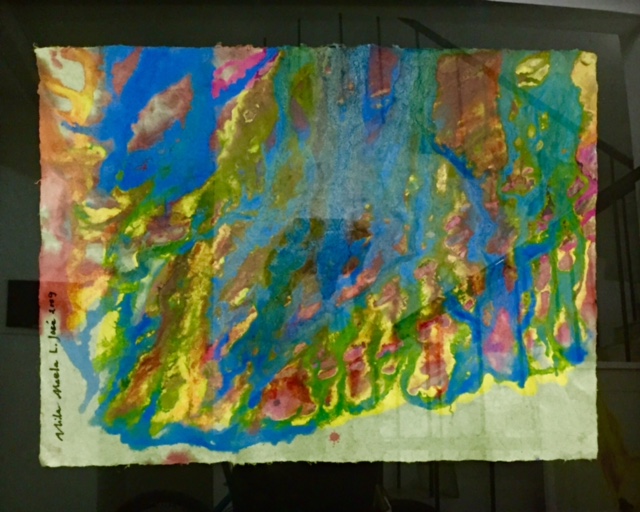
On another front, and also in Quezon City which seems to be shaping up as the cultural center of the metropolis, a new exhibit of paper and paper-based art titled “Pumapapel” opened last week at the Erehwon Center for the Arts, probably the city’s most dynamic privately-operated art center.

This exhibition expands the possibilities of Filipino artistic expression by combining many fields of art making, from painting, drawing, printmaking, mix-media, sculpture and installation, to photography and book/graphic illustration by focusing on the unique qualities of paper as both ground and medium. Curated by UP professor Dr. Reuben R. Cañete, “Pumapapel” features the works of about 100 artists including those of National Artists Vicente Manansala and Benedicto Cabrera, as well as those of Philip Victor, Renato Villanueva, Ofelia Gelvezon-Tequi, Manuel Rodriguez Jr., Juvenal Sanso, and Manuel Ocampo. Also on the list are upcoming artists from the Cordillera, Cebu, Bacolod, and Mindanao, and photographers and graphic artists, among others.

“Pumapapel”’s focus on paper art brings us back, like murals do, to the earliest periods and forms of artistic human expression. From paintings to paper sculpture, this exhibit showcases the myriad possibilities of paper both as medium and material, and also not incidentally celebrates Erehwon’s third year as the upcoming place-to-be for QC-based artists.

Erehwon may not be the easiest place to get to (it’s located at 1 Don Francisco Street, Villa Beatriz Subdivision, Old Balara) but it’s served as a home not only for painters and sculptors but also for musicians, dancers, and writers, thanks to the generosity of its founder and president, Raffy Benitez, and the support of people like Erehwon Arts Foundation President Boysie Villavicencio. (I shouldn’t forget to mention my wife June, who serves as Boysie’s vice president and who has been spending many sleepless nights helping to put this exhibition together.) The Erehwon Center for the Arts’ new Dance Studio was also inaugurated last week.

Pay these exhibits a visit, and you’ll remember and understand how and why art means something to ordinary people, in extraordinary ways.

(Mural by Janice Young. Batik painting on paper by Maela Jose.)


Penman No. 118: To Teach Is to Persist

To-teach-is-to-persist-Penman-Butch-DalisayPenman for Monday, October 13, 2014


SOMEONE REMINDED me that World Teachers’ Day was celebrated earlier this month, on October 5. I forgot about it because I was—I am—overseas, on sabbatical leave until mid-2015. In our department at the University of the Philippines, we normally get just one sabbatical leave over the course of our teaching career, and typically, professors take it a few years before retirement. I’m five years away from that crossroads, so this is a good time to be away from the classroom and to recharge, which is what the sabbatical leave was originally designed for.

Wikipedia tells us that “Sabbatical (from Latin sabbaticus, from Greek sabbatikos, from Hebrew shabbat, i.e., Sabbath, literally a ‘ceasing’) is a rest from work, or a break, often lasting from two months to a year. The concept of sabbatical has a source in shmita, described several places in the Bible (Leviticus 25, for example, where there is a commandment to desist from working the fields in the seventh year). In the strict sense, therefore, a sabbatical lasts a year.”

This sabbatical, however, is shaping up to be anything but a vacation, or a rest break. I may be cool and dry in an America turning pretty with the onset of autumn, but my workload is as tropically toxic as ever, with several books to complete, columns and articles to write, faculty advising duties to perform, and sundry interests—totally and thankfully unscholarly—to pursue.

I do get a respite from the classroom, but, perhaps ironically, that’s the part of teaching I miss the most. As we celebrated World Teachers Day, I also realized that I was marking my 30th year of teaching this November, and I asked myself what three decades of teaching have taught me. After some reflection, it came down to this: to teach is to persist in the perfection of our humanity and our citizenship. That sounds awfully grand to the point of being pompous and pretentious—don’t we, after all, just grab a book, drag our feet to class, and preach bunkum for an hour to a roomful of people with the pulse rate of zombies to earn our lunch and gas money?

There are, of course, many days just like that in a teaching career, days that blur one into the other until the end of yet another semester. And at some point, it’ll get to you: your speech starts slurring and your eyes get glassy, and you can’t wait until the bell rings or the hour hand moves; you had a long rough night, the car needs new tires, the bills are piling up, your thoughts keep drifting back to Paris or Palawan, and the last thing you or your students want to talk about is disease and social order in William Carlos Williams’ “The Use of Force.”

Maybe ten years ago, I had such a day at the very start of the semester, and without realizing it, I must have been so bleary-eyed that I gave off the impression of not quite being there. To my great shock and dismay, one student later blogged about her disappointment with what she had seen; she had expected a stirring performance from her professor on Day One. It was a wake-up call, and I woke up; I promised that student that I would do my best to live up to her expectations, and I hope I did; we’re good, and she’s since gone on to a promising career in writing.

What I became acutely aware of then was that every teaching day is a performance, not unlike a show a professional actor studies and rehearses for, with the additional challenge that one simply doesn’t repeat the previous show, but keeps adding to it, improvising when possible to adapt to changes in the composition and the mood of every audience. I mutter my first lines to myself on the steps up to my classroom, ticking off the day’s main points and questions in my head; I take a deep breath, step into the door, flash a brief smile, and the day begins. And like the pro I have to be, I’ve learned to take care of myself, so I can teach well—to stay healthy, to sleep well (especially before a class day), and to think of something new to say or to bring to the next class.

So we all have our bad days, but it’s precisely on days like these when we need to remind ourselves of what a tremendous opportunity we have to make this Tuesday or Wednesday one of the most memorable in our young charges’ lives, through something we say, an idea or an experience we share, that will turn a key and open a door in their minds. Only in teaching can an ordinary, even a boring, day suddenly become indelibly special, with nothing more than thoughts and words—and the teacher’s persistence and faith in every student’s potential for transformation into someone more aware, more human, more Filipino. Perfectability? It’s more about the effort than the goal—and I’m sure that whatever we do for our students, we teachers do for ourselves as well.


SPEAKING OF teaching, my department has asked me to invite all teachers and students interested or involved in translation issues to attend the 6th Asian Translation Traditions Conference (ATT6) to be held October 23-25, 2014 at the University of the Philippines, Diliman, Quezon City.

The official flyer says that “The rationale for the ATT series is to challenge the Eurocentric emphasis of Translation Studies, which is largely due to the “unavailability of reliable data and systematic analysis of translation activities in non-European cultures” (Hung and Wakabayashi 2005). The ATT series was initiated by Professor Eva Hung of Hong Kong in 2002. A small but successful workshop was held in London that same year, followed by well-attended international conferences in India, Turkey, Hong Kong, and the United Arab Emirates. It is hoped that ATT6 will lead to theorizing on translation and developing methodologies on translation arising from the specific historical and contemporary contexts of Asia.”

Hmmm, I think that needs to be translated: this conference will explore the theory and practice of translation in an Asian context. For more details, please visit http://asiantranslation6.up.edu.ph/.

{Illustration by Igan D’Bayan of the Philippine Star.)

Penman No. 65: Tried and Tested

Penman for Monday, Sept. 23, 2013

LAST WEEK’S piece on the kind of open-book exam I give my students reminded me of the toughest exams I myself had to take as a student. It’s been more than two decades since I last stepped into a classroom and sat opposite the professor’s table and chair, but the memory of those exams remains vivid—in some cases, distressingly so.

I have to declare, at the outset, that unlike most students, I liked exams, especially in subjects that I knew I would do well in. I got a thrill from being tried and literally tested; I saw the exam as a game of wits between me and my professor, and while my professor certainly knew much more than I did about the subject, I was always on the lookout for angles and insights that my professor might never have considered, and would therefore appreciate as something fresh. I disdained what professors call “spitback”—the rote regurgitation of points already discussed in class—knowing that many of my classmates were going to do just that.

I was, in other words, something of a smartass, and like all the annoying smartasses you remember and loved to hate from high school and college, I deserved and got my occasional comeuppance. Returning to college after a ten-year absence, I thought I could wing it in my Lit classes, but instead got the loudest wake-up calls I possibly could, from two professors known to be formidable “terrors” in the English department—Filonila Tupas and Damiana Eugenio—both of whom gave me a “5.0” in the objective quizzes that they began the semester with. Thankfully these were diagnostic quizzes, and the diagnosis was clear: I had to hit the books to do well, so I became a textual bloodhound, memorizing odd details and references (plants from Shakespeare: wild thyme, oxlips, woodbine, eglantine). I would not embarrass myself again—or so I thought.

Shakespeare and the Elizabethan age became a passion for me, a period fraught with dark political intrigue and steeped in grime yet also ennobled by some of the most sublime poetry ever written. It wasn’t even Shakespeare so much as the lesser poets and dramatists around him—Sidney, Wyatt, Webster, Middleton, Marlowe—who piqued my interest, thanks to a teacher who took kindly to an older student making up for lost time (I was 27 when I returned as a freshman to UP; my Paulinian colegiala classmate, Judy Ick—who would go on to become Dr. Ick, the real Shakespeare expert in the department—was just 17).

That teacher was the impeccably fashionable Prof. Sylvia Ventura, commended (as Shakespeare himself might have put it) by all the swains but feared by most of her students for the spot-passages exams she gave. (A spot-passage exam gives you nothing but an obscure passage drawn from the text of a play or a poem, for you to identify, contextualize, and discuss.) I thought I was doing pretty well in her class until the final exam, when I ran into a passage that might as well have been Greek. Knowing that I had absolutely no chance of identifying the passage correctly, I gathered my wits and used Shakespeare himself to explain my predicament, beginning my answer (whatever it was) with a quote from Act I, Scene 1 of A Midsummer Night’s Dream: “So quick bright things come to confusion!” Apparently it worked, because I escaped with a 1.25.

The toughest teacher I had in UP, however, was the legendary Wilhelmina Ramas, whose final exam on “The Idea of Tragedy” took us five hours and several bluebooks to finish—a herculean effort rewarded, in my case, with a niggardly (and probably accurate) 1.75. Soon after, I flew off the US for graduate school, and it was only then that I appreciated the rigor that my UP “terror” profs had put me through. Their American incarnations were tweed-suited dons rather than coiffed matrons, but they were no less demanding. I had come well prepared.

In my Shakespeare class at Michigan, taught by the pipe-smoking Russell Fraser, I felt like I had orchids coming out of my ears when Dr. Fraser commended me for being the only one in class to be able to answer his question about differentiating “hypotaxis” from “parataxis” (no, it has nothing to do with paid transportation). That still didn’t save me from the pain of Fraser’s final exam: a spot-passage exam, employing two totally unheard-of quotations from Shakespeare’s plays, with one question to answer: “Which is early and which is late Shakespeare, and why?” This was also an open-book exam that we had one day to complete; we were free to roam the library and to read Shakespeare from end to end.

Now, mind you, this was 1986, well before the Internet and Google; students were still using 5.25” floppy disks, if they were using computers at all (I wasn’t; I’d dragged my Olympia portable with me across the Pacific). Today my students would take seconds to find the answer to “early” and “late”, and maybe an hour to cough up a reasonable “why.” Back in ’86, it was all intelligent guesswork, knowing that no amount of speed-reading and cramming could possibly turn up those passages, let alone contextualize them. And Fraser knew that; whether we had the “early/late” part of the question right or wrong, he wanted to see us reasoning our way through our answers, given what we knew from class of the younger and the older Shakespeare. (Only later, in the age of Google, would I discover that Fraser was then at work on two books: Young Shakespeare, and Shakespeare: The Later Years.) I can’t recall how I scored on that exam—I passed the course with an A-minus—but it was the kind of exam that was both gut-wrenching and exhilarating at the same time; I loved it.

Still later, now doing my PhD at the University of Wisconsin-Milwaukee, I had a professor in Bibliography and Research named James Kuist. As mild-mannered as he was, Dr. Kuist had a fiendishly difficult task for us to complete. His exam question went like this: “The year is 1663 and I am a Fellow of the Royal Society. What books would be on my bookshelf?” So off we went to the library on a wild goose chase, and like an eager labrador retriever, I enjoyed the hunt, searching the stacks for the spoor of these antiquarian volumes.

Now that I’m the one giving the exams, I hope to come up with questions and problems that my students will remember 20 years from now, and still get a bit of a headache from—or let’s make that the pleasant buzz, the distant refrain, of an unusually agitated mind.

Penman No. 59: A Boon for UP Artists

IMG_2770Penman for Monday, August 12, 2013

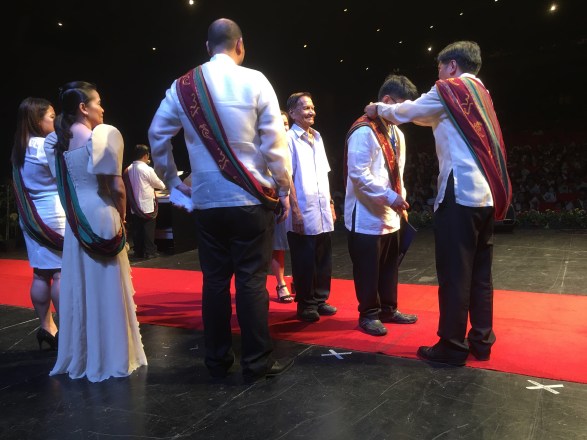
LAST WEDNESDAY, I had the privilege of being part of a special ceremony at the University of the Philippines in Diliman, this time for the UP Arts Productivity System or APS awards. Initiated under former UP President Emerlinda R. Roman in 2009, the APS provides substantial monetary incentives to artists within the UP System for work produced within a three-year period (or five, the first time you apply). Twenty-eight UP artists were honored, including 17 from the first batch in 2009. (A similar system had been earlier put in place for UP scientists.)

A committee of peers—themselves highly accomplished artists, including National Artists—receives and evaluates applications from Diliman and UP’s many other campuses. Points are assigned to specific works, such as books, productions, exhibitions, and major lectures; further points accrue from notable awards and distinctions, especially forms of international recognition. Within this committee, spirited discussions inevitably arise over the merits of an artist’s work. Since the award is given for new and continuing work, it isn’t a lifetime achievement award, and no matter how highly regarded an artist may be, only his or her sustained productivity will be recognized by the APS.

Not surprisingly, many questions and concerns come up in the APS. The proper and fair valuation of artistic work is one of the most difficult tasks anyone can assume, even and especially within an academic setting, which may not necessarily reflect what the market thinks say, of a painting or a commissioned biography. Academia is the bastion of theory, and an award-giving situation like this challenges and exercises every humanities professor’s notions of what is good and valuable.

The idea that art itself is of real value is, in the first place, something one can’t assume to be a general belief in our country, and even in our university. Painters have it easier in terms of establishing their worth, because people have gotten used to the spectacle of, say, a Van Gogh selling for many millions of dollars, even if they may not understand why. They can look at a painting or sculpture in their living room or in an office lobby and at least appreciate its decorative value (although modernist art will probably leave them deeply perplexed, especially when told that the piece was worth a lot of money).

The utility and practical value of a poem is far more ephemeral. Artistry in the form of a service—say, directing a play or curating an exhibit—is even harder to apprehend for many. This is why it takes another artist—or a scholar and academic—to seek out and to recognize these obscure but important triumphs of mind, spirit, and sensibility over matter.

There are awards enough in the Philippines for artistic endeavor, capped by the National Artist Award, which the Supreme Court found the good sense to rescue from pit of political patronage. Elsewhere there are the FAMAS, the Palancas, the Thirteen Artists, and any number of music-industry awards. What distinguishes the UPAPS is its recognition of artists who also teach, or teachers who also manage to produce good art despite the well-known rigors of teaching and that other great devourer of time and energy, administration.

This is particularly important in an institution like UP, which—not unlike many other Philippine universities today, for understandable reasons—seems to have reoriented itself toward more support for science, technology, and engineering. (One thing most people don’t realize is that, based on enrolment figures alone, UP Diliman is really basically an engineering school; those of us in a small minority in the humanities and the law just happen to be noisier than the typical engineer.)

I was told that the UP science complex—an impressive array of colleges and institutes geared toward establishing UP as a force to be reckoned with in regional S&T—has so far received some P3.5 billion in various forms of support and investments, chiefly from the government. Under President Alfredo E. Pascual, UP has asked Malacañang for a small fraction of that for what we might call cultural infrastructure—studios, laboratories, theaters, exhibition spaces, and equipment that our students and their teachers need to produce significant new work; so far I’ve yet to hear of a firm commitment for even this sliver of support given to S&T. (For the record, we shouldn’t be competing with S&T, but alongside S&T for our share of the national budget.)

Never mind, for now, our standing recommendation for the creation of a Cabinet-level Department of Culture to oversee national cultural policy and arts promotion. Never mind that we hardly ever hear about arts and culture in the SONA, very likely because our high officials still see culture as entertainment, as an intermission number without any material contributions to make to the national good.

Last week, where someone could do something about the lot of the Filipino artist, they did, and on behalf of the UPAPS awardees, I’d like to thank President Pascual and his administration for this initiative, and can only hope that it is picked up by other visionary academic leaders elsewhere.

Herewith, the list of UPAPS awardees—including, immodestly, yours truly (who had to publish five books in three years to make the grade!):

MUSIC and DANCE: Maria Christine M. Muyco, La Verne C. de la Peña, Jonas Baes, Josefino J. Toledo; ARCHITECTURE: Gerard Rey A. Lico, Danilo A. Silvestre; FILM: Grace J. Alfonso, Sari Raissa L. Dalena; FINE ARTS: Patrick D. Flores, Jason B. Banal, Leonilo O. Doloricon, Ruben Fortunato M. De Jesus, Ma. Eileen L. Ramirez, Reuben R. Cañete; LITERARY WORKS: Jose Y. Dalisay Jr., Ricardo M. de Ungria, Eugene Y. Evasco, Jose Neil Carmelo C. Garcia, Roland B. Tolentino, Rosario T. Yu, Layeta P. Bucoy, Victor Emmanuel Carmelo D. Nadera Jr.; RADIO, TELEVISION and RELATED MEDIA: Fernando A. Austria, Jr., Danilo A. Arao; SCHOLARLY WORK: Priscelina P. Legasto; and THEATRE: Josefina F. Estrella, Dexter M. Santos, Alexander C. Cortez.